Showing posts with label H.P. Lovecraft. Show all posts

Saturday, 22 November 2014

Meglos


I am a huge fan of Season 18 and consider it to be the strongest season of the show (the only other contender being Season 25, which is let down by Silver Nemesis). Meglos is unfortunately the weakest story of an otherwise brilliant season. However, Meglos is not nearly as atrocious as it is sometimes considered by fans and shows the consistent improvement in quality between Seasons 17 and 18.

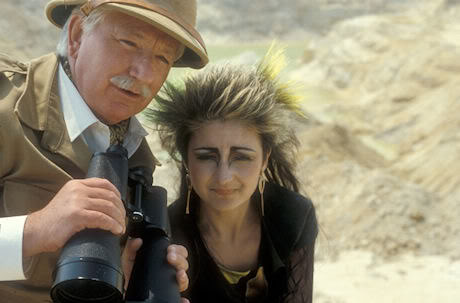
Central to John Nathan-Turner's agenda for his first season as producer was in improvement on production values after the sloppiness of the Graham Williams era. This is very much evident in Meglos, with the spacecraft design, the costumes and the the appearance of Zolpha-Thura. Tigella is perhaps less effective as a planet, with the jungle looking a little unimpressive. More importantly, the brilliant musical score helps to give the worlds of this serial an haunting sense of atmosphere. As even critics of Meglos agree, the spiny make-up effect on Tom Baker is extremely impressive and disturbing. Meglos is certainly an interesting character, a disembodied intelligence manifesting in a cactus. It reminds me a bit of Vulthoom from the Klark-Ash-Ton story in the Cthulhu Mythos.

We also get Jacqueline Hill returning to the show in the role of Lexa. Admittedly her part as a closed-minded fundamentalist is a rather cliched one, with little for her to develop, yet she still gives a lovely performance.

The Chronic Hysteresis is rather less impressive, as well as being scientific nonsense. The scene goes on rather to long, even if Lalla Ward does a good job of appearing distressed by the absurd situation.

I always love carnivorous plants, so I quite like the Bell Plants, even if they are not terribly impressive. It would not be long before the BBC put Doctor Who completely to shame with the brilliance of its Triffid monsters in their own series.


Part of the charm of Meglos is that it is an old-fashioned space adventure that goes to strange and exotic worlds. The presence of Jacqueline Hill is rather appropriate, as it very much evokes the spirit and style of the Hartnell era. This willingness to create exotic worlds is something sadly lacking in the new series.

Friday, 11 October 2013

I Destroy Therefore I Am: The Three Doctors


"If I survive only by my will, then my will is to destroy!"


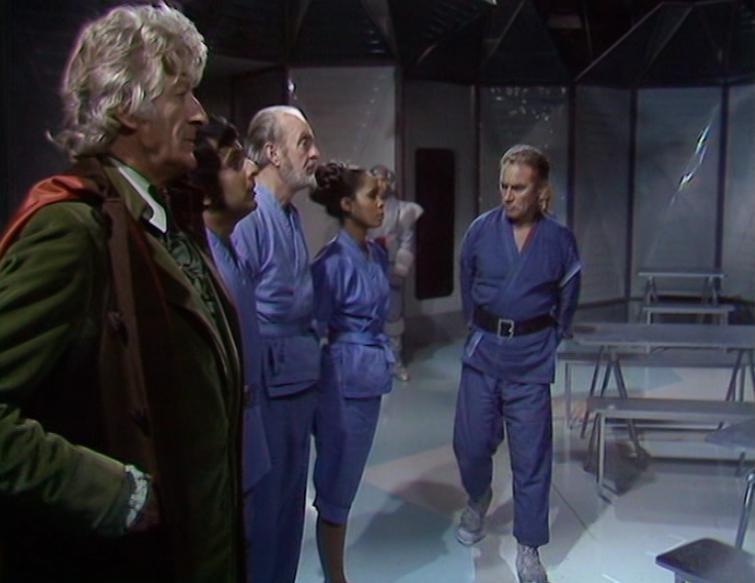
It was perhaps unfortunate that before watching The Three Doctors at the age of ten, I had read the Target novelization. It was disappointing that the Gell Guards did not form into one tentacled mass, as they did in the novel, nor was Omega's palace a fantastic castle, but instead a makeshift door in a quarry. While in the book, the Third Doctor was transported into a giant gladiatorial arena to battle a hideous demonic creature rather like the Destroyer in Battlefield, Pertwee instead wrestled a man in a sequinned catsuit. Thankfully this discovery of the limitations of BBC special effects did not spoil my enjoyment of the serial and they still do not twenty-two years later.

The first Doctor Who story I ever watched was The Five Doctors, so I'm rather used to seeing more than one Dr. Who around. It is hard to imagine what a treat it must have been for the original viewers to see Troughton, Hartnell and Pertwee sharing the screen. The celebration is rather marred by the sadly unwell state of Hartnell, who can only deliver a few lines from a chair. It is impossible not to notice how Troughton's acting outshines Pertwee's. Quite a few of the original viewers must have been wishing that Troughton had stuck around a bit longer.

Like the stories of Season 18, The Three Doctors seamlessly blends hard science with mysticism. It is striking that the story offers a three-decker model of the universe, with UNIT on Earth, the Time Lords in their heaven and Omega in his hellish Pandemonium beyond the black hole. The writers have quite clearly borrowed liberally from William Blake as is demonstrated in Phil Sandifer's beautiful, but barely comprehensible essay on the serial.

I just adore Stephen Thorne's performance as Omega. Doctor Who has plenty of baddies who shout and rant, but Thorne takes it up to a new level. His voice is so rich, even when he speaks softly, his voice booms. I found him rather scary when I fist watched The Three Doctors. He is helped in his performance by the brilliantly designed mask. With its hollow mouth and eyes, emotion can be projected on to it. Depending on Thorne's delivery, the mask looks angry, disdainful, haughty or sad. Omega truly comes across as a pitiable figure.


The Gell Guards have come in for a lot of criticism. While they look a little comical at times, I do like their appearance. They are how I imagine H.P. Lovecraft;s Shoggoths in At the Mountains of Madness. Admittedly, Katy Manning's Gell Guard vocal contributions on the DVD commentary is very funny. The blog creature is one of those less effective Seventies CSO effects. It looks good when going down drains, but when it becomes larger, it is less impressive. Omega's palace is interesting visually, despite looking a little unconvincing. Perhaps the stagey looks is appropriate given the story's Christmas pantomime feel.

While Brigadier Lethbridge-Stewart is rather funny in this story, it is unfortunate that he has become such a figure of fun. He is ridiculously obstinate and pig-headed in The Three Doctors. On the other hand, it is interesting how unhinged he seems to become throughout the story. Was his mental health deteriorating? Mawdryn Undead has the Brigadier undergoing a breakdown. This is explained in-story as a result of the timestreams crossing, but had he already suffered trauma as a result of this experience and others? It would explain the quiet and unglamorous circumstances of his retirement that seems to bother some fans for some reason. He was never meant to be a companion and seems to be seriously effected by TARDIS travel.

Jo Grant seems to have overdosed on Cute and Fluffy pills in The Three Doctors. She might as well be one of those generic anime cute girls that people love to draw on DeviantArt.

As with The Five Doctors, it is implied that the First Doctor is older and wiser than the other Doctors. This does not really fit with the First Doctor era, in which he appears to be a lot less mature and less able to handle situations than his successors. This might be explained if The Infinity Doctors is a pre-Unearthly Child story, featuring a younger Hartnell Doctor. It may be that the First Doctor, unlike the other two, has some memory of the encounter with Omega in The Infinity Doctors and can understand the situation better.

This was a celebration of Doctor Who, but in many ways this is a celebration of the Barry Letts era, with all of the usual tropes- Ineffectual UNIT, excessive CSO, blobby monsters, a bumbling scientist, a yokel and the Time Lords needing Dr. Who's assistance. It is held together by an interesting story. In my judgement, it is a lot better than The Five Doctors which was just a collection of set pieces artfully, but not altogether convincingly scraped together by Terrance Dicks. While I can't bring myself to dislike The Five Doctors, I genuinely do like The Three Doctors and consider it to be one of the more enjoyable stories of the Pertwee era.


Sunday, 2 June 2013

Divided Loyalties, by Gary Russell


It's often little details that annoy me most about stories. I found myself feeling a certain annoyance at Gary Russell's drop of a hat revelation in this novel that Tegan's family are Jewish. Not that it wouldn't be great to find out a companion is Jewish, but this does not fit anything we know about Tegan.

So we have an Australian young woman who is from Brisbane, but does not have a Brisbane accent (apparently). A woman who has a Slavonic surname and an unusual Celtic first name, with Serbian grandparents. A woman who speaks the Aborigine's language. A woman who is apparently Jewish.

It's not impossible that Tegan might be Jewish. There are Jews who have the surname Frazer, the name of the other side of her family. There was a very old Jewish community in Serbia. There are still some Jews there today, but not very many. The Jewish population in Serbia was decimated by the Holocaust. Most of those who survived emigrated to Israel. Tegan's grandfather, however, still lives in what was then Yugoslavia. That does not help Russell's case for a Jewish Tegan.

Paul Cornell's novel Goth Opera had a scene in which our favorite Austalian air hostess chases off a vampire with a Gideon Bible in hand. We get the impression she would have been just as comfortable brandishing a crucifix. The scene very much suggests a Serbian Orthodox background. That I am discussing this shows I am just as much a continuity obsessive as Gary Russell, but that is neither here nor there. The disturbing impression I get is that Russell's logic was on the lines of "Lots of Jews have Eastern European names. Tegan's family is from Eastern Europe, so they might be Jewish," thus ignoring the impact of the Holocaust and the fact that there are not that many Jews left in many parts of Eastern Europe. It does not suggest much broader cultural awareness. Maybe events in former Yugoslavia made the thought of a Serbian Orthodox background rather unappealing for Russell. Being Serbian was not terribly glamorous in the nineties, with all that went on in Sarajevo and Kosovo.


So having dealt with the fascinating question of Tegan's religious background, we move to the more mundane question of this novel. Is it actually any good? This novel would probably make it on to a top ten list of hated Doctor Who novels. It has been savaged by fans and reviled as an example of the worst excesses of continuity fetishism. Some of this criticism is a bit harsh, but I did find the book difficult to enjoy. It was a very plodding story, with too many dreamscapes and the non-regular characters were largely uninteresting.

There were some things in the story that I enjoyed. Gary Russell has a great affection for the Fifth Doctor era and this very much came out in the portrayal of the regular characters, with all their bickering and conflicts. He does a great job of fleshing out the individual characters of Tegan, Nyssa and Adric (aside from the bit about Tegan supposedly being Jewish). Unlike a lot of readers, I rather enjoyed the high school style depiction of the Doctor and chums at school. I have always liked the idea of Dr. Who and other renegade Time Lords being at school together. I also enjoyed the exploration of Doctor Who cosmology and the insights into the Great Old Ones.

There is the question of whether it is really appropriate to write a spin-off novel featuring the Celestial Toymaker given that he is such a racist caricature. Phil Sandifer dismissed The Celestial Toymaker as racist garbage and seemed to suggest that the recycling of the character in spin-off media was a really bad idea. Gary Russell seems to try to remedy this by pointing out that the Toymaker is Caucasian, despite his oriental dress. I'm not altogether sure in my own mind. The Celestial Toymaker is a very significant figure in the Doctor Who mythos in that he is the first super-powerful adversaries of the Doctor, after the Animus. He is a mysterious and disturbing figure. While it might be politicall dubious to dress him up like a Chines Mandarin, it does create a striking and memorable visual image.


Divided Loyalties on the whole a disappointing novel. Terrance Dicks offered lots of continuity references to stir the hearts of fans. Yet he wrote novels that were tightly plotted and often quite gripping. Divided Loyalties is just not a very interesting story.

Sunday, 2 December 2012

The Greatest Show in the Galaxy


You're not only a scoundrel and a meddling fool, but you're also a crushing bore!


Greatest Show in the Galaxy is a story that feels utterly removed from anything that has gone before in Doctor Who. There are similarities with Warrior's Gate, Kinda and Paradise Towers, but Greatest Show in the Galaxy is quite unique in its approach to storytelling and in it's visual effect.

The Psychic Circus may not be the most impressive looking big top, but this story has a visual look that captures the eye delightfully and makes vibrant use of colour. There are many symbolic flourishes, such as the mystical eye symbols and the hearse and funereal outfits used by the clowns when they go out hunting. The costume work is among the best of the era, even if we have to forgive the less inspiring werewolf effect on Mags.

The plot structure of this story is very unusual and in places it feels a little awkward, yet the sense of uncertainty means that it does not fail to induce excitement and tension. A lot in this story does not make a lot of sense. However, it is quite different from Ghost Light. Ghost Light was confusing on the first viewing, but everything in that story can be pieced together if one makes the effort to watch it several times and listen to the dialogue carefully. Greatest Show in the Galaxy offers no explanations. The reader is left to interpret the significance of much of it.

It's fascinating how so much of the Sylvester McCoy era makes use of a metaphorical depth in its storytelling. We have all that stuff about 'undercurrents' in Curse of Fenric, the power of life in Delta and the Bannermen and Survival's cryptic theme of menstruation. However, it is Greatest Show that really goes to town on metaphor. None of the characters feel like real people, but more like archetypes. Much fan discussion of the story has centred on what the individual characters represent. Do the Gods of Ragnorak represent BBC executives or the public? Does Captain Cook represent the show's past or Star Trek?

While much of the theme is left uncertain and for viewers to puzzle out for themselves, the story most definitely raises a question about the values of the Sixties. The Circus people are hippies who have betrayed what they once stood for and sold out. One suspects that the targets here are individuals like Richard Branson and George Lucas, figures who rose up from the counter-culture to become commercial masterminds. Doctor Who is itself a product of the Sixties and the story throw open the question- has Doctor Who gone wrong? Has it become pointlessly violent like Nord, or obsessed with its past like Captain Cook? Is it hopelessly out of touch, like Whizzkid?

Captain Cook the Intergalactic Explorer is a brilliantly conceived character in that he represents a kind of pseudo-Doctor. He is a restless explorer with a boundless curiosity. He travels with a punky young woman who has a dangerous side. He is also a figure with somewhat colonial leanings, reflecting the Doctor's Edwardian tendencies. The Seventh Doctor would eventually take to wearing a safari suit himself in the New Adventure novels. With his obsession with past adventures, the Captain is Doctor Who gone wrong, sadly like too much of 80s Doctor Who (though the Whizzkids of fandom probably have an inflated view of much of 70s Doctor Who). T.K. McKenna brings him to life marvelously, though this unfortunately makes it a disappointment that he dies. It would have been nice to have seen a return from him. My favorite moment in the story has to be the look on the Captain's face when the Doctor calls him a 'crushing bore.' He looks so surprised and so furious.

Captain Cook's companion, Mags, is equally fascinating. She clearly disagrees with the Capatain's methods, but she sticks around with him and takes his orders. It's never altogether clear what Mags thinks of him. I can't help thinking that they are probably sleeping together. If the Captain represents slavish obsession with continuity, then Mags represents Doctor Who's capacity to terrify. The show has always aimed to scare and thus her character survives. It is noticeable that Mags is dressed like a Goth. As the Seventh Doctor era shifted into the New Adventure era, Doctor Who would develop close ties with the Goth subculture.


There have always been elements of Doctor Who that lie more in the realm of fantasy than science fiction- the Land of Fiction, the Celestial Toymaker and the Mara. Yet it is in the Seventh Doctor era, that the show makes a conscious shift to include overtly supernatural elements. Greatest Show is very much a story that is more fantasy than science fiction. The only real technological element here are the robots. We get no explanation as to how the kites work or how the ringmaster and Morganna disappear. Likewise the Gods of Rrrragnorrrak seem to be real gods. There is no suggestion that they are just aliens like Sutekh (even if they look a bit like him). According to All-Consuming Fire and Millennial Rites, they are Old Ones, powerful beings from a primordial pre-universe.

Sylvester McCoy gives a really great performance in this story. It is here that we really see the 'Dark Doctor' coming to life more than ever before. He appears to manipulate Ace into going to the circus, he seems to have an unstated agenda and he clearly knows a lot more about what is going on than he is letting on. We get a definite sense that what we are seeing is only a part of some larger cosmic game that the Doctor is playing. The Doctor's statement that he has been battling the Gods of Ragnorak throughout time and space is interesting. It is very similar to the way that we meet Fenric in the next season, a villain who turns out to be the Doctor's worst enemy, even though we had never heard of him before. This certainly throws a lot of mystery about the Doctor's activity. However, it could be that the Doctor is referring to Great Old Ones in general, and so would include encounters with the Great Intelligence (Yog-Sothoth) and the Animus (Lloigor). Though it was actually a mistake, this serial gives us the most inconic image of the Seventh Doctor ever, when he calmly walks away from the exploding circus. This image does so much better at demonstrating the presence and power of the Doctor than any rant by Matt Smith about how impressive he is and how scared the monsters ought to be of him.

We are treated to a lovely score by Mark Ayres. I found the rapping a bit annoying at first, but it grew on me. It sort of adds to the surreal atmosphere of the circus. A mention must go to the Chief Clown, played by Ian Reddington. Every moment that he appears onscreen is a pleasure, with his expressive hand gestures and his two distinct modes of speaking. I love the nervous tremor in his voice, when he is speaking without the clown persona.


The Greatest Show in the Galaxy is a fantastic example of how Doctor Who can triumph over a troubled production. It is not perfect and is not the greatest Seventh Doctor story, yet it has a brilliance that seems to defy categories and draws the viewer into an unearthly and surreal world of its own.

Saturday, 6 October 2012

Dr Who and the Great Old Ones


This has to be the best ever Target novel cover art. I remember seeing this paperback in a shop when I was nine years old. I was quite disturbed by it and decided I definitely didn't want to read that novel.

It is such a shame that this does not actually depict a scene in Spearhead from Space. The idea of some colossal eldritch space monstrosity threatening the Earth is so much cooler than anything in that serial. It reminds me a little bit of the Fendahl Predator in the 8th Doctor novel The Taking of Planet 5.

Friday, 7 October 2011

Ice Cream with Howard, by Matthew Clarke (fan fiction)

In the novel, The Taking of Planet 5, we learned that the Doctor had been friends with H.P. Lovecraft and had shared a mutual love of ice cream.

I decided that our Howard would have been friends with the Seventh Doctor, as he was the most American of the Doctors, with his fondness for jazz music, not to mention his habit of tangling with cosmic evil...

The origin of the Great Old Ones is taken from the novels Millennial Rites and All- Consuming Fire.


New York, 1917

The Doctor and Howard sat in an ice cream parlor, enjoying their frozen delights. The Doctor had left Mel on her own to go and explore New York. The young woman had been so excited at the prospect of seeing the city in the early twentieth century. The Doctor knew that his time with Mel was drawing to a close. He had fearful plans that needed to be set in motion and terrible evils to face. He would need to do these things without Mel. The red-haired young woman could never be a part of the darkness that was to engulf him in this regeneration.

Like Mel, Howard also seemed to be excited to be in the city. Who would have guessed that in later years he would come to despise New York so passionately?

The war was raging fiercely in Europe, but here in New York, life was giddy, gay and energetic, with the fruits of prosperity still in much abundance.

Howard was clearly loving his ice cream. The Doctor had introduced him to the delights of ice cream on his last visit. In this time, ice cream was not a domestic product, but a rare treat to be enjoyed on special occasions. It seemed ironic to the Doctor that the man loved a frozen delicacy so much given his hatred and terror of cold weather.

Howard scooped up another spoonful of vanilla ice cream, drenched in toffee sauce.

"Doctor, on your last visit, you spoke of beings called the Great Old Ones. Would you care to tell me a bit more about them?"

The Doctor looked thoughtful. So yet again history was taking it's shape around him. Time was so like a waterfall; once one entered into history, one was carried along with it's course. Howard was just beginning his writing career and now he was about to receive inspiration for so many of his writings. The Doctor had entered the history of American literature and now he was called to play his part in that history, shaping the direction of Howard's writing. He could tell Howard all about the Great Old Ones and inspire the man to write a whole series of stories. Alternatively, he could change the subject and talk about cats. Howard loved cats and so did the Doctor. It did not matter; Howard would go on to write Call of Cthulhu and At the Mountains of Madness whatever the Doctor said to him. You can't change history, not one line.

The Doctor decided to enlighten Howard.

"Howard, imagine, if you will, that somewhere in this universe that there are an whole race of gods. Not gods as you will read about in religions like Christianity, nor the kind of gods in ancient mythology, though the gods of Greek or Norse myth might be a little closer. Somewhere in this universe are a race who are true lords of time. These Time Lords were one of the first races to emerge in this universe. They were here when the universe was young, when it was filled with chaos."

"History owes it's birth to the Time Lords. They decided how the universe should work, what kind of life forms could be permitted to evolve and in what direction history should go. They are the true centre of time; it flows around them like water flowing around a great rock."

Howard interrupted. "Creatures that are mortal like us, yet which have achieved mastery over the cosmos?"

"Indeed," affirmed the Doctor. "You can compare them with Prometheus if you like, or Satan in Milton's Paradise Lost. But suppose that this race encountered a race who had a better claim to be gods?"

The Doctor continued.

"You may think that the cosmos is everything, that the universe is the full extent of reality, yet in truth there are many universes. There are a multitude of cosmoses floating in the colossal sea of Ur-Cosmos. Before the birth of time and space, there was another cosmos. This universe was very different to ours, with physical laws utterly opposed to those of this one. Yet it had one similarity to ours; this universe had a race of beings who had lifted themselves to godhood and had gained mastery of time and space. The time lords of this universe were able to survive the death of their universe and enter into our cosmos at its very birth."

"Such beings would be seen as gods!" exclaimed Howard.

"As these beings were more ancient than our universe, they came to be called the Great Old Ones, beings older than the dawn of time. As you said, in this universe, they were like gods, with tremendous powers. As you might imagine, they came to be worshiped on countless worlds by mortals who understood little about their nature."

"Now the Time Lords were determined to be masters of this universe. History had to be ordered to their design. They believed that the cosmos needed to operate by fixed laws. The Old Ones, being from another universe and possessing powers not governed by physical laws were utterly abhorrent to the Time Lords. The Old Ones could be seen as nothing but a force of chaos and an obstacle to their ascendancy over time."

"The Time Lords and the Old Ones fought a terrible war, a war that lasted so long that it became known as the Eternal War. The Time Lords won this war, but after it was over they were utterly sickened by violence. They were determined never to fight again. They sealed and fortified their homeworld against the outside universe, making themselves an impregnable bulwark against the forces of change. In defeating the Old Ones, the Time Lords had enthroned themselves as the true gods of the universe."

Howard seemed absolutely fascinated.

"It reminds me of the myth of the Greek gods fighting their primordial war against the Titans," said Howard.

"Yes," agreed the Doctor. "Perhaps it is the origin of that myth. You could make the comparison in two different ways. You could view the Time Lords as the forces of order fighting against the Titans of chaos. Alternatively, you could view the Time Lords as upstart Titans fighting against the gods. Only these Titans won against the gods. It is all a lot like Wagner, the Supermen and the Giants and so forth."

"You must understand, Howard, that it was not just the Old Ones who fought against the Time Lords. There were other forces of chaos at work in the universe. The Time Lords had carried out incredible experiments in order to gain control of time. They created holes in the very fabric of the cosmos, allowing other things to enter in. The Yssgaroth were the most terrible of these, hideous winged serpent-like creatures from another universe. They swarmed through the universe creating vast armies of terrible giant bats and vampires. They bled whole worlds dry."

Howard shivered as the Doctor spoke of the horrors of the Great Vampires that the Time Lords had fought in the Eternal War.

"There was also the Hoothi, super-intelligent fungus that was able to animate whole armies of walking corpses. There was also the spider-like Racnoss. Never forget the Racnoss.."

Howard was clearly most fascinated by the Old Ones.

"Doctor, what happened to the Old Ones? Were they destroyed by the Time Lords?"

The Doctor's eyes narrowed.

"Oh no, they could not be destroyed so easily. They escaped into the darker places of the universe, biding their time for a return. The most terrible of them lies in the time-vortex, the barrier between dimensions. He is Nylarthotep, the crawling chaos. I have never faced him before and I dread the day that I do."

"There was also Yog-Sothoth, known as the Great Intelligence. He was the Old Ones' strategist. He used the most bizarre and complicated plots. I fought against him twice, though that's a couple of decades away."

Howard looked puzzled. The concept of time travel was still unfamiliar to him.

"Shub-Niggurath is dead. She died giving birth to a Thousand Young. This offspring became known as the Nestene Consciousness. They rule a great empire in the stars. The one called Cthulhu is already here on this planet, imprisoned in its depths. He was worshiped by the reptilian race that once ruled the Earth."

"Mankind was not the first intelligence in this world?" asked an amazed Howard.

"By no means, but that story is for another time," replied the Doctor. "Through time and space I have battled these entities. Entities like the Gods of Ragnorak, who delight in nothing so much as the destruction of life. They watched countless beings go to their deaths for their entertainment." The Doctor snarled with anger at the thought.

"Among the most evil of the Old Ones was Hastur the Unspeakable. Some people call him Fenric. I defeated him a long time ago and imprisoned him. I know that one day I will have to face him again. Hastur did some terrible things..."

At the mention of Hastur, the Doctor seemed to become even angrier, yet this receded into what appeared to be sadness. Howard realised that the Doctor had ventured onto a subject deeply personal to him, as though Hastur was connected to some tragedy in his past. Howard knew that it would be futile to question the Doctor regarding it. He had his secrets.

"There are many cults, even on this world, that adore the Old Ones," said the Doctor. "There have always been foolish men who would try to gain power through things they do not understand. Evil from before the dawn of time is not to be trifled with."

"Doctor, you speak of the Old Ones as being evil. Yet I wonder if such categories of good and evil are appropriate," said Howard. "I would imagine that such an ancient being, from another cosmos would be so powerful that it would be indifferent to human beings and be beyond morality."

"You think that ultimately morality has no cosmic significance?" asked the Doctor.

"No, I do not. I believe that there is no real meaning to this cosmos. Good and evil are merely human trifles. Humanity will pass away into nothingness as is the way of all things. There is no grand purpose in the universe," said Howard.

"I understand your belief, but I have travelled in time and space and I have come to see that a higher purpose can be found when you seek it out. Perhaps in time you will see that," said the Doctor.

"I rather doubt it," said Howard. "I must thank you , Doctor for this treat. It is wonderful to talk about the wonders of the universe over ice cream. The universe is becoming a larger place for me."

The Doctor smiled at Howard. He was saddened by his pessimistic attitude, but he understood perfectly why Howard felt that way. He had seen how dark and savage the cosmos really was. With such unfeasibly monstrous beings as the Old Ones and the Yssgaroth, who could fail to be horrified at the apparent chaos and bleakness? Yet while there was evil from before the dawn of time, there was also a power of good. For all the darkness of his pilgrimage, the Doctor had seen that power at work amongst those he travelled with and in the lives of those he helped. The universe was not so lacking in purpose as Howard believed.

Monday, 1 August 2011

Spearhead from Space


I think I first watched Spearhead from Space when I was eleven years old. The day I watched the recently re-released DVD, I started reading The Adventuress of Henrietta Street, by Lawrence Miles, the first chapter of which features prostitutes offering Tantric sex. The variety of depth and scope in Doctor Who is just breathtaking.

The Pertwee era is definitely one of my least favorite parts of the Doctor Who legacy. Nevertheless, I can't help sharing the sense of excitement and anticipation that Spearhead from Space exudes. Coming right after the slightly repetitive format of the Troughton era, Spearhead from Space feels new and fresh. This is heightened by the fact that it was shot on entirely on location using film. This gives it a delightfully cinematic look and feel. I do wish more stories from the Pertwee era had been made this way.

The full revelation of the new Doctor is delayed for the first two episodes. In the meantime, we are re-introduced to the already familiar Brigadier Lethbridge-Stewart. Nicholas Courtney takes to his new role as a regular wonderfully. He is entirely removed from the buffoon that he would become in later stories. He is joined by Cambridge scientist Liz Shaw. Her scepticism and reluctance makes a nice contrast with the Brigadier's familiarity with alien menaces. This makes for a kind of Mulder and Scully team that might have actually worked in the absence of the Doctor. The mistake of later writers would be to make the Brigadier into the Scully figure, which was absurd as weekly encounters with aliens ought to eradicate anybody's scepticism.

Caroline John's performance as Liz is quite excellent. She comes across as intelligent and sophisticated and her sarcastic wit is amusing. Unfortunately, her character was never given sufficient chance to develop. She was also unwisely dressed in miniskirts that seemed to detract from the seriousness of the character. Part of me rather wishes we had seen her being searched on arrival at UNIT HQ.

John Pertwee was never the strongest actor to play the role of the Doctor, yet he comes across as fairly likable in this story. Robert Holmes does seem to be writing more for Troughton and at times one can see Pertwee attempting to mimic Troughton's style. Pertwee was clearly not at ease in the role at this point, nevertheless he is enjoyable. He comes across like Mr. Toad in Wind in the Willows in the way he borrows a motorcar.

We get some great guest performances in this story. Hugh Burden is superb as the sinister Channing. John Woodnutt comes across as wonderfully oppressed as Hibbert and Derek Smee is convincingly terrified in the role of Ransome. Neil Wilson also gives an enjoyable performance as the not altogether pleasant poacher.

As regards the Nestenes and their Auton servants, I'm afraid I can't really believe in them. We are told that they have been colonising planets for a thousand million years. The Virgin New Adventures gave them a Lovecraftian twist by identifying the Nestene Consciousness as the offspring of the Great Old One Shub-Niggurath. Nevertheless, all we ever see of the Nestenes is them using various infiltration tactics involving plastic objects. They seem to be a race perfectly adapted to invading Twentieth Century Earth, but as far as we are aware, have no conceivable activity beyond that. I can imagine the Daleks burning planet after planet to cinders. I can imagine Rassilon battling giant vampire bats. I cannot, however, imagine the Nestenes doing anything other than using plastic to invade Twentieth Century Earth. It does seem to me that the Nestenes have something of a gimmicky quality to them that does not make for convincing science fiction.

While the Nestenes might not be altogether believable as an alien race and a little gimmicky, in this story they do have the capacity to terrify. The scenes of the Auton approaching the UNIT van and menacing Mrs Seely are genuinely scary. It is rather surprising that the shot of the blood on the smashed windscreen was allowed in. Personally, I feel that was a little too horrible.

The biggest failing is the plot. The various elements, the walking dummies, the attempted kidnap of the Doctor and the waxwork dummies don't quite hang together very well. The Nestene strategy does not make a huge amount of sense and there are numerous holes in the plot. The ending feels rushed, with the Doctor simply building a gadget to kill the Nestenes.

Many fans are uncomfortable with the Doctor's new role working with a military organisation. Philip Sandifer at TARDIS Eruditorum argues that the problem is not so much that the Doctor does end up working with UNIT, but that he actively seeks them out without exploring any other options. This might be explained by the fact that Lethbridge-Stewart immediately seeks out the Doctor after his regeneration. It is likely that the Doctor is influenced by the things he encounters after he regenerates, for instance, the Fifth Doctor being taken by the cricket gear in Castrovalva. I also think that there may be an unseen adventure that the Second Doctor had with the Brigadier prior to The Invasion.

Although Pertwee's gurning at the end is rather hilarious, the tentacles really do look quite impressive. Spearhead from Space is on the whole, a good start to the Pertwee and UNIT era.

Sunday, 24 July 2011

Dead Romance, by Lawrence Miles


The founder of time-traveller society was a great thinker, a great scientist, a great philosopher, and a great politician. That's what the stories say, although whenever Cwej told me the stories he always got distracted and started talking about rocket-ship fights with giant vampire-beasts. But the statue in the fortress? Just a great warrior. Because warriors were what Cwej's employers needed, I suppose. Warriors were what they wanted their agents to be.... When I think about Cwej, I sometimes end up thinking about two different people. Nice Cwej, who used to snuggle up next to me and watch night-time TV in the flat. The Cwej of cuddles. And Warrior Cwej, who did whatever his employers told him to, right up until the end. The Cwej of Holy War. The Cwej of Destruction. I think I know which Cwej is going to end up on top, if his employers ever get round to writing their history of their fight agaist the Gods.


Dead Romance is Lawrence Miles' best novel ever. Alien Bodies was great, but it pales in comparison to the brilliance of Dead Romance. Furthermore, Dead Romance sets a literary standard that outshines and outclasses every single Doctor Who novel ever written. I won't say this is the best Doctor Who novel ever, as it is not altogether certain this is a Doctor Who novel, but if it was, it would be the best Doctor Who novel ever.

Dead Romance was originally published as part of Virgin's Bernice Summerfield range of novels. It was more recently republished with minor changes by Mad Norwegian Press. It is not actually part of the Faction Paradox series (they are never mentioned in it), but does provide some background to how the Faction Paradox ideas and concepts developed. It is difficult to fit Dead Romance into any sort of continuity. The bottle universe idea was Miles' way of illustrating his denial that the Virgin and BBC novels occupy the same universe. The novel is part of a story arc within the Bernice Summerfield novels, but now that it was republished independently, it is not clear that this continuity still stands. Do the revelations about the Gods in Twilight of the Gods apply to the new edition of the book? The ideas in it are similar to those in the Faction Paradox books, but are certainly not identical. It's not at all certain that the Gods in Dead Romance are the same as the Enemy in The Book of the War.

This novel is closer to being Doctor Who than the Faction Paradox books. Cwej, first introduced in the New Adventures, is one of the main characters. Bernice Summerfield does not appear, but is referred to throughout the book. The Doctor is mentioned, described as 'the Evil Renegade,' according to Cwej a sinister character who kidnaps people and makes them think they are having wonderful adventures. We also get the Time Lords, Rassilon and even the Daleks without any copyrighted names being mentioned. The clever nameless references work really well and show just how shallow a lot of the continuity referencing in some Doctor Who novels can be.

Nevertheless, this is very much a Doctorless novel. Even the darkest of Doctor Who novels still have the reassuring presence of the Doctor. Dead Romance does not. There is no Doctor to rescue everybody here. We are told right from the start that the world is going to come to an end and it does. This is a dark, bleak novel pervaded with an overall mood of pessimism. Dead Romance presents an hopeless, chaotic and futile cosmos. This is a quite different mood to what we generally get in Doctor Who.

The story is told through a first-person narrative. Cleverly, this an unreliable narrator. In a postmodern spirit, we are never quite sure how much of the cosmic picture she has grasped. She is also clearly baffled by all the alien technology she encounters and so describes it in magical terms like 'potions.' This is a refreshing change from the technobabble you get in so much Doctor Who.

The narrator, Christine Summerfield (not an ancestor or in any way a blood relative to Benny) is a typical Lawrence Miles character, a cynical drug addict with very loose morals. I find her very likable. She is a down to Earth person who is easy to identify with. I much prefer her to Bernice Summerfield. Despite my adoration of the Virgin NAs, I absolutely hate Benny. She is far too overconfident and self-righteous. Christine is a much more believable character. Cwej comes across quite differently to how he appears in other novels. Part of the tragedy of the book is seeing just how corrupted he has become. The lack of redemption for him shows just how far this is from the happy humanism of Doctor Who.

Like every other Lawrence Miles book, the plot rambles a bit. There is a bit red herring half way through. There is also a massive twist in Dead Romance towards the end. I won't give it away, but it totally changes your perspective on the story and it makes the whole thing seem even more dark than it was up to that point.

I really appreciated the lack of action in the book. It is very much a work of reflection. It is all about exactly what is going through the mind of the protagonist and narrator. In fact, the only time in the book that she does something heroic, there is an apology!

The Time Lords are brilliantly portrayed. We never meet a flesh and blood Time Lord in the book, and this distance helps to keep them god-like and ethereal. They appear utterly cold and ruthless. They are simply beyond caring about the lives of human beings. Their obsession with altering the bodies of their subjects and employees is a new idea. I suppose the Rani must have learned her tricks on Gallifrey.

Dead Romance shares some common themes with the works of H.P. Lovecraft, as well as the sense of doom and cosmic pessimism. However, it stands above pretty much everything which is consciously written in the vein of Lovecraft. Seeing Miles manage to use the very same ideas as Lovecraft, yet avoiding the cliches of his imitators made me realise just how bad and pointless most Mythos fiction is.

Dead Romance is simply the cleverest and best written book ever to be associated with Doctor Who. It's absolute literary perfection.

Friday, 27 May 2011

The Taking of Planet 5, by Simon Bucher-Jones and Mark Clapham (BBC Novel)


The creature was unlike everything. It required an effort of will to even look at it. It was a void, a chasm, an absence made visible, it was everything made nothing. Faced with it, the brain rushed to fill it with detail, any detail, a black world-devouring octopus, a spider with eyes the size of Mars, a crooked cube unfolding, a ruined city cluttered with insane memorabilia, a cartoon character with eye sockets crammed with worms. Phantom images projected by the tottering brain into the yawning absence of the creature.


To say that The Taking of Planet 5 looks to Lawrence Miles' Alien Bodies for inspiration is a serious understatement. Not only does it use the concepts introduced in Alien Bodies, but it also has such a similar style that it might almost have been written by the same author. Of course, Simon Bucher-Jones and Mark Clapham have not outdone the master of cosmic madness. The Taking of Planet 5 is not such a good novel as Alien Bodies, but it is still a worthy successor to it.

Like Lawrence Miles, the authors of this book place world-building before the story. While the novel is an important landmark in the development of the story arcs relating to the regular characters, the novel is less interesting for the story itself and more for the glimpse it offers into the depth and scope of the Doctor Who macrocosmos. As with Alien Bodies, there is an unsettling sense that weird and unexpected things are being done with the Doctor Who mythos.

This novel is remarkably similar to the much more traditionalist Quantum Archangel, by Craig Hinton. Both books are sequels to Seventies stories, but they also share the common interest of grounding their vast cosmologies in hard science. Simon Bucher-Jones and Mark Clapham take their science seriously (just like Lawrence Miles takes his British Cultural Studies seriously). The novel even has an appendix explaining its cosmology in scientific terms with references to real sources (as an Evangelical Christian I was pleased to spot a book by William Lane Craig among them).

The Taking of Planet 5 continues the War in Heaven story arc first introduced in Alien Bodies. This time we get to see a little more of it and a glimpse of just how much the future society of Gallifrey has been changed by the War. We also get the fascinating revelation that the Time Lords have perfected regeneration to such a level that they can take a non-hominid form; in this case Lovecraft's Elder Things, as described in At the Mountains of Madness. Faction Paradox only get a mention this time. The Celestis and their hellish realm o Mictalan apparently meet their end here. It is cool, but it is perhaps a sign that the BBC editors were wanting to eliminate the various concepts introduced by Miles. It is great to see the Time Lord, Homunculette again (why couldn't he make some more appearances?), though it would have been nice to see more of his Companion/ TARDIS Marie.

When I first read about the plot of this story, I was a bit disappointed. Having read the references to the various Great Old Ones in the New Adventures, I had hoped that nearly all the Lovecraft stuff could be true within the Doctor Who mythos. Here we find out that the Doctor is a personal friend of H.P. Lovecraft, both men sharing a mutual love of ice cream, and he knows full well that At the Mountains of Madness and its primordial entities are fictional. Nevertheless, the Doctor discovers that somehow they have become real. The Taking of Planet 5 is something of a tribute to Lovecraft. Like any Lovecraft story, there is a strong sense of lingering atmosphere and cosmic unease. I will confess I punched the air when Compassion came under the psychic influence of the fictional reality and spontaneously quoted Lovecraft:

"They were the mankind of their epoch. Scientists to the last. Radiates, vegetables, monstrosities, star-spawn- whatever they had been, they were men!"


The connection drawn between the Elder Things enslaving the Shoggoths and the Time Lords enslaving the TARDISes is an extremely clever and thoughtful use of the source material.

Appropriately, given the Lovecraftian theme, The Taking of Planet 5 is a sort of sequel to Image of the Fendahl. This is rather obvious from the cover picture. The Fendahl creature does not actually appear in the story. Instead, we get the Fendahl Predator, an even more horrifying eldritch entity. I can't help wondering if there is a slight pastiche intended in the idea of a being that feeds on a being that feeds on all life. The Fendahl Predator is a Memovore, a being from outside the universe that eats concepts. Simon Bucher-Jones contributed to Lawrence Miles' The Book of the War, in which Memovores were also featured. The Book of the War seemed to take a very Platonic metaphysic, with concepts having a very actual existence.

In my judgment, this is one of the best portrayals of the Eighth Doctor. Fitz is a simply glorious character; he is so down to earth. In The Taking of Planet 5, we also get a rare glimpse of Compassion's personality. Most of the BBC writers had no idea how to write Compassion, so they got into the bad habit of writing her out. Like Seven-Of-9 in Star Trek Voyager, it is her coldness and matter of factness that is so appealing. In this story we get some major clues about her identity. The scene where the three regulars discuss the identity of the Enemy is particularly fun. The Doctor concludes that in the end they will probably turn out to be just "Yartek, leader of the alien Voord with a big stick." His reference to Transformers and Saturday morning television is nice.

The Taking of Planet 5 is not especially well written. The plot is dense and a little hard to follow. A lot of the human characters are utterly uninteresting. Nevertheless, it is deeply enjoyable for its fascinating concepts and vivid cosmological themes.


Recommended soundtrack for reading: Preemptive Strike 0.1 'Extinction Reprogrammed'

Sunday, 22 May 2011

The Rebel Flesh


This one comes a little closer than previous efforts to being a decent story. However, it still threatened to send me to sleep.

On the positive side, the look of the gangers was great. It was also good to see an attempt to create a more futuristic look. That was a little spoiled by the unexplained decision to set the story in a medieval monastery for no apparent reason (other than saving money). It is also interesting to see the Doctor knowing more than he is letting on, just like the Seventh Doctor.

This is let down by a sense of predictability. Inevitably, we get the gangers going rogue, lots of running around, all the menace of a base-under-siege and most tedious of all, a load of moral dilemmas about the rights of duplicates. Something done to death on Star Trek and sort of inevitable in a science fiction show. It just does not interest me. Maybe it's because I am so confident in my rejection of a physicalist view of human consciousness. I believe the mind is not something that can be located purely in the biological organ of the brain. I am confident that a duplicate of that sort would be a mindless zombie. Likewise, I am confident that genuine artificial intelligence is an impossibility, so I hate stories about evil computers like Face of Evil. This is a genuinely Doctor Whoish story, but that does not make it good in itself. The Troughton demonstrates how boring a run of base-under-siege stories can become.

One thing which was very much missing was scene setting. It was quite unclear how far into the future this was, why acid was being pumped around, what was generally going on in the world or why this was being done in a monastery that ought to be subject to conservation efforts. Despite the slightly slower pace, we still needed a bit more time to get a feel for this future society.

One thing on my mind is why the gangers wear the same clothing as the originals. I know they don't expect the gangers to go rogue, but they must surely be prepared for them to become unstable. It's like they are just gearing to re-enact The Thing.

Am I never satisfied?

I have read some fans speculating that this is story is the 'Genesis of the Nestenes.' That would be a total contradiction of what we have been told in Spearhead from Space (set before this story) that the Nestene Consciousness began its conquest of space a thousand millions ago. The novels also tell us that the Nestene Consciousness was born from the Great Old One Shub-Niggurath when the universe was still young. Then again, I am not sure that Moffat cares that much about Doctor Who continuity, so you never know.

Tuesday, 3 May 2011

Millennial Rites, by Craig Hintom (Virgin Missing Adventure)


"Anne placed the glass on the table. 'Yog-Sothoth? Now why does that sound familiar?'

'It's the Intelligence's real name and it crops up in certain arcane literature from time to time. Over the billennia, he mounted thousands- millions- of campaigns against inhabited planets, trying out the gambits and games that he had played on computers in his previous existence. On Hiskith, he chose to use the Hiskith version of Koala bears to invade; on Danos, domestic animals- like dogs- were the vanguard. And on earth, well the Intelligence seemed to have a fondness for Tibet and the Yeti.' The Doctor held up his hands. 'Don't ask me why. Perhaps some childhood teddy-bear fetish.'"


I quite like Millennial Rites. It is hardly the greatest Doctor Who novel, but it is enjoyable and is easily better than his later Sixth Doctor novel, The Quantum Archangel. Two factors made me want to read it; the influence of Lovecraft (this is thematic, rather than stylistic) and the fact that it dates UNIT to the 1980s, contrary to other Virgin novels.

Millennial Rites has been criticised for all the heavy continuity stuff with Anne Travers and the Great Intelligence. This misses the point. It actually plays a trick on the unknowing reader, letting them think that this is a sequel to Web of Fear, with the Great Intelligence behind it all, when in fact the alien menace is something else entirely. Anne Travers herself is portrayed in typically grim Virgin fashion as an angry and embittered woman. I don't have a problem with that; why should everyone always be grateful to the Doctor? I am a bit annoyed that Hinton kills her off at the end though (why do Virgin writers have to do that?).

Things get very weird when reality is reshaped and London turns into a place resembling an hybrid of a Michael Moorcock novel and Warhammer 40K. The main characters all take on important roles in this bizarre role-playing game style world. It is quite a clever idea.

Craig Hinton does a good job of portraying the Sixth Doctor. Of course, he brings up all that stuff about the Valeyard. It is good, but personally I am a bit sceptical of the claim that the Valeyard really is the Doctor. I suppose I shouldn't be, being a broad canonist (the novels and audios mostly seem to take the claim at face value), but I just feel it is too bonkers an idea to be assumed as truth.

Mel is brilliant in this book. She gets a much needed rehabilitation. She is presented as cheerful and moralistic, but also clever and resourceful. She is very much like the Mel we see in the audio, The Juggernauts. The minor characters have something of a soap opera quality, though they are well-rounded.

The reference to Rachel Jensen in Remembrance of the Daleks peaked my obsessive fannish side, not least because I consider her to be the most sexy character to have appeared in Doctor Who (including that Burberry-clad chav, Romana I). We are told that Anne Travers replaced Jensen as scientific advisor to the cabinet in the 1980s. This surprised me because Jensen was talking about retiring and growing Begonias in Remembrance and I assumed that she was in her late forties or early fifties in 1963. More recently I read John Peel's novel War of the Daleks that states that Rachel Jensen was in her mid-thirties in 1963. While that age description makes her talk of retiring in Remembrance of the Daleks odd (perhaps she was married and could live off her husband's income?) does fit better with the idea of her being scientific advisor to the cabinet in the early 80s. I can't believe it, this is the longest paragraph in this review- you can see where my priorities are. Anyway, Millennial Rites is a good novel.

Friday, 22 April 2011

Klein at the Feast of the Gods, by Matthew Clarke (my fan fiction)

Another story featuring Big Finish character, Elizabeth Klein. This is set between A Thousand Tiny Wings and Survival of the Fittest.


The Doctor and Klein sat at the breakfast table in the TARDIS. Klein was in her dressing gown and slippers. The Doctor wore his linen safari suit ('Did he ever take if off?' wondered Klein).

Klein tucked into her continental breakfast. She had absolutely no idea where the fresh croissants and orange juice came from. She had seen the food machine, but that only offered stuff that looked like marzipan. The Doctor had mentioned a kitchen, but she had never seen it and presumably the stock had to come from somewhere. There were times when she felt it was a waste of time trying to puzzle out the mysteries of the Doctor's bizarre lifestyle. Nevertheless, the croissants tasted good where ever they came from. She and the Doctor might be enemies, but he treated her like an honoured guest on board his TARDIS.

"Make sure you save your appetite," the Doctor said. "We are going to be having a substantial lunch."

"Intriguing, Herr Doctor," replied Klein. "Where in the universe are you taking us?"

"There's some maintenance that needs doing to the ship. After that we are going to ancient Egypt," he explained.

"Earth again? It was not that long ago that we went to that villa in ancient Rome," she protested.

"I know that you enjoyed the rest, Klein, even if you are loathe to admit it," he said.

"Perhaps I did, Doctor. However, it does seem a shame to spend so much time on earth when we could see any planet in the entire universe," said Klein.

"One can't appreciate the universe without knowing something about where you came from, Klein. Which is precisely why I want you to see ancient Egypt. You have this idea that your own branch of Homo Sapiens are the master race. Yet did you know there were sentient beings on earth before your race evolved? Did you know that at many points in history, humanity has been influenced and aided by beings from other planets?" said the Doctor, his eyes widening.

"Theosophy," sneered Klein. "I am well aware of such theories. Reichsfuehrer Heinrich Himmler was very enthusiastic about such notions. 'Ancient Masters' and the 'Elder Race.' It all seems very unscientific."

The Doctor smiled. "Himmler might be surprised how un-Aryan his 'Ancient Masters' looked. Anyway, we shall get to meet them later on today."


Elephantine, c.2630 BC

Klein felt very under dressed walking through the streets of the small town in her flimsy Egyptian dress and bare feet. Apparently sandals were not worn much in the Old Kingdom of Egypt. Still, in this hot weather, the light Egyptian clothing did leave her feeling comfortable at least. This was the southern part of Egypt, near the frontier with Nubia. The dark-haired wig, on the other hand was not comfortable in the slightest. The Doctor had pointed out that her fair hair could attract too much attention. Next time the wretched Doctor wanted to visit the ancient world, it had better be to her Nordic barbarian ancestors, she told herself. She smiled at the thought of dressing up like a character in a Wagnerian opera.

It suddenly occurred to Klein that the Doctor was still wearing his safari suit. She felt a little surprised that she had not noticed this when they were leaving the TARDIS. She pointed this out to him. "Herr Doctor, I appreciate your assistance in helping me to blend in with the surroundings, but I can't help pointing out that your own attire is rather anachronistic."

The Doctor gave her one of his typically mysterious looks. "I am a Time Lord. Being anachronistic is simply an impossibility for me." Klein decided that it was pointless to enquire further. The Doctor was happy to explain about the mating habits of alien fauna, but would never give a coherent explanation of anything related to his person.

The town was small. It was clustered around a temple. Klein's knowledge of archaeology was limited, but she could see that this temple was a good deal less impressive than some of the Egyptian buildings she had seen in photographs. According to the Doctor, the Egyptians had only just started building pyramids at this stage.

A thousand unfamiliar smells assaulted her nose. They were as strange to her as those of any alien planet. She watched as lightly clad dark-skinned people scurried about their daily business. Klein imagined that an archaeologist or historian from her time would be fascinated at this glimpse of the ancient world, but she found it dull. Her interest was in science and the future, not the dead past.

A man walked past. The Doctor approached him. "Ah, you look like a scribe," he said. "Might I borrow some of your papyrus?" The scribe passed him a sheet of papyrus.

The Doctor took it from the scribe. Klein was surprised at how readily the scribe handed it over. Surely it had some value? The Doctor seemed to be very good at getting what he wanted. She noticed him take out a fountain pen and begin to write.

As he wrote,the Doctor continued to talk to the scribe. "Tell me, sir. Is the Feast of the Gods taking place today?"

"Indeed it is," replied the scribe. "The great old ones will be attending the temple of Khnum where I humbly serve the priests. No doubt it will be a wondrous occasion for those priests who are permitted to behold it."

The Doctor smiled. "My friend and I were planning to drop in ourselves," he said.

"That is impossible," cried the scribe. "As I said, the only mortals permitted there are the priests- and you are certainly not among that number."

"No, I am one of the gods," said the Doctor casually. He showed the priest the papyrus on which he had just been writing. "This document is proof of my godhood. As you can see it is signed by the Sun God himself."

The scribe fell to his knees in shock. "Forgive my ignorance, Great Lord Thoth! I will show you and your immortal handmaiden to the feast at once."

Following the scribe, Klein whispered in the Doctor's ear. "You wrote that document yourself in front of his very eyes!"

The Doctor beamed at her. "Yes, it's amazing what people fail to notice," he said dryly. Once again, it was useless for Klein to enquire any further.


The Doctor and Klein were led to the largest room of the Temple of Khnum. It was decorated by statues of various peculiar looking idols. Most prominent of all was a massive statue of Khnum, a ram-headed deity. The feast was arranged like a buffet, with a table laid with all kinds of foods, some of which were recognisable to Klein, others of which were quite mysterious. Yet the food was not the surprise but the guests. Milling around the table were various strange beings, some humanoid, others of which were bizarre creatures. Klein felt quite uncomfortable at being surrounded by so many alien lifeforms.

"Don't be shy, Klein. Help yourself to the food," the Doctor instructed. "Ancient Egypt was a cosmopolitan and multi-racial society. All kinds of extraterrestrials were welcomed here. They are here under a truce. They're friends now, but tomorrow they will be back to killing each other. Naturally, some of them are my deadly enemies."

The Doctor and Klein were approached by a huge figure. His head was horned and his legs were like hoofed and goat-like. "Doctor! You Time Lords are most welcome here, though I know your people are so loathe to visit. Enjoy the food and good company," he said before moving on.

Klein turned to the Doctor. "He looked remarkably like a satyr or a medieval illustration of the Devil!"

"That's where they got the idea, Klein. He is worshipped here in ancient Egypt under the guise of Khnum. His race are best known as Daemons. They have influenced the course of evolution on many worlds, including your own," he explained.

Klein stared at a figure that moved past her. It was vaguely humanoid in shape, but its body was composed of a mass of green tubes, like spaghetti. In its oddly-shaped head it had one single eye. The Doctor ushered her away from the creature. "That gentleman is the last of a warlike race called the Jaggoroth. I don't really want to bump into him," he warned.

The Daemon was conversing with two figures wearing long robes. They had peculiarly immobile mouse-like heads. "Those are Osirians. A lot of people think they have dome-shaped heads. I think they must be getting them mixed up with the Sontarans."

The Doctor pointed to some humanoid creatures with rough, bark-like green skin. "Those are Exxilons. They are mostly busy building stuff in South America. A rather boring lot if you ask me."

A man walked past who appeared to be a perfectly normal human. He had a thick black beard and wore the garb of ancient Mesopotamia. He smiled at Klein, revealing large, sharp canine fangs. One of the Egyptian priests knelt before him, offering his arm. The man bit into the priest's arm and sucked. Removing his bloodstained fangs, he allowed the priest to get up again and stagger out of the room.

The Doctor snarled with anger. "That is a Mal'akh. He is a human who has been tainted by the DNA of the Yssgaroth, terrible vampire creatures from another universe. As a Time Lord, I have a duty to destroy such creatures. It would be a breach of hospitality to do that now, however. Another time."

"Its nice to have some female company here," said a creature to Klein. It was a woman with shiny green skin. Like Klein she wore a white Egyptian dress and was barefoot. On her head she wore an impressive headdress decorated with ostrich feathers. "I'm Valtair, from the planet Diplos. The natives here worship me as the goddess Maat. What goddess are you posing as?"

Klein was amused by the question. "I'm just a humble handmaiden of Thoth, I'm afraid," she replied.

"Bad luck," said Valtair of Diplos. "Next time you must come as Hathor, daughter of Ra. It's dreadfully fun being a goddess." She then walked back to the buffet table.

A priest approached the Daemon and handed him a piece of papyrus. He made a loud coughing noise and addressed the feast. "Ladies and gentleman, if I may briefly have your attention. I have here a note of apology from The Enemy of the Time Lords. They were hoping to attend, but they have been unavoidably detained in Japan. Perhaps we shall see them next time."

The Doctor muttered to himself. "Enemy of the Time Lords? I must look into that." He then noticed two scaly, reptilian humanoids picking up slices of meat from the buffet table. "Eocenes!" he exclaimed, turning to Klein. "They inhabited the earth when humans were apes. I had no idea that any were dormant at this time."

Some of the species were completely removed from any resemblance to humans. The Doctor pointed out a peculiar creature that looked like a giant crab, with thin, membranous wings on its back. In place of a head, it had a mass of nodules. "That's a Mi-Go, also called a Darkling. They originally came from Yuggoth, but they invaded earth in the Jurassic era. Although it looks like a crab, it is actually a sort of fungus. My old friend Howard was fascinated when I told him about those."

Another peculiar creature resembled a giant locust, but with three legs. The Doctor seemed unusually startled by it. "I haven't not met one of those before," he said. "Old Bernard at the British Rockets Group did some research on their fossils. He seemed to think they were from Mars, but I rather doubt it. It's a bit too crowded on Mars."

There were other creatures at the feast that even the Doctor did not recognise. He had never encountered the humanoids with the deep voices and glowing eyes before. He asked one of the Osirians about them. It could not remember the name of this race, but told the Doctor that they had a worm-like creature inside their chests. The Doctor had also never seen the large muscular creatures with dreadlocked hair, massive jaws and tusks. These creatures carried an awful lot of weaponry and he judged it was best to avoid them. It was about time to go.

"Are you ready to go, Klein?" he asked.

However, Klein was not at all herself. She sat on the floor scratching the walls of the temple. He addressed her again "Klein?" She stared at him and made an ape-like grunting.

"Oh, poor, Klein! You're having some race memories flooding back. I had better get you back to the TARDIS and into bed. We'll soon have you back to normal after a good's night's rest and a cup of tea."

Wednesday, 30 March 2011

The Roof of the World, by Adrian Rigelsford (Big Finish Audio)


*Spoiler alert*

The Fifth Doctor, Peri and Erimem encounter an ancient evil in Tibet (which is not the Great Intelligence, fanboys and fangirls).

Big Finish have produced a number of audio plays set between Planet of Fire and Caves of Androzani. This is a rather controversial continuity gap. It has been argued by some fans that a lot of the impact of the Fifth Doctor's self sacrifice is down to the fact that he gave his life for somebody that he barely knew. This impact is muted if she had several unseen adventures before Caves of Androzani. I have a lot of sympathy with this argument, however it must be said that there is a good reason for creating these stories (aside from the unwillingness of Janet Fielding to work with Big Finish until recently). Peri and the Fifth Doctor make such a great team. She is a bit abrasive, he is gentle and calm. The Fifth Doctor takes some of the edge of Peri, while the Sixth Doctor just fired her up. It is natural that fans should want more stories with Peri and the Fifth Doctor.

Big Finish introduced a new companion to this TARDIS crew, Erimem (Caroline Morris), who is a princess from Ancient Egypt. I have not listened to any of her other stories so I am going to have to judge her on the basis of this appearance alone. It's great to have Peri interacting with another companion and she seems to take on a protective big sister role towards Erimem. It also seems a great idea to have a character from such a distant time in the past, especially as the potential of Katarina was so wasted. On the other hand, Erimem does not come across as particularly exotic and speaks like a typical middle-class English girl from the Home Counties. I suppose the Doctor's telepathic gift (it had nothing to do with the TARDIS until the New Adventures) might make her sound English, but one might expect an ancient Egyptian princess to speak in a quite different manner.

The story begins with the Fifth Doctor getting involved in a game of cricket with a bunch of English explorers in Tibet. There is always something heartwarming about the Fifth Doctor playing cricket; it's when he is in his element. The interaction between two groups of explorers is also quite effective.

A good deal of the story takes place in a kind of dream sequence, in which Erimem is lead to believe that she has died. The exploration of Erimem's background is useful and makes me want to listen to the The Eye of the Scorpion, her introductory story. These kind of dream sequences are a risky strategy (the NA writers seemed to go to town on them and got them right only some of the time) as you can be sure that the Fifth Doctor and Peri would not really be dead and blaming it all on Erimem. Knowing this is obviously not real makes one a little impatient with the sequence. On the other hand, with Erimem being a new and unfamiliar character, one had to face the possibility that the writer might have killed her off. I found myself checking the CD box to work out if she made further appearances just to make sure!

The big bad guys turn out to be an ancient evil, the Old Ones. It's been done before, but personally I can't get enough Lovecraftian influences in my Doctor Who. Clearly, these are not the Great Intelligence who also coincidentally inhabited Tibet. We never get a true description, but they seem to be twisted, hideous things with claws. They have apparently interbred with other lifeforms and so are clearly physical beings, unlike Fenric or the Nestene Consciousness. The Doctor mentions the Dark Times and so the Yssgaroth seem to be in view. The Old Ones here are evidently more corporeal and less powerful than the Yssgaroth seen in the The Pit. According to Lawrence Miles' Book of the War, the Yssgaroth tainted other species creating the hybrid Mal'akh, the source of the vampire legends and presumably the vampires of State of Decay. The Old Ones of this story seem to be some variation on the Mal'akh.

As ever, nobody can play creepy, sinister aristocrats with the same style as Edward De Souza. General Bruce (Sylvester Morand) is a bit cliched, but has a wonderful relationship with his companion, the frustrated journalist John Matthews (Alan Cox). The writer, surprisingly plays a minor role in the drama. The best performance comes from Nicola Bryant. Her acting has improved enormously since her television role. She plays Peri as a much more mature and intelligent character and when she appears to be angry and accusative in the dream sequence, she is very impressive. Peter Davison is good, but does not bring much that is new to the role and as with his other Big Finish appearances sounds regrettably older.

This is hardly the most original Doctor Who audio, but if you are keen to hear more of Peri with the Fifth Doctor or you need more Lovecraft in your Who, then this is worth a listen.

Saturday, 19 February 2011

Season 10


Thankfully this season saw the departure of that awful Jo Grant woman. Unfortunately, that did not occur until the season finale and she continued to annoy throughout.

Season 10 sees the growing emergence of continuity. In the first story we get a celebratory reunion of the first three Doctors. This story also gave the first glimmer of Time Lord history (even if the name Gallifrey still had not been revealed). Later in the season, viewers were granted two interconnected Dalek stories. Thus, the history of Doctor Who as a fictional universe was beginning to be established.

The Three Doctors- 4/10

For the first time, viewers got to see more than one Doctor at the same time and compare them. A pity that this both a confused story and an atrocious production. Patrick Troughton rather steals the show, though Omega is well conceived and played. Katy Manning gives the most diabolical performance of her Dr. Who career in this story.

Although they do look silly, I have a certain fondness for the 'Gell Guards.' They remind me of Lovecraft's Shoggoths.

Carnival of Monsters- 10/10

How did that get in here? This story really is a diamond in mud. With it's postmodern irony and camp comedy it actually feels like it ought to be in Season 24 (though it is better than every Season 24 story, even Delta and the Bannermen). Does anybody else find it really easy to imagine this story with the Seventh Doctor and Mel?

We get a sneak preview of future regular Ian Marter too.

Frontier in Space- 5/10

The basic premise of this story is quite inviting, but it's so tedious. The Doctor and Jo go through a cycle of capture and escape followed by re-capture. The presence of the Ogrons rather gives away the fact that the Daleks are behind it all.

On the other hand, the Draconians are really well designed and the Master is very effective here as a cosmic manipulator. On the realism front, the Doctor has his fancy dress clothes replaced by a prison uniform, even if the mixed-sex correctional facility does seem a little odd.

Planet of the Daleks- 2/10

A tedious jumble sale of Terry Nation stock plots. Even watched as weekly episodes it starts to get old.

The Green Death- 7/10

It's irritatingly cosy and one that will invariably annoy somebody like me who dislikes the Pertwee era. On the other hand, it's flaws are fairly minimal and it is quite well thought out and produced. The Doctor's sadness at Jo's departure is a nice touch, even if it does strengthen the impression of the Third Doctor as a sad old man.

Is it really feasible that mutated maggots would be immune to gunfire and explosives? I suppose they would have had a hard time getting six episodes out of this story if they were not.

Monday, 14 February 2011

The Yssgaroth


My favorite Doctor Who monsters!

"Its body resembled a huge serpent, with spikes and billowing dragon-like wings. Its reptilian head was lean, with dozens of eyes square in the forehead, savage teeth, long, languid tongue and small horns bulging from the crown.

As she stared, the Beast seemed to take on many forms. Glimpses. Was it one monster or a myriad? She thought she could see painted wings, like a deaths-head moth, claws, wet feathers. Perhaps there were smaller creatures clinging to the main body, or maybe flying things hovering around the Beast. Whatever the Beast was, it rose up above the machinery, through the hole in the roof and hundreds of metres into the heavens."


Neil Penswick- The Pit


The Yssgaroth first appeared in the Virgin New Adventure novel, The Pit by Neil Penswick. This is a very poorly regarded Doctor Who novel, but it is appreciated by fans who enjoy exploring some of the more Lovecraftian elements in Doctor Who.

We learn in The Pit that the Yssgaroth are monstrous beings from another universe. The Yssgaroth were introduced into our universe eons ago by Rassilon and his fellow Gallifreyans. Rassilon experimented with black holes in order to achieve time travel. This tore open the fabric of space and allowed the Yssgaroth to enter.

The Time Lords then fought a terrible war, known as the Eternal War against the Yssgaroth. Apparently, none of those who fought survived. The Gallifreyan General Liall a Mahajetsu was believed to be killed, however, he survived and waited through long millennia to guard against the return of the Yssgaroth. The Time Lords were clearly embarrassed by this event and erased it from their records of the Dark Times. The Yssgaroth were remembered on Gallifrey only in tales told to frighten children. The universe was ravaged and many planets were devastated by the extra-dimensional invaders. Stories about these horrific beings entered into the mythology of many cultures. The Yssgaroth were regarded by some races as the 'Elder Gods.' Through the ages, various nihilistic cults worshipped them and performed gruesome sacrificial rituals to them.

The Doctor described the Yssgaroth as 'nameless, formless horrors.' They do not appear to have any definite form and shape. As they come from another universe, they are probably constructed of a very different kind of matter and substance. When the Yssgaroth first appear in the novel; it takes the form of a lamb on a throne, an obvious allusion to Christ in the book of revelation. It then transforms into a terrifying winged and horned serpent with multiple eyes. The Yssgaroth are forces of chaos, misery and death. They are utterly antithetical to life and if they were given free reign in this universe would utterly destroy it. The Yssgaroth have captured and enslaved countless beings in this universe and brought them to their own hellish realm. These enslaved beings exist in eternal torment; denied the release of death.

Are the Yssgaroth the same as the Great Vampires? Neil Penswick used the word 'vampires' in The Pit, without clarifying whether these are the same kind. The background to the Great Vampires in the Season 18 serial State of Decay is obviously similar to the Yssgaroth. The Great Vampires apparently came from nowhere during the Dark Times of Gallifrey. They swarmed across the cosmos, spreading their evil to many worlds. They were defeated by the Gallifreyans and their menace was stopped. The record of the war with the vampires was erased and only survived in stories like the ones that were told to the young Doctor.

There are some clear differences between the Yssgaroth and the Great Vampires, however. The Great Vampires have a definite form and shape and are made of like matter to living beings. The Yssgaroth are formless, ethereal beings of a more spiritual nature. The Great Vampires can be destroyed by piercing their hearts with a bolt of steel. It is hard to imagine the chaotic entities that Penswick describes being so easily described. It also appears that Rassilon took a more active role in the conflict with the vampires than he had in the Eternal War against the Yssgaroth. This could be propoganda on the part of Rassilon, his morality seems ambivalent enough to try to steal the glory from Liall a Mahajetsu. On the other hand, if the vampires are a slightly different order of beings, then it could be that the war with the vampires is a second stage of the Eternal War.

I would suggest that the Great Vampires are Yssgaroth that have adapted to exist in our universe. They have a physical form that enables them to remain in this universe and to produce vampiric offspring from the species of our universe. This comes with the downside of making them vulnerable to weapons such as Rassilon's bowships.


The Yssgaroth are one of the few elements of the Whoniverse that have been retained in Lawrence Miles Faction Paradox spin-off without a change of name. The Book of the War, an encyclopedia of the War in Heaven, fought between the Time Lords and an unknown Enemy, contains many references to the Yssgaroth. The Eternal War against the Yssgaroth was the first and original War in Heaven. The Time Lords had never been engaged in war between this conflict and the conflict with the Enemy.

According to The Book of the War, the Yssgaroth represent a primal bestial chaos:

"One of the Yssgaroth (if, indeed, there is more than one) would, fully unleashed, be capable of turning an entire world into a playground of casual torture. Nor did the Yssgaroth seem to have any ambition beyond this, or any desires more complex than the generation of pain and the glorification of despair."


The Yssgaroth turned many worlds into 'laboratories of cruelty' where the inhabitants were subjected to unimaginable torment. These worlds were thought to have been retro-annulled by the Time Lords.

The Book of the War ties the Yssgaroth to the vampires through the Mal'akh. These are hybrid offspring of the Yssgaroth and the species of this universe. These are identified with the story of angels mating with humans in the Old Testament and the apocryphal Book of Enoch.


The Yssgaroth show the clear influence of H.P. Lovecraft, who populated his stories with similar intangible, conceptual horrors. As mentioned above, the appearance of the Yssgaroth as an enthroned lamb is a reference to Christ in the book of Revelation. The multitude of eyes that the Yssgaroth posses may also be an allusion to descriptions of heavenly beings in the Bible. A number of mythologies make reference to winged serpents and dragons.

The Yssgaroth are intended on a symbolic level to be complete opposites of the Time Lords. The Time Lords are creatures of science, knowledge and harmony, while the Yssgaroth are creatures of chaos, death and pointless destruction.

The reason I love the Yssgaroth as a Doctor Who monster is because they reflect my own worldview as Bible-believing Christian. I believe that there was a primordial conflict before this present creation between forces of chaos and the Lord. The Old Testament uses the serpentine Leviathan as a symbol of the chaos before creation and the evil that will be defeated by Yahweh in the future. The Book of Revelation takes on this imagery and presents Satan as a dragon or sea monster. I believe that there is an age-long struggle being fought between God and His angels and evil spiritual beings in heaven. These things in Doctor Who may be fiction, but they are not far from the truth.

Thursday, 13 January 2011

Doctor Who for Goths


Since the 80s there has been a signficant contingent of Goths within Doctor Who fandom. The Goth subculture is all about non-conformity and the Doctor is the ultimate nonconformist. Your typical true and tragic Goth will probably be just as much a geek as a typical Whovian, loving role-playing games, H.P. Lovecraft and old horror movies.

I can't really claim to be a Goth (though I have been described as one) as I don't dress that way. Black is just not my colour and I have yet to see a Goth wear flip flops. I do have a fair amount of gothiness in my soul. I love Gothic rock bands like Joy Division, Lacrimosa and Faith and the Muse. I love industrial music even more and I am a big Lovecraft reader.

Here are ten Doctor Who stories that are especially for Goths:

1. The Curse of Fenric

A really dark bleak story with a new twist on the old vampire myth. It has a thumping industrial soundtrack. True, not all Goths like industrial music, but there is a certain amount of crossover between the Goth and Industrial subculture.

This story also brings in H.P. Lovecraft (Fenric is an ancient evil deity) and has something of a role-playing game ethos (the Doctor in a cosmic game against the powers of evil).

2. State of Decay

Season 18 was the beginning of Doctor Who in the 80s. It is in that decade that the Gothic rebellion began. State of Decay is a really Gothic story, the soundtrack, the vampires, the medieval castle and the emphasis on visual style.

Every other fan will disagree with me, but I think State of Decay is much better than all those faux Gothic Hinchliffe stories.

3. Warriors' Gate

Another Gothic story at the start of the 80s. Visually influenced by the Gothic fairytale movie, La Belle et le Bette, Warriors' Gate gives us a very Gothic looking set.

Warriors' Gate is a tale of despair, tragedy and futility, yet not without hope.

4. Talons of Weng Chiang
Gothic Victoriana

5. The Greatest Show in the Galaxy

As with The Curse of Fenric, there is the Lovecraft and role-playing element. You also have a strange girl who is dressed like an 80s Goth and who happens to be a werewolf.

6. The Happiness Patrol

One for the 'Perky Goths.' This may be colourful, but it has that Tim Burton darkness to it.

The Happiness Patrol celebrates misery and blasts conformity. What could be more Goth than that?

And of course, the title is a reference to a certain dark band whose singer had a tragic fate.

7. The Brain of Morbius

A reworking of Mary Shelley's Frankenstein. Creepy but camp.

The Sisterhood of Karn give us some Gothic exoticism. Dead Can Dance could have given this a great alternative soundtrack for the DVD release.

8. Pyramids of Mars

A dark homage to Hammer Horror films. Extremely bleak. Not a story that I enjoy very much, but dreadfully popular.

9. The Five Doctors

Doctor Who turns into a big game of Dungeons and Dragons.

We get hints of the very gothic past of the Time Lords, back in the 'Dark Times.' Despite the sentimental nostalgia, there are some quite dark elements to this story.

10. The Chase

Episode three is set in a creepy Gothic castle and features a mock-up version of Bela Lugosi's Dracula. Alone in a darkened room. Undead! Undead!