Showing posts with label Seventh Doctor review. Show all posts

Saturday, 21 November 2015

Gods and Monsters


I'm not sure we really needed a sequel to The Curse of Fenric. The really interesting thing about The Curse of Fenric is that we were faced with the Doctor's greatest ever enemy, a character that we had never even heard of before that story. We were being given a glimpse of a strange unseen backstory to Doctor Who. It seems rather appropriate that after that episode, Fenric was never mentioned again, apart from the revelation that he was the Great Old One Hastur. Bringing him back makes this entity a lot less mysterious and therefore a lot less interesting.

I found it a bit difficult to appreciate this story, as it is the conclusion of a trilogy and draws heavily from the Ace and Hex range of Big Finish audios. Nevertheless, it was interesting and had some great drama. The audio was reasonably well paced and structured.

The Haemovores are definitely a problem. In Curse of Fenric, these were silent monsters and so lacked a lot of potential for translation to audio. In this audio, they are made to wail, moan and gurgle, which does not come across as nearly as terrifying as it ought to. They are a very ineffective menace here.

My biggest problem is the way that this story changes the nature of the Doctor's contest with Fenric. In Curse, this was a mythic battle between two gods. Here, the Doctor is reduced to just a helpless pawn of Fenric. Big Finish has little time for the Virgin New Adventures notion of the Doctor as a god-like elemental figure. It is hard not to feel that Big Finish is in a number of ways working to undo the legacy of the New Adventure era.

Monday, 15 June 2015

Revenge of the Swarm


I doubt many fans were campaigning Big Finish to bring back the Swarm from Invisible Enemy. It's not the most memorable monster, but it was not an uninteresting one. As laughable as the Nucleus shrimp-like appearance was, there was something appropriate about it. Some crustaceans may be good to eat, but there are a lot of crustaceans which are nasty parasitic creatures, which fits quite well with the Swarm. Could it be that the Swarm is not actually a virus, but a microscopic crustacean, a mini-Macra? I think there was a real potential for Big Finish to make the Swarm a terrifying adversary. Unfortunately, Jonathan Morris chose to send it up, continually mocking its Napoleon complex. It does appear that the origin of the Swarm has been changed. The Invisible Enemy told us that the Swarm had been floating in space for millennia. According to this audio, the Swarm was created in a laboratory. I find this new origin banal. The idea of a virus mutating in a test tube is not nearly as interesting as the very Quatermassy notion that space is filled with terrible things just waiting to infect us.

Revenge of the Swarm does not just send up the Nucleus. It does not seem like anybody involved is taking this story very seriously. We get an awful lot of silly voices here, like this is being made for young children. It does seem like the worst aspects of the Graham Williams era are being invoked in this.

I haven't followed the Hex arc, as I don't like the way that these stories fail to fit wwith the Virgin New Adventures development of Ace. I therefore have no idea how Hex came to have his personality replaced by Hector. It seems a bit odd to have a new character become replaced for much of his first story proper, though the New Adventures did exactly the same thing with Bernice n Transit. Which leads me to another interesting point about this audio. Although the plot of Revenge of the Swarm is disappointingly close to being a remake of The Invisible Enemy (as well as a prequel and sequel combined), it is also a plot that was done quite a few times in the Virgin New Adventures. An alien entity attempts to take control of cyberspace. This is basically a Virgin New Adventure story with the tone of a Graham Williams story.

Revenge of the Swarm manages to be fun, but it rather fails to do anything interesting with its source material.

Wednesday, 10 September 2014

Shakedown, by Terrance Dicks (Virgin New Adventure)


Shakedown, originally a Virgin New Adventure, was republished by BBC Books as part of a series of novels called 'The Monster Collection.' These all featured images of New Series monsters on the cover art. Having a New Series Sontaran on the cover is fine with me, though the New Series Eocene on the cover of the newly repuglished Scales of Injustice seemed a bit weird. Nevertheless, I was glad to see Virgin novels being republished by BBC books. I was disappointed that the Remembrance of the Daleks novelisation rather than a New Adventure was re-released as the represenative Seventh Doctor novel. That said, the New Adventures were not really about reviving famous monsters, they were about doing new and exciting things with Doctor Who.

Shakedown began life as a fan made video production, featuring the Sontarans, but not the Doctor. It was scripted by Terrance Dicks, apparently for a very minimal fee. Terrance Dicks was later approached by Virgin, who wanted him to adapt it as a novel featuring the Doctor. Instead of changing the story of Shakedown to include the Doctor, Dicks did something rather more interesting. He wrote a basic novelisation of Shakedown, then included this as the middle section of a longer novel. This novel created a literary backstory for the fan movie. This involved the Doctor and his companions pursuing a Rutan spy.

Shakedown is written in that minimalistic, unfancy prose which characterised Terrance Dicks' novelisations. The middle section, based on the fan movie, is very reminiscent of his Target novels. However, it also draws on his Virgin novels too, with the playfulness and the endless references to other Doctor Who storie, especially Uncel Terry's own scripts. And with it being a Terrance Dicks, a female character inevitably gets threatened with rape.

As with some of his other novels, Dicks tends to make the Seventh Doctor seem more like Pertwee than McCoy, though he gets Bernice, Chris and Roz spot on. The Sontarans were portrayed more sympathetically here than in the Classic Series, one can see the emergence of the friendly Sontarans of the New Series. I was rather glad to see the Rutans getting a bit more attention here. I think they are a great monster.

There is some great world-buiding here, especially the planet of insectoid Oxford dons. Likewise, Dick's portrayal of the corrupt and anarchic Megacity has a cynicism to match the late Robert Holmes. The most striking character we are introdued to is the Ogron police chief, a polite and educated Ogron, who sips tea and eats cakes. Before we can applaud Dicks for breaking stereoypes, it turns out that this Ogron has been surgically altered. This is rather disappointing. Dicks just assumes Ogrons are all dumb because they conform to racially suspect stereotypes. Wouldn't it have been nice if Dicks had given us an Ogron who really did fail to conform to the cliche (without having been 'civilized' by surgery)? But we can hardly expect Uncle Terry to be progressive.

This is a fun novel with plenty of action. Readers who have grown up with Terrance Dicks' Target novels will very much enjoy this.


Friday, 31 January 2014

1963: The Assassination Games (Big Finish audio)


I think I suggested a while ago that the spin-off Counter-Measures series might benefit from a guest appearance from the Doctor. As part of the anniversary celebration, we get a special audio story in which the Seventh Doctor is re-united with Gilmore, Rachel and Alison. I'm not quite sure if it's the Doctor making a guest appearance in Counter-Measures, or Counter-Measures making a guest appearance in the Seventh Doctor audio range.

Assassination Games evokes the early Sixties Counter-Measures era, with all the Cold War paranoia, the nuclear scares, the allusion to the Profumo affair and the upper class domination of public life (I suppose that's true of today!). In the first half of the audio, the Counter-Measures team get to play their various parts in the story. On the whole, however, it does not quite feel like a Counter-Measures story. For one thing, being a prequel to the series, the team don't quite feel like the characters those of us who followed the spin-off have come to know. Furthermore, the threat turns out to be on a more cosmic scale than Counter-Measures is used to dealing with and so the focus rather shifts onto Ace and the Doctor in the second half.

Regular readers will know that I am not a fan of much of the Big Finish Seventh Doctor material. I feel that the Seventh Doctor and Ace relationship was beautifully developed in the Virgin New Adventures and the Seventh Doctor audios seem to detract from that. In this audio, there is nothing fresh or original that the Seventh Doctor or Ace bring to the story.

I was convinced until the climax that the bad guys in this would turn out to be the War Lords from The War Games. The title of the story hinted at that, as did the delight in which the villains seemed to play their aristocratic role. I do think it would have made for quite an effective re-vamping of this old foe. I was very disappointed when it turned out they were some faction we had never heard of, one that was immersed in the cliched trappings of conspiratorial thinking. It also seemed that there was something of a tension between how the Light were written and how they came across. The writer seemed to conceive them as selfless fanatics, yet they seemed to come across more as self-serving public school bullies.

It must have been lovely for the cast of Remembrance of the Daleks to re-unite and it was nice to have a taste of Counter-Measures prior to Season 3, but on the whole this was a little disappointing.

Sunday, 8 December 2013

"I don't know if you're familiar with Wagner's Ring des Nibelung" : Silver Nemesis


I like Wagner a lot. He's definitely my favorite composer. I got into him when I was 13, at a time when I was going through a worrying phase of interest in the Third Reich. It would be interesting to explore whether there are any Wagnerian elements in Doctor Who. I don't think I have the expertise to write such an essay. Perhaps Phil Sandifer could, though I don't know if he is much of a Wagner enthusiast. It would be a little disappointing if Silver Nemesis is the only Doctor Who story with roots in Wagner.

I love Season 25. It's such a strong season. It begins with two 10/10 serials and ends with a 9/10 serial. Yet stuck between these brilliant stories, there is Silver Nemesis, a serial that is just dreadful. Really dreadful.

One of Silver Nemesis' faults is very similar to that of Dragonfire. Dragonfire is supposed to be set on an ice planet, yet absolutely nobody in the cast acts as though they are cold. It is such a basic flaw one wonders how they could have got it wrong. Likewise, Silver Nemesis is supposed to be set in November, yet everything you see on the screen tells you this is a glorious summer day. Faults like this can't simply be ignored, they ruin whole productions. It is simply absurd to suppose the viewer can pretend this is November when they are watching an outdoor jazz concert with nobody wearing gloves or a woolly hat.

It is generally agreed by fans and critics that there is just a bit too much going on in this story; too many plot threads and too many villains. Having a 17th century sorceress, a bunch of Neo-Nazis and the Cybermen does not leave much room for the exploration of what makes these adversaries interesting. Some fans wish that De Flores and his Nazi pals had been left out, considering them superfluous to the plot. I would have left out the Cybermen; their addition to this was typical JNT shopping list commissioning. I would have beefed up De Flores into a bigger menace and given him more interaction with Peinforte. The messiness of the plotting is not helped by the fact that what there is here is remarkably similar to the season's opener, Remembrance of the Daleks.

The Cybermen are simply rubbish here. They are not a convincing threat in the slightest. While the addition of gold as a Cyber-weakness in Revenge of the Cybermen was unnecessary, at least then it was actually quite difficult to use it against them. Here the Cybermen are terrified of the metal and their chest units explode on contact with gold coins.

Anton Differing, best known for his role in Where Eagles Dare has had a lot of criticism for his performance. I actually think he was alright here. He was not exactly helped by the character being so underdeveloped. I like the fact that he understates the performance. I can't stand cliched, caricatured Nazi characters.

Lady Peinforte comes across very well, particularly as she descends into madness. On the other hand, her sidekick, Richard (with his beard, it's hard not to keep thinking of Richard Branson. I keep expecting him to get into a balloon) is a really badly written character. He starts off as a badass criminal and killer, who brutally murders an old man and who can overpower two skinheads. Then he morphs from this to being a frightened peasant, then a fanatical devotee of his mistress, then finally turns out to be a rather nice chap at the end.


We see in this production one of those faults that has carried over into the New Series, namely an obsession with spectacle at the expense of story. This story throws in Courtney Pine, a Queen-impersonator, Windsor Castle, Cybermen and some American actress. It is all about grabbing attention. RT Davies has gone down this road and so has Moffat. It's a really bad way to produce Doctor Who.

I very much enjoy the exploration in Seventh Doctor stories of the theme of the Doctor's mysteries and the Dark Times of Gallifrey. Unfortunately, this story is not strong enough to hold such weighty themes and they fall slightly flat. When Peinforte threatens to reveal the Doctor's name, he acts like he does not care (we know he is called Dr. Who anyway).

It does seem like Silver Nemesis is the classic story that most provides the template for Moffat-Who, with the mystery about the painting of Ace, Peinforte's empty tomb, the comic tone that detracts from the story, the stuff about the Doctor's name, not to mention the fez. This really feels like it could be an Eleventh Doctor story.


I do like the fact that Silver Nemesis offers no wonky scientific explanation for Peinforte's time travel. She is a magic user, plain and simple. This acceptance of the supernatural can be seen in other Seventh Doctor stories, such as Greatest Show and Survival. Given the mention of Old Time Gallifrey, we might wonder if she trafficks with the Old Ones, such as Fenric.

Friday, 8 November 2013

Introducing the Real Doctor's Wife: Cold Fusion, by Lance Parkin


"Turning her over onto her front, kissing the back of her neck, his hand running down her body. His thoughts dipping into hers, tasting her emotions. She was propping herself up on her elbows. Her body was familiar, he'd known it for centuries, seen it for centuries, seen it age ever so slowly. The birthmark on her ankle, the pattern of freckles on her shoulderblades. Only he had ever had those thoughts."

The above is one of the rather racy memories that Dr. Who experiences when he mindmelds with "Patience" a mysterious woman from ancient Gallifrey who turns out to (probably) be his wife. That the Virgin novels would include sex scenes involving, or at least appearing to involve, Dr. Who is an example of just how radical they were. Of course, the introduction of the lost Doctor's wife is not the only ambitious thing about this Missing Adventure. It is multi-Doctor story involving two Doctors, two sets of companions, includes an encounter by the Doctor with Adric after his death, as well as a complex plot involving another universe and dealing with themes of political conflict and a clash between magic and science. More than any other Missing Adventure, Cold Fusion pursues the New Adventures path of radically reshaping what Doctor Who can do. Lance Parkin is one of the few Doctor Who writers who could write a novel like this and he truly makes it work.

Lance Parkin pursues a somewhat ambivalent course with Patience. In some parts of the book, it is implied that she is the Doctor's wife. Yet he also implies, equally strongly, that she is the wife of the Other, an ancient Gallifreyan who was an associate of Rassilon and Omega. Since Remembrance of the Daleks, the Seventh Doctor material has hinted at a connection between the Other and Dr. Who. This myth arc was concluded with Lungbarrow by Marc Platt. This revealed that Dr. Who was an reincarnation of the Other. It also made the monstrous and abominable suggestion that Susan was not the Doctor's granddaughter, but the granddaughter of the Other. This is a terrible idea. Not only does it pander to the preference of some fans for an asexual Doctor, but it seems to diminish the genuine bond between the Hartnell Doctor and Susan. Lance Parkin seems to play a double game in Cold Fusion; on the one hand implying that the Doctor is a reincarnation of the Other and on the other hand implying that the Doctor was really married to Patience in some time in the past. He also stronly implies that the Doctor (or Other) married to Patience was one of the Morbius faces, specifically the Douglas Camfield face. I have said before that I do not care for the idea of pre-Hartnell Doctors. However, as the Doctor's experiences are only revealed through recovered memories when he mindmelds with Patience, the reader is left free to figure it out themselves. The Infinity Doctors seems to contradict this. The Infinity Doctor tells Patience that he is in his old body, while she has regenerated. This would imply that the Infinity Doctor has not regenerated, that he is a younger Hartnell Doctor and that there are no pre-Hartnell incarnations.

Freed from the constraints of the Virgin editorship, Parkin would go on to write Gallifrey Chronicles and The Infinity Doctors. While neither book is exactly intended as a retcon of Lungbarrow, Parkin drives a few nails into the coffin of the Virgin novel, by giving the Doctor biological parents and implying even more strongly in The Infinity Doctors than in Cold Fusion that the Doctor is the husband of Patience and the biological grandfather of Susan. Many fans have wrongly assumed that The Infinity Doctors is an apocryphal Unbound Adventure that does not take place in real continuity. This is a mistake; Lance Parkin incorporates it into his AHistory chronology, while acknowledging the conflict with Lungbarrow. Other fans have treated Infinity Doctors as an 8th Doctor story, taking place on a reconstructed Gallifrey. Parkin has stated this was not his intention and it is contradicted by the fact the Infinity Doctor is surprised by Patience's regeneration. It is clearly set in the Doctor's past, but Patience's future.

In trying to make sense of how Patience fits into Doctor Who continuity, I not only consulted Parkin's own AHistory, but I also bravely attempted to study the perplexing and bewildering chronology of the Doctor on Curufea.Com. Curufea offers a fascinating attempt to tie up disparate sources about the life of Dr. Who and the history of Gallifrey. It is difficult to read because of the multi-coloured text and like most fan chronologies, it completely ignores the TV Comics and World Distributors annuals (as does AHistory sadly). According to Curufea, Patience was in a love triangle with Omega and the Other in the Dark Times of Gallifrey. She went on to marry one of the Morbius Doctors. When the Time Lords began to kill their children for being womb-born, she travelled back to the Dark Times to ensure Susan's safety, possibly in the company of her son. She then attempted to leave ancient Gallifrey in a proto-type TARDIS, only to be discovered in Cold Fusion.


The attempt to re-sexualize the Doctor that we see in Cold Fusion (and in Infinity Doctors) has been done very differently from the New Series. While the Tennant Doctor kisses one woman after another, the Fifth Doctor in Cold Fusion recovers tender and bittersweet memories of a love we have never been allowed to see. Contrast Patience with the horrible attempts to create a "Doctor's wife" in the New Series. We get the pathetic notion of a man wishing his car was a sexy woman in The Doctor's Wife and elsewhere, we get River Song, a character who tastelessly flirts and who exists primarily to serve Moffat's banal and mechanical plot-writing. Patience, on the other hand, is a beautiful and mysterious figure, elegant and almost goddess-like. Somebody we can imagine being married to the Doctor. Like him, we never know her real name (of course, he is called Who, but this may be a pseudonym). In a DVD commentary, Andrew Cartmel suggested that it was a mistake that the Doctor was given a granddaughter at the birth of the show. In his opinion, the Doctor should not have a family. Cartmel did a great job as script writer in the 80s and he did write the hauntingly brilliant Cat's Cradle: Warhead, but a lot of his ideas about Doctor Who are very wrong. That is certainly one of them. That Dr. Who has a granddaughter actually makes him more mysterious. It means that he had children of which we know nothing. What happened to them? It also implies he had a partner of whom we know nothing. What happened to her? Cold Fusion offers us a glimpse of the answers to these questions, but still leaves the Doctor and his past as mysterious as before.

Forgive me if I am talking a lot about Patience and forgetting the novel. The introduction of this character is such a bit development that it does almost overshadow the brilliance of the novel itself. Cold Fusion is extremely well written. Lance Parkin does a great job of portraying two Doctors, the Fifth and the Seventh, along with their companions, Tegan, Nyssa and Adric, and Chris and Roz. Parkin's prose has a strong flavour of Terrance Dicks. One thing that he particularly excels at is writing action scenes, never allowing the reader to be bored by his prose. It is very much in the style of a Seventh Doctor adventure, but it manages to fit the very different Fifth Doctor era characters into it.

Thursday, 3 October 2013

Daleks Among Us, by Alan Barnes (Big Finish Audio)

*Spoiler Alert*


Alan Barnes, what have you done to my favorite character?

I was dreading listening to this audio. The recent Klein trilogy beginning with Persuasion has been disappointing, and I had a feeling that the concluding release would seriously mess up Klein's character arc. It took me nearly a week to pluck up the courage to listen to this CD. I suppose it could have been worse, but I was hardly impressed with what was done with our favorite blonde ice maiden scientist.

I think we can all agree that Klein's backstory is a bit complicated. She is a character whose entire life has been re-written, having previously been the sole survivor of a deleted timeline. Now we are told that the current UNIT version of Klein is a clone who was created by the Third Reich (!) using the DNA of Elizabet Wolfenhart, a sadistic female SS officer, who was also the daughter of another Nazi scientist that we met in this trilogy. Klein was then adopted by Ralf Klein, a German officer who was spying for the British. Let's not go into the unlikeliness of the Nazis obtaining cloning technology. This is Doctor Who, even if this is rather stretching credulity.

Why was all this complication necessary? Klein's backstory was complicated already, but what we knew of it had an elegance to it. It was always plausible that the UNIT version of Klein might have been the Klein that would have existed in our timeline anyway in the absence of the events of Colditz. This retelling of Klein's story makes what we saw before feel very distant. The big question left in my mind is what we are to make of the original version of Klein from the Colditz timeline, the one who travelled with the Doctor after A Thousand Tiny Wings. Did Elizabet Wolfenhart marry Ralf Klein in the Nazi victory timeline? If so, why do the two Kleins look the same? We get confirmation in this story that the UNIT Klein was born in 1945. I do still think Colditz implies that the Nazi Klein was born before the Second World War. The strange development of Klein's backstory makes me wonder how much input, if any, Steve Lyons her creator had into this trilogy. Is this really how he imagined the character?

The original Klein triology, beginning with A Thousand Tiny Wings was very much in the mould of the New Adventures, with all their sense of tragedy and moral complexity. The new Klein triology, on the other hand, has all the worst excesses of Moffat-Who. Klein has become a cosmic pixie girl, a Teutonic Amy Pond, a fifty-year old Clara or a less flirtatious River Song. Klein has ceased to be a person and has become a walking plot device.

Dominion largely avoided delving into Klein's backstory. Instead, we got a glimpse of a new and different Klein. The character we met in Dominion had the potential to be developed and to become interesting in her own right, aside from her complex backstory. This character was squandered by the writers of the new trilogy. Character development is not about adding new details to a character's background. Character development is not about creating puzzles for listeners to solve. Character development is about seeing how the narrative shapes the character and how the character moves forward the narrative through her actions. Moffat does not get this and it seems the writers of Big Finish are following his poor example. There was a nice moment when Klein accuses Dr. Who of ignoring the person she is and refusing to acknowledge her as a character distinct from what she was in a previous timeline, but such moments are largely absent from Daleks Among Us.

One of the things that can be admired most about the original Klein trilogy was its moral depth and the complex interplay between the Doctor and Klein. We have none of this here. What is more, the Klein trilogy was free from irritating cartoon Nazis. Here in the Persausion trilogy we have Schulke and also Klein's clone-mother Elizabet Wolfenhart, one of the most cliched portrayal of a female Nazi she-wolf ever.

Thankfully, Klein survives this story and we can hope that better writers will do new and exciting things with the character. Tracey Childs is a brilliant actress and Big Finish know that her portrayal of Klein is one of their best creations. I'll also try and get over my Klein fixation and point out that it was nice to see Terry Molloy reunited with Sylvester McCoy. As tired as the character of Davros has become, Molloy can always be relied upon to put in a great performance.

Saturday, 24 August 2013

Starlight Robbery, by Matt Fitton (Big Finish Audio)


The prospect of Elizabeth Klein meeting the Sontarans was certainly exciting one. So far, the only recurring monster she had encountered was the Selachians from the BBC novels. This audio will be followed by a story with the Daleks. I am not the kind of fan who thinks everything is better with Famous Monsters, but as a massive Klein fanboy, I'm keen to see her do cool stuff like fighting Daleks.

The premise of Starlight Robbery is that Garundel, a Salamader-like arms dealer holds a galactic arms auction to sell weapons to the war-like races of the universe. The highlight of the auction is the Persuasion Machine, the key component of which is Kurt Schulk. Determined to recover, Schulk, the Doctor sends Klein and her lab assistant Wil Arrowsmith to infiltrate the auction. This being a cosmic auction, fans will inevitably find themselves being reminded of Alien Bodies. This story does not come close to the surreal brilliance of Alien Bodies, but it is still funny and enjoyable in a number of ways.

Given the way Nu Who has treated the Sontarans, it is a bit disappointing that the Sontarans here are mostly played for laughs. They are given distinctive voices, which is helpful, but they have none of the intimidating presence of Lynx. However, Garundel, the Urodelian merchant, truly is a character worthy of Robert Holmes. He is hilariously played by Stuart Milligan in a camp American accent. Like the best of Robert Holmes' villains, he is ridiculous up until the point when you realize he is a cold blooded killer who is actually deadly serious. There is a wonder transition between Garundel being funny and Garundel finally becoming deadly serious. In a shocking moment, he shoots dead his former associate for her betrayal.

Starlight Robbery does a lot more with Klein than the disappointing Persuasion. There is a nice moment when she complains about the absurd leather uniform the Doctor has given her as a disguise. She is more compassionate and humane here than her Nazi alternate self, showing shock and disgust at Ziv's death, but she is still cold and detached about Garundel's fate. In an interesting moment, she gives an uncomfortable pause before replying when she is asked by the Sontaran marshal about motherhood. I am a bit worried about the revelation of a connection between Klein and Schulk. I do hope the writers do not make Klein's backstory even more complicated than it already is. I think she deserves to be developed as a proper rounded character, rather than turned into a Moffat style cosmic pixie girl like Amy Pond or Clara.

Will remains as annoying as he was in the previous story. He does have a few good moments, however. One really appreciates his sense of wonder and fascination at everything he sees. He is incredibly impressed with the twenty-first century mobile telephone, coming as he does, from either the late eighties or early nineties. I'm not convinced by the implication that he has not had much experience with women, given the rugged good looks he displays on the cover of Persuasion. The Doctor is largely left out of the action until the third part. I rather like the way Garundel points out his un-trusting, controlling nature.

One complaint I have is that during the auction, there is a lot of screaming in the background. Presumably, this is on video footage that is being played to the guests. However, the noise does give the confusing impression that the weapons are being demonstrated on live victims, a notion that would rather conflict with the dialogue.

I am not really a critic of the arms trade. Governments need weapons and somebody has to manufacture and sell them. Of course, such companies can have unethical practices and there so there is a need for them to be regulated. Given those reservations, I was rather surprised how little this story attempts to satirize or critique the arms industry. I can imagine what a leftist like Jack Graham would say about this story. He would probably point out that the villain turns out to be just a small-time conman, and not a powerful corporation, thus avoiding critique of capitalism. Most of the outrage that the characters express toward Garundel is over the fact that he is ripping off his customers rather than his involvement in the arms trade.

I think Starlight Robbery goes on a little too long. It could probably have been finished in three parts, rather than four. It is however, a vast improvement on Persuasion and is enjoyable throughout.

Wednesday, 21 August 2013

Bernice Summerfield and the Criminal Code (Big Finish Companion Chronicle)


Being an huge fan of the Virgin New Adventures, I was really keen to hear a Companion Chronicle starring Bernice Summerfield. Not that I am actually a fan of the character. I find her a bit too overconfident and clever, as well as annoyingly Leftist in a self-righteous way. Arguably, she is a Mary Sue for fannish Doctor Who writers. Yet it is significant that she was the first non-televised companion to have her own Companion Chronicle. She is indeed a memorable and popular Doctor Who companion in her own right. She is also a character who is always going to deliver great dialogue, even if it is irritatingly cocky.

While there are a lot of continuity nods to the Virgin Doctor Who novels in this story, this very much feels like a Bernice Summerfield adventure, with the futuristic archaeologist once again investigating another weird planet. The Doctor takes a back seat for much of the story, with the focus thrust onto Bernice. Unlike a typical Katy Manning or Carole Anne Ford companion chronicle, this is not really about the Doctor. Yet the descriptions really do manage to create a mental image of McCoy's mannerisms and evoke nostalgia for both Seasons 24-26 and the Virgin novels.

I rather wish that this had been a story featuring 'New Ace' as well as Bernice. I would love to have heard Lisa Bowerman attempting to create the mature voice of Sophie Aldred's character. Incidently, I rather felt that Sophie Aldred failed to really capture the Virgin books conception of Ace in Shadow of the Scourge.

It's not the most exciting story. It's a little bit 'talky' with some big information dumps and it does not move all that quickly. Nevertheless, it kept my attention better than a lot of audios and delivered a reasonably interesting, if not altogether Earth-shattering tale.

Lisa Bowerman delivers the narration expertly, and unsurprisingly so given that she has directed plenty of companion chronicles. A lot of reviewers have complained about her imitation of McCoy's voice. She does not get it quite right; it's a bit too Scottish, nevertheless it is fun to listen to. Lisa Bowerman's skillful delivery is not really matched by her co-actor, Charlie Hayes, who fails to really bring much to her role.

For those who love the Seventh Doctor in a linen safari suit, this is definitely worth a listen.

Monday, 29 July 2013

Persuasion, by Jonathan Barnes (Big Finish Audio)


For the first time we get a Klein story that is a bit disappointing. Not that this is Tracey Childs' fault; as usual her superb acting range shines through this story. It is still wonderful to have another Klein fix (and this is the first of a trilogy of new Klein stories as well!). I complained in my review of UNIT Dominion that Klein needs to get out of her laboratory a bit more. The writer had obviously read my review, because she was given a scene in a bar, where she sips a white wine and soda. This is in the context of trying to be a considerate and approachable boss to her subordinate, Will Arrowsmith. The decision to introduce a new character for Klein to interact with was a sensible one from a character development point of view, though oddly, the pair are separated for much of the story. Despite the positive signals of continued development for Klein, this audio does little with her, leaving her to simply complain about Dr. Who not telling her anything, like so many other companions. I disagree with reviewers who say she has become a generic companion in Persuasion, but it is not material that complements the character.

So, Will Arrowsmith? What does the cover suggest to you? A character who is rugged, easy-going and sexy? A character who is smart, if perhaps a little out of his depth, like most companions? Clearly a contrasting character to Klein; one expects she will find him exasperating, but admit grudgingly that he is useful to have around. The character that we actually get in the audio, voiced by Christian Edwards, is the most appalling and cliched caricature of a nerd ever. I found it impossible to imagine the character voiced by Edwards looking like the chap on the cover. My mental image was something of a cross between Billy Bunter and Herbert in Timelash. It was a really big mistake to give the character such a silly voice. We ought to be be able to feel for Will. We can laugh at his inadequacies, but this laughter should feel painful, knowing he reflects ourselves. Instead, we are encouraged to ridicule the man. The character needed to be played straight, or at least straighter (not necessarily in a sexual sense!) It's a real failure of direction.

The story itself is a bit uninspiring, with a rather meandering plot. Ostensibly, it is set at the end of World War Two, but this setting plays no real role in the plot, other than offering some Nazi characters who don't really show much ideology. It could have been set in any historical period. It also suffers from an unevenness of tone. The sections with the alien god-like beings are grandiose and ethereal, while the sections with alien races doing battle has a comic satirical tone that jars with the rest of the material. One can only hope that the next two stories in this trilogy show some improvement. Personally, I'm not sure we needed a trilogy like this for Klein. We got an awful lot of grandiose cosmic drama in previous Klein stories. What we need with Klein is a more low-key, more incidental story. That would probably do more for Klein as a companion than another big story arc.

On the positive side, it was a good idea to have the alien gods speaking in Shakespearean poetry was a great idea and sounds beautifully haunting. It really makes them stand out for other run-of-the-mill Space Gods. There is also a lovely reference to Quatermass.

Continuity Question

According to this story, Klein's parents moved to Britain after the Second World War. I had been pretty sure, based on Colditz, that Klein's parents had emigrated before the war. I suppose this could be a result of the re-writing of her history. It might allow her to be a bit younger than she would be had she been born in say, 1935 (a detail I created for my fan fiction).

Saturday, 9 March 2013

Remembrance of the Daleks, by Ben Aaronovitch (Target novelisation)


I read the novelisation of Remembrance of the Daleks when I was a nine-year old fan, new to Doctor Who. Having avoided Doctor Who when it was on television, this was my first experience of the Seventh Doctor and Ace. I did not fully appreciate them, as I found this novel very difficult and hard going. As a young fan, I preferred Target novels written By Terrance Dicks. They were so much easier to read than the more ambitious novelisations. Yet as an older reader, I find myself very much appreciating and enjoying the bold and creative style of the Remembrance of the Daleks novel. Its prose is very creative, particularly in those sections that attempt to write from a Dalek's perspective.

Remembrance of the Daleks adds to the original serial by fleshing out a lot of the characters and giving background. In some cases it's not altogether necessary, but it is interesting to get a more direct perspective from the writer. It's also interesting to read this having listened to the Counter-Measures audios that pick up on these characters and some of the details given in the novel. While the book has some sections set in ancient Gallifrey featuring Rassilon and Omega, we don't actually get that much more information about those events than we are told in the serial.

Prior to the Counter-Measures series, Rachel Jensen had been given two different post-Remembrance destinies. According to Who Killed Kennedy, she definitely retired in accordance with her stated intention in the script. However, in Millennial Rites, we are told she became scientific adviser to the Cabinet and was instrumental in the establishment of UNIT. My preference is for the latter version, Jensen does seem to be a bit young to be thinking about retiring. The novelisation, however, has her retiring and also implies that she marries Gilmore. So far Counter-Measures have not gone in that direction. It is also revealed that Jensen had a romance with Gilmore. Maybe I missed it, but I did not see any hint of that in Counter-Measures. To be honest, the whole idea of a romance between Jensen and Gilmore feels just too mundane and uninteresting. It feels disconcerting to read about it in the novel simply because there is no hint of it in the serial. Just watch Remembrance and try to imagine Gilmore and Jensen having a past history and feelings for each other. It just does not work.

The novel does a great job with Ace, showing the anger in her system over the racist attack on Manisha. I was late coming to the televised Seventh Doctor adventures and so my initial experiences of Ace were through this novel and the New Adventures. As a result of this, I viewed Ace as a very angry, angsty character. When I finally got round to seeing Seasons 25 and 26, I was rather surprised at the much milder, very children's television style Ace that was broadcast.

Remembrance of the Daleks is my favorite Doctor Who story and I think its novelisation is a worthy adaptation of it.

Sunday, 2 December 2012

The Greatest Show in the Galaxy


You're not only a scoundrel and a meddling fool, but you're also a crushing bore!


Greatest Show in the Galaxy is a story that feels utterly removed from anything that has gone before in Doctor Who. There are similarities with Warrior's Gate, Kinda and Paradise Towers, but Greatest Show in the Galaxy is quite unique in its approach to storytelling and in it's visual effect.

The Psychic Circus may not be the most impressive looking big top, but this story has a visual look that captures the eye delightfully and makes vibrant use of colour. There are many symbolic flourishes, such as the mystical eye symbols and the hearse and funereal outfits used by the clowns when they go out hunting. The costume work is among the best of the era, even if we have to forgive the less inspiring werewolf effect on Mags.

The plot structure of this story is very unusual and in places it feels a little awkward, yet the sense of uncertainty means that it does not fail to induce excitement and tension. A lot in this story does not make a lot of sense. However, it is quite different from Ghost Light. Ghost Light was confusing on the first viewing, but everything in that story can be pieced together if one makes the effort to watch it several times and listen to the dialogue carefully. Greatest Show in the Galaxy offers no explanations. The reader is left to interpret the significance of much of it.

It's fascinating how so much of the Sylvester McCoy era makes use of a metaphorical depth in its storytelling. We have all that stuff about 'undercurrents' in Curse of Fenric, the power of life in Delta and the Bannermen and Survival's cryptic theme of menstruation. However, it is Greatest Show that really goes to town on metaphor. None of the characters feel like real people, but more like archetypes. Much fan discussion of the story has centred on what the individual characters represent. Do the Gods of Ragnorak represent BBC executives or the public? Does Captain Cook represent the show's past or Star Trek?

While much of the theme is left uncertain and for viewers to puzzle out for themselves, the story most definitely raises a question about the values of the Sixties. The Circus people are hippies who have betrayed what they once stood for and sold out. One suspects that the targets here are individuals like Richard Branson and George Lucas, figures who rose up from the counter-culture to become commercial masterminds. Doctor Who is itself a product of the Sixties and the story throw open the question- has Doctor Who gone wrong? Has it become pointlessly violent like Nord, or obsessed with its past like Captain Cook? Is it hopelessly out of touch, like Whizzkid?

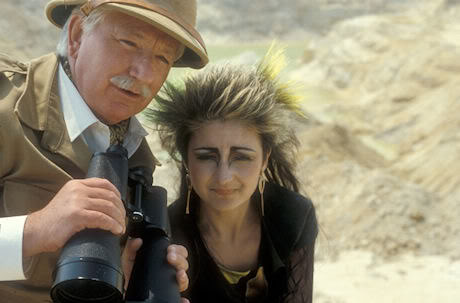
Captain Cook the Intergalactic Explorer is a brilliantly conceived character in that he represents a kind of pseudo-Doctor. He is a restless explorer with a boundless curiosity. He travels with a punky young woman who has a dangerous side. He is also a figure with somewhat colonial leanings, reflecting the Doctor's Edwardian tendencies. The Seventh Doctor would eventually take to wearing a safari suit himself in the New Adventure novels. With his obsession with past adventures, the Captain is Doctor Who gone wrong, sadly like too much of 80s Doctor Who (though the Whizzkids of fandom probably have an inflated view of much of 70s Doctor Who). T.K. McKenna brings him to life marvelously, though this unfortunately makes it a disappointment that he dies. It would have been nice to have seen a return from him. My favorite moment in the story has to be the look on the Captain's face when the Doctor calls him a 'crushing bore.' He looks so surprised and so furious.

Captain Cook's companion, Mags, is equally fascinating. She clearly disagrees with the Capatain's methods, but she sticks around with him and takes his orders. It's never altogether clear what Mags thinks of him. I can't help thinking that they are probably sleeping together. If the Captain represents slavish obsession with continuity, then Mags represents Doctor Who's capacity to terrify. The show has always aimed to scare and thus her character survives. It is noticeable that Mags is dressed like a Goth. As the Seventh Doctor era shifted into the New Adventure era, Doctor Who would develop close ties with the Goth subculture.


There have always been elements of Doctor Who that lie more in the realm of fantasy than science fiction- the Land of Fiction, the Celestial Toymaker and the Mara. Yet it is in the Seventh Doctor era, that the show makes a conscious shift to include overtly supernatural elements. Greatest Show is very much a story that is more fantasy than science fiction. The only real technological element here are the robots. We get no explanation as to how the kites work or how the ringmaster and Morganna disappear. Likewise the Gods of Rrrragnorrrak seem to be real gods. There is no suggestion that they are just aliens like Sutekh (even if they look a bit like him). According to All-Consuming Fire and Millennial Rites, they are Old Ones, powerful beings from a primordial pre-universe.

Sylvester McCoy gives a really great performance in this story. It is here that we really see the 'Dark Doctor' coming to life more than ever before. He appears to manipulate Ace into going to the circus, he seems to have an unstated agenda and he clearly knows a lot more about what is going on than he is letting on. We get a definite sense that what we are seeing is only a part of some larger cosmic game that the Doctor is playing. The Doctor's statement that he has been battling the Gods of Ragnorak throughout time and space is interesting. It is very similar to the way that we meet Fenric in the next season, a villain who turns out to be the Doctor's worst enemy, even though we had never heard of him before. This certainly throws a lot of mystery about the Doctor's activity. However, it could be that the Doctor is referring to Great Old Ones in general, and so would include encounters with the Great Intelligence (Yog-Sothoth) and the Animus (Lloigor). Though it was actually a mistake, this serial gives us the most inconic image of the Seventh Doctor ever, when he calmly walks away from the exploding circus. This image does so much better at demonstrating the presence and power of the Doctor than any rant by Matt Smith about how impressive he is and how scared the monsters ought to be of him.

We are treated to a lovely score by Mark Ayres. I found the rapping a bit annoying at first, but it grew on me. It sort of adds to the surreal atmosphere of the circus. A mention must go to the Chief Clown, played by Ian Reddington. Every moment that he appears onscreen is a pleasure, with his expressive hand gestures and his two distinct modes of speaking. I love the nervous tremor in his voice, when he is speaking without the clown persona.


The Greatest Show in the Galaxy is a fantastic example of how Doctor Who can triumph over a troubled production. It is not perfect and is not the greatest Seventh Doctor story, yet it has a brilliance that seems to defy categories and draws the viewer into an unearthly and surreal world of its own.

Friday, 23 November 2012

UNIT: Dominion (Big Finish audio)


* Massive great spoiler alert!*

When the announcement was made about a year ago that Tracey Childs would be reprising her role as Elizabeth Klein, I was absolutely over the moon. I totally fell in love with the character of Klein in her trilogy.

UNIT: Dominion is possibly one of the most ambitious projects of Big Finish. This four-part audio series features not only the return of Elizabeth Klein, but also a new team of UNIT, the later era Seventh Doctor re-united with Raine and a previously unknown incarnation of the Doctor. Furthermore, this unlikely team are faced against a bewildering array of extra-dimension alien beings across several international locations. This is a story on an epic scale that could never have been realized on the small screen.


As anyone who heard the Klein trilogy would have expected, Tracey Childs puts in a glorious performance as our Aryan heroine. This is not the Nazi Klein we have previously seen, but a Klein who worked as scientific advisor to UNIT. She is portrayed as psychologically troubled, haunted by the 'Umbrella Man' and the sense that he is spying on her.

I had assumed that the UNIT Klein is the version of Klein that was mean to exist in our universe and which had existed prior to the Second World War when the timeline diverged. This is not made clear in this audio. No details of Klein's past in this timeline are given, leaving open the bizarre possibility that she just materialised in this timeline as somebody working for UNIT. I do hope the writers did not intend such a notion. Dating UNIT stories opens up a minefield of complexities, but the timing of this story is left vague, leaving open the possibility that this is the same Klein who was presumably born in the 1930s (in my fan fiction I pegged Klein as born in 1935). This story is clearly set before Battlefield. There is no mention of internet phenomena such as Google. The only certainty is that it is set after 1985, as Sergeant Wilson is pictured holding an SA 80 rifle.


On the whole, Klein is written well. She may not be a Nazi, but she is cold and ruthless. Her interaction with Raine shows she likes being the alpha bitch. This is softened by her real emotional problems as a result of her awareness of the Doctor. On the other hand, she does come across as a little two-dimensional at times. We are led to believe that she spends nearly all her life in a laboratory. Clearly she does not, as she obviously goes to the hairdressers to keep her helmet-shaped hair in trim. A few more details about Klein's life would help to humanize her a bit more.

The lack of detail about Klein touches on the other difficulty with the way the character is portrayed. She very much props up a rather sexist trope about powerful and successful women being lonely, isolated and frustrated. There is a definite cultural subtext here about women being unable to have a high-powered career without sacrificing a meaningful and well-adjusted personal life.

Alex McQueen plays the Other Doctor. The characters are led to believe that he is a future incarnation of the Doctor, until they discover the truth. You can certainly sympathize with them, McQueen gives an immensely Doctorish performance. I can't be the only listener who was expecting some really complicated explanation for the Other Doctor, probably involving parallel universes. The last thing I expected was for him to be the Master. Yes, the Master. An explanation so obvious that it does not occur to any sensible fan. It just shows that an old trick can work if it is done right. Remarkably, McQueen gives a performance as the Master which could almost equal those of Delgado. He is certainly the campest Master we have seen, yet he absolutely ruthless and cruel. He is the Master done right.


With Klein occupying the limelight, Raine is left a little in the shadow. I'll admit I am not a big fan of Raine. She comes across as too much of a generic companion. Yet Beth Chalmers still gives a good performance and works well as a contrast to Tracey Childs. I can see why Big Finish chose to run with Raine; they used her for 'Season 27' and they wanted to give her a comeback.

The UNIT we see here are not quite as Dad's Armyish as the Seventies UNIT, but both their commanders are rather inept. We are given a bit of emotional drama with Sgt Wilson, who is about to become a father. This might have come across as more refreshing if it were not for the irritating and sentimental obsession with fatherhood displayed in the last couple of Doctor Who seasons under Moffat.

Near the end of the story, Klein is injured by a gunshot and we are teased with the possibility that the character might be at an end. Yet she survives and we can hope that she will make another appearance with a revitalized UNIT team. My only hope is that they get Klein out of the laboratory a bit and give her a bit more of a life. Maybe even give her scene in an hairdressing salon!

Friday, 16 November 2012

The Happiness Patrol


Like Delta and the Bannermen, the title of The Happiness Patrol is a reference to Indie music. This is just an example of the way the McCoy era exudes cool. No other era of Doctor Who has this sense of being in touch with pop culture.

As with so many Seventh Doctor stories, The Happiness Patrol completely divides fan opinion, with a large segment of fandom dismissing it for its camp excesses. My own opinion is that The Happiness Patrol is among the greatest of Doctor Who stories.

The Happiness Patrol is perhaps best remembered for the Kandyman. This Bertie Basset lookalike has drawn much mockery. Yet I would suggest that he is one of the greatest Doctor Who monsters ever created. Unlike so many other monsters, the Kandyman manages to avoid looking like a man in a suit. It's high pitched voice is delightfully sinister. A quite wonderful piece of terrifying surrealistic madness. He is also given a fascinating symbiotic relationship with his creator, Gilbert M.


Probably the greatest strength of this serial is how differently it looks and feels from other Doctor Who stories. It feels so fresh and original. It has a striking visual look with an immensely effective use of colour and shade. It also has a plot free from half-thought out hard Sci-Fi elements always end up creating confusion.

The subtext of The Happiness Patrol has been endlessly discussed and dissected by fans. Sheila Hancock is clearly imitating Margaret Thatcher and her husband is obviously Dennis. Yet the story is not simply a satire of Thatcherism. The references to townships echoes Apartheid South Africa and the disappearances bring up the spectre of South American dictatorships. Some have seen in it a subtext about homophobia. It is a multi-faceted story, but not one which becomes didactic or attempts to do too much as the audio Jubilee does.

What is particularly striking is how prophetic this story was. Not long after this story was broadcast, the Communist dictatorships would fall in a similarly bloodless manner to the downfall of Helen A's regime. People in these countries would simply get tired of doing what they were told and living under lies.

Sheila Hancock's performance as Helen A is very impressive. It is rather a shame that she was herself dismissive of the story. It is very clear from her portrayal that Helen A genuinely believes in her ideology of forced happiness. I also very much like Priscilla P. She seems to be the only inhabitant of Terr Alpha who tries to look happy. This perhaps fits with her fanatatical nature. Sylvester McCoy's performance shows considerable improvement from that of the previous season, even if it does become a little bizarre towards the climax.

The sets have been criticized as looking tacky, but I quite like them. They have the look of a faded, worn-out old theatre. It is interesting how the very stagey, simplistic sets are reminiscent of the less polished sets of the Hartnell era. The costumes are wonderful; they are so colourful. Of course, it is absurd that the Happiness Patrol dress that way. That is the point. Dictatorships always have something ridiculous about them. Just look at the way the North Koreans celebrate the birthdays of their leaders. The music also deserves a lot of praise, with both the lift Muzak and the bluesy harmonica. I especially like the moment when Earl switches to a happy tune as the Happiness Patrol go by.

I am glad that Helen A is not killed in the end. In a Hinchcliffe or Saward story, she would died an horrible death. Here she is defeated by her own inconsistency. It is a beautifully poignant moment when she weeps at the death of her pet. Presumably, she is tried and imprisoned for her crimes later.

The story suffers a little in places due to editing, but on the whole the fast pace works very well and it is a great example of how three-episode stories can be effective. The Happiness Patrol is one of the highlights of 80s Doctor Who and one of the greatest of Doctor Who serials.

Wednesday, 7 November 2012

Dragonfire


You know, the really big problem I have with Dragonfire is that it is set on an ice planet, yet nobody gives the slightest indication that they are cold. This might seem like a small fault, yet it is glaring all the more for the fact that this story is so visually strong. Dragonfire is blessed with beautiful sets and pretty decent effects that have been achieved on a woefully low budget. Yet the failure of direction displayed in the lack of 'cold acting' lets them all go to waste. If ice does not feel cold, then it is just glass.

Dragonfire is most notable for its introduction of Ace. Ace is a refreshing in having much more depth of personality than other characters. The moment at which she is tempted to serve Kane as a mercenary is beautifully done. Yet Sophie Aldred never really convinces us in her portrayal of a rough teenage girl. Aldred was always at her best when she forgot about trying to sound like an aggressive working class girl and just played Ace as a slightly otherworldly middle-class girl. That was not how the character was supposed to be, but it suited Aldred far better. Aldred saying "I don't need no mum and dad" just sounds embarrassing.

As well as the arrival of Ace, we get the departure of Mel. Her decision to leave the TARDIS is as hurried and unprepared for as that of any companion. It is slightly disappointing because she has such a great rapport with Ace. Perhaps a few adventures featuring Ace and Mel together might have made the latter more fondly remembered. Note that Mel is wearing combat boots with red laces. Everybody in this era of Doctor Who seems to have a slightly Punky appearance, even Mel.

The return of Sabalom Glitz is a disappointment in a season remarkably free from past references. His transition to lovable rogue is rather jarring, even if he has a good chemistry with McCoy.

The plot leaves an awful lot to be desired. One might have thought that after over a thousand years, Kane would have found a way to escape or at least to find the secret of the key hidden in the dragon creature. It does not feel very well thought-out. We also get some appalling direction, such as the literal cliffhangar with the Doctor.

McCoy does quite a bit of clowning in this story. I think on the whole his performance was better in Delta and the Bannermen. However, I love the moment when he regretfully tells Belazs that she will never be free from Kane. This is very reminiscent of the dark Doctor of Cat's Cradle: Warhead who passes judgement on characters in that book. His intellectual discussion with the guard is also a nice touch.

The multitude of film references in Dragonfire is very clever and works well with the strong visual elements of this story. It is just unfortunate that this story does not quite lift itself above mediocrity as Paradise Towers and Delta and the Bannermen do. Dragonfire lacks both the sinister and surreal atmosphere of Paradise Towers and the joyous magic of Delta and the Bannermen.


Friday, 12 October 2012

Battlefield, by Marc Platt (Target novelisation)


When Battlefield was on television, a lot of my friends at school were watching it. They urged me to watch it, but back then I had no interest in Doctor Who. A year later, I suddenly developed an interest in Doctor Who. Hence, three years after the serial had screened, I read the Target novel without having seen the original. I really enjoyed this book. Despite the fantasy plot, it felt much more realistic and gritty than other Target novels I had read.

The Seventh Doctor run of Target novels featured quite a few that had a much deeper level of literary sophistication. While Battlefield is less experimental than Ian Briggs' Curse of Fenric novelisation, it's prose is very rich. The moment of Lt. Laval's death in particular is beautifully described. Battlefield is a much more straightforward retelling of the original story than Curse of Fenric, yet it still adds considerable richness to the narrative.

The big problem with the Battlefield serial was that it had too many characters. None of them really got the treatment they deserved. The great strength of the novelisation is that Marc Platt was able to add a depth of characterisation to them that was very much lacking in the original. The portrayal of Professor Warmsley, for instance is infinitely better than what we saw in the serial. Mordred becomes a bit more than just a mummy's boy.

The novelisation also treats us to a few glimpses of the strange Thirteen World realm of Morgaine. We also get to see the Merlin incarnation of the Doctor. I particularly like the way the Doctor sees his doom as Merlin as an inescapable fate than he can delay, but never avoid.

On the whole, the novelisation does a much better job than the well-meant but lacklustre serial. Battlefield was one of the brightest ideas in Doctor Who, but one of the most disappointingly executed ones.

Wednesday, 26 September 2012

Paradise Towers


The first time I watched Paradise Towers, I found it extremely enjoyable. I was sucked into this surreal and fascinating world. Yet with each viewing of this serial, I am ever more conscious of it's faults.

Paradise Towers has a lot going for it. It offers a fascinating nightmare world based on the mundane reality of British housing blocks. It has a very clever and witty script that plays with language in a way not seen in any other Doctor Who story. It makes a fairly effective use of Mel and after the difficulties of Time and the Rani, we see Sylvester McCoy really settle into the role and make the Seventh Doctor his own. Watching him with the Kangs, we see a Doctor who is cool in a way the previous Doctors could never be.

Yet Paradise Towers is let down by a number of problems. The score is too loud and fails to fit the mood of the story. The sets are very well designed, but they are far too brightly lit, a common failing in 80s Doctor Who. While the Kangs are very enjoyable, they are quite obviously middle class drama school graduates.

The Chief Caretaker is a brilliantly conceived character. He is inspired by the very British phenomena of the overzealous council official who 'thinks he's Hitler.' Richard Briers performance does not quite do the character justice. While he has some glorious moments together with McCoy, most of the time he overplays the role and sends it up just a little too much.

One definite problem is that the world of Paradise Towers does not really make sense. The ages of the actors do not fit, we are given no explanation of why nobody ever leaves, we have no idea where the characters get their clothes or food or just generally how the whole society of the Towers works. This is not a problem in a story like Greatest Show in the Galaxy, where everything in the story is left mysterious. The problem with Paradise Towers is that we are given an awful lot of information about this society, but it still makes no sense.

Paradise Towers is not the highlight of the McCoy years and it is not even as good as Delta and the Bannermen, the story that followed it. Yet it was an important milestone in treading out a different path for the program. This serial was a bold experiment that offered a new and fresh avenue for Doctor Who.

Tuesday, 18 September 2012

Death Comes to Time


Death Comes to Time was a webcast made by the BBC in 2001, with an impressive cast of voice actors, most notably Stephen Fry and Anthony Head. It featured the Seventh Doctor, a surprising choice as it was made after the McGann TV movie.

This webcast is a colossal, epic drama that occurs on an overwhelmingly cosmic scale. Yet it is not epic in the silly over the top way of the new series' season finales. This story has a beautiful poetic feel. With it's orchestral classical score, a far cry from the sentimentality of Murray-Gold, Death Comes to Time feels very much like a Wagnerian opera. It is furthermore, a story that touches on religious and philosophical themes.

The story opens with a voiceover that is reminiscent of Bagpuss. It tells a fairy tale about a land of giants; an allusion to the Time Lords. This very much sets the tone of Death Comes to Time; it is more of a fantasy story than a science fiction story. You only need to watch this to realise just how shallow Moffat's notion of what the word 'fairy tale' means.

The big mistake of the TV Movie was to include too many of the shallow trappings of the show's past- the Master, regeneration, the Eye of Harmony. It assumed that the viewer would be interested to know that Time Lords regenerate and that they come from the planet Gallifrey. In contrast, Death Comes to Time does not tell us what Time Lords are, but shows us. We are introduced to the concept gradually through analogies like the beautiful parable about the painter and his painting.

Granted, Death Comes to Time gives us a radical revision of what Time Lords are. They are no longer a society of old men, but a race of gods who wield terrible power. Gallifrey is not even mentioned (though no doubt the three faces in the Temple of the Fourth are supposed to be Rassilon, Omega and the Other), but rather the Time Lords are wanderers in the fourth dimension. Fascinatingly, the idea of the TARDIS is deconstructed. The Doctor insists that his TARDIS contains no technology at all. It is rather portrayed more as a manifestation of some magic power that Time Lords possess. When the Doctor revokes the Minister's TARDIS, it is impossible not to be reminded of Gandalf breaking the staff of Saruman.

Death Comes to Time is often out of character with much of the history of the show. It is bizarre to think that the Doctor possesses the power to kill by thinking. Yet, we the idea of the Time Lords as gods can be found within parts of the Doctor Who mythos such as The War Games. For all that this story departs from continuity, the Doctor Who mythos is big enough to embrace a story like this; and it is a story that is made with passion and conviction.


This story is rarely accepted as a part of true Doctor Who continuity on account of how it departs from other stories. Yet there are many divergent and conflicting threads within Doctor Who. I'm sure that most of the discrepancies can be explained away. While Ace does not become a Time Lord in the New Adventures, this Ace appears to be older. It could be a Post-Lungbarrow Ace. It has been argued that if the Master or the Rani could kill by thinking like the Time Lords here can, they would have done so. Perhaps they had not yet mastered that power?

What are we to make of the Doctor's death? As is the golden rule in fantasy and science fiction. if there is no body, you can expect the character to return. Perhaps the Doctor does not really die? If you hate the TV Movie, you could see it as an alternative regeneration into the McGann Doctor, one that happens offscreen. Or if you hate everything in the New Series, you could use Death Comes to Time as a reason to exclude the RT Davies and Moffat era from your personal canon.

It is a shame how little the BBC Wales series has drawn from Death Comes to Time, as this is Doctor Who done well.

Tuesday, 11 September 2012

The Curse of Fenric, by Ian Briggs (Target novelisation)


The quality of Target novelisations varied enormously, but a distinct improvement in literary depth can be seen in some of the novelizations of Seventh Doctor stories. The novelization of the Curse of Fenric, by it's original writer, is a good example of a novelization that attempts to provide a much deeper penetration into its source text. I think that the original serial was brilliant and this novelisation does not improve on the original (or remove all confusion about the plot) but it does provide a fascinating perspective on the story and enlarges on the writer's original vision.

The stark prose of this work has a somewhat avant-garde feel, but occasionally it becomes banal enough for you to remember it is a kid's book. Unlike most of Target novels it brings up sexual themes, with Millington and Judson's homosexuality made explicit and the surprising revelation that Miss Hardaker had a child out of wedlock (and was subsequently socially ostracised).

Many details are added to the televised story. The Russian soldiers are given distinct personalities and Nurse Crane turns out to be a Soviet spy (which seems to me a pointless addition). The story of how Millington's homosexual jealousy of Judson led to the latter becoming crippled is an interesting touch.

Particularly interesting are the editorial notes between chapters, which take the story in different directions. These include a schoolboy essay by Millington on the subject of Norse mythology and a letter from Bram Stoker about vampirism. Most interesting of all is an Arabian Nights-style account of the Doctor's first contest with Fenric. We learn that after defeating Fenric, the Doctor travelled for two years with Zeleekah, a freed Ethiopian slave. This is generally thought to have taken place during the Doctor's first incarnation, though few fans have considered exactly where in the chronology of the Doctor's life it occurred. I am dying to write some fan fiction featuring Zeleekah, though I find it hard to think how exactly to go about her character.

The novelisation is more upfront than the book in identifying the Doctor as a power of Good from before the dawn of time. Personally, I like this idea, though I do think it was better left ambiguous as it was in the serial.

The story gets even more confused when it comes to the subplot about the Ancient One and the dead Earth of the future. The book repeats the line about the dead world being the result of 'industrial progress' but it also seems to suggest that it is Millington's poison that creates it. It is implied that this future is prevented. I am unhappy with this. For one thing, it implies a temporal paradox. As I interpret the televised version, the desolate Earth of the Ancient One is the result of pollution and it is not erased. This should not be thought to contradict other Doctor Who stories set in the future. There is room for a desolate Earth (which will get repopulated by space colonists).

The novel ends with the Doctor meeting up with an older version of Ace in 19th century Paris, who has a relationship with Sorin's ancestor. Kate Orman's New Adventure novel, Set Piece would come to set up this surprising scenario.

The Curse of Fenric novel is a great read. It lacks the self-confidence and maturity of the New Adventures, but it is definitely a step in that direction.

Friday, 7 September 2012

Canon and Conundrum


I absolutely love the New Adventure novel, Conundrum by Steve Lyons. I think it is among the best of the Virgin New Adventures. The sequel, Head Games is also a great book. Steve Lyons is a great Doctor Who writer. Yet I find it really hard to forgive him for a clever meta-textual trick he pulls in Conundrum and repeats in Head Games.

In Conundrum, we learn that a new Master of the Land of Fiction has created a fictional counterpart of the Doctor, who is called Dr. Who (and the real one is not?) and who has two grandchildren, John and Gillian. In the sequel, Head Games, we meet Dr. Who. Although he looks like the Sylvester McCoy Doctor, his personality is quite different, having a very superficial and naive view of good and evil. His answer to monsters is to wipe them out. Dr. Who references several TV Comic stories. The clear meta-textual implication is that the TV Comic stories did not feature our Doctor, but this Land of Fiction creation.

I realize very well that Steve Lyons meant all this in good humour, but I can't help seeing a certain literary snobbery in the idea of relegating all the TV Comic stories to the Land of Fiction. This is basically an attempt to create some sort of Doctor Who canon and to define the boundaries of what is Doctor Who and what is not.


Doctor Who has no canon. The BBC licences products, but it makes no attempt to define what material is part of the Doctor Who mythos. Doctor Who has no Gene Roddenberry or George Lucas who can make pronouncements about canon. I'm very glad it does not. I grew up with the Star Wars Expanded Universe novels. I actually have a much fonder place in my heart for them than I do for the original Star Wars trilogy. When George Lucas changes things in the Expanded Universe, it really annoys me. I totally agree with Paul Cornell's claim that canon is just another form of bullying. To exclude a story from the canon is to say "No matter how much you might love this story, it doesen't count. So there."

There is a certain incongruity about a spin-off novel trying to exclude another spin-off from an hypothetical canon. I am a New Adventures fanatic, but there are plenty of fans who hate them. There are fans who hate the manipulative Doctor in the NAs and the bitter and violent Ace. There are fans who like the idea planned for Season 27 of Ace going to Gallifrey to become a Time Lord. Steve Lyons seemed to think that the TV Comic did not count. Plenty of fans think the New Adventures don't count and only the televised stories are genuine Doctor Who.


It is often pointed out that the TV Comic stories give the Doctor a somewhat different personality to the televised Doctors. The TV Comic version of the First Doctor uses magic and its Second Doctor invents things to make money, appears on a television chat show and carries a ray gun. Yet it ought to be apparent to a fan that even the televised show does not always get the Doctor quite right or achieve a consistent tone. Take the Seeds of Doom. I'm sure that Seeds of Doom went through a much more rigorous editorial process than Martha the Mechanical Housemaid, but there are still some oddities about that story. Seeds of Doom is a very enjoyable story, but in some ways it does not feel like Doctor Who. The tone of it comes closer to a spy thriller at times and in the end, the monster is destroyed not by the Doctor, but by an airstrike. Furthermore, the fourth Doctor does not quite feel the same as in other Fourth Doctor stories. He seems more of an establishment figure and much more ready to deal out violence. Robert Banks Stewart had not spent hours studying past episodes to make sure he got every detail right (as a fan would do); he just wrote it to commission. That is why the tone of the story is different and that is exactly why the TV Comic strips feel different to most Doctor Who stories. We would not exclude Seeds of Doom from the 'canon' because it is a bit different and neither should we exclude the Sixties comic strips.


Steve Lyons makes a really interesting point in Head Games about the TV Comic version of the Doctor having a naive view of good and evil and being ready to destroy anything that looks like a monster. While this is true of the Doctor in the TV Comic, it is also true of much of the televised show, especially in the Second Doctor era. The Doctor wipes out the Macra without knowing anything about them, he cheerfully blows up the Dominators with a bomb and he destroys the entire Martian fleet, even though they are a dying race. This is the sort of gung-ho attitude that Robert Holmes so brilliantly satirized in The Two Doctors.

There is another irony in the idea of the TV Comic being relegated to the Land of Fiction, that is that the whole idea of the Land of Fiction is a bizarre concept in itself and might just as easily have been something from the TV Comic strips. The Mind Robber might be part of an hypothetical canon, but there is no way that story would have been made in any period other than the Sixties era of Doctor Who. There is just as much a stretch to say that The Mind Robber and Terminus occurred in the same universe as to say that The Challenge of the Piper occurred in the same universe as Pyramids of Mars.