Showing posts with label Season 25 review. Show all posts

Sunday, 8 December 2013

"I don't know if you're familiar with Wagner's Ring des Nibelung" : Silver Nemesis


I like Wagner a lot. He's definitely my favorite composer. I got into him when I was 13, at a time when I was going through a worrying phase of interest in the Third Reich. It would be interesting to explore whether there are any Wagnerian elements in Doctor Who. I don't think I have the expertise to write such an essay. Perhaps Phil Sandifer could, though I don't know if he is much of a Wagner enthusiast. It would be a little disappointing if Silver Nemesis is the only Doctor Who story with roots in Wagner.

I love Season 25. It's such a strong season. It begins with two 10/10 serials and ends with a 9/10 serial. Yet stuck between these brilliant stories, there is Silver Nemesis, a serial that is just dreadful. Really dreadful.

One of Silver Nemesis' faults is very similar to that of Dragonfire. Dragonfire is supposed to be set on an ice planet, yet absolutely nobody in the cast acts as though they are cold. It is such a basic flaw one wonders how they could have got it wrong. Likewise, Silver Nemesis is supposed to be set in November, yet everything you see on the screen tells you this is a glorious summer day. Faults like this can't simply be ignored, they ruin whole productions. It is simply absurd to suppose the viewer can pretend this is November when they are watching an outdoor jazz concert with nobody wearing gloves or a woolly hat.

It is generally agreed by fans and critics that there is just a bit too much going on in this story; too many plot threads and too many villains. Having a 17th century sorceress, a bunch of Neo-Nazis and the Cybermen does not leave much room for the exploration of what makes these adversaries interesting. Some fans wish that De Flores and his Nazi pals had been left out, considering them superfluous to the plot. I would have left out the Cybermen; their addition to this was typical JNT shopping list commissioning. I would have beefed up De Flores into a bigger menace and given him more interaction with Peinforte. The messiness of the plotting is not helped by the fact that what there is here is remarkably similar to the season's opener, Remembrance of the Daleks.

The Cybermen are simply rubbish here. They are not a convincing threat in the slightest. While the addition of gold as a Cyber-weakness in Revenge of the Cybermen was unnecessary, at least then it was actually quite difficult to use it against them. Here the Cybermen are terrified of the metal and their chest units explode on contact with gold coins.

Anton Differing, best known for his role in Where Eagles Dare has had a lot of criticism for his performance. I actually think he was alright here. He was not exactly helped by the character being so underdeveloped. I like the fact that he understates the performance. I can't stand cliched, caricatured Nazi characters.

Lady Peinforte comes across very well, particularly as she descends into madness. On the other hand, her sidekick, Richard (with his beard, it's hard not to keep thinking of Richard Branson. I keep expecting him to get into a balloon) is a really badly written character. He starts off as a badass criminal and killer, who brutally murders an old man and who can overpower two skinheads. Then he morphs from this to being a frightened peasant, then a fanatical devotee of his mistress, then finally turns out to be a rather nice chap at the end.


We see in this production one of those faults that has carried over into the New Series, namely an obsession with spectacle at the expense of story. This story throws in Courtney Pine, a Queen-impersonator, Windsor Castle, Cybermen and some American actress. It is all about grabbing attention. RT Davies has gone down this road and so has Moffat. It's a really bad way to produce Doctor Who.

I very much enjoy the exploration in Seventh Doctor stories of the theme of the Doctor's mysteries and the Dark Times of Gallifrey. Unfortunately, this story is not strong enough to hold such weighty themes and they fall slightly flat. When Peinforte threatens to reveal the Doctor's name, he acts like he does not care (we know he is called Dr. Who anyway).

It does seem like Silver Nemesis is the classic story that most provides the template for Moffat-Who, with the mystery about the painting of Ace, Peinforte's empty tomb, the comic tone that detracts from the story, the stuff about the Doctor's name, not to mention the fez. This really feels like it could be an Eleventh Doctor story.


I do like the fact that Silver Nemesis offers no wonky scientific explanation for Peinforte's time travel. She is a magic user, plain and simple. This acceptance of the supernatural can be seen in other Seventh Doctor stories, such as Greatest Show and Survival. Given the mention of Old Time Gallifrey, we might wonder if she trafficks with the Old Ones, such as Fenric.

Sunday, 2 December 2012

The Greatest Show in the Galaxy


You're not only a scoundrel and a meddling fool, but you're also a crushing bore!


Greatest Show in the Galaxy is a story that feels utterly removed from anything that has gone before in Doctor Who. There are similarities with Warrior's Gate, Kinda and Paradise Towers, but Greatest Show in the Galaxy is quite unique in its approach to storytelling and in it's visual effect.

The Psychic Circus may not be the most impressive looking big top, but this story has a visual look that captures the eye delightfully and makes vibrant use of colour. There are many symbolic flourishes, such as the mystical eye symbols and the hearse and funereal outfits used by the clowns when they go out hunting. The costume work is among the best of the era, even if we have to forgive the less inspiring werewolf effect on Mags.

The plot structure of this story is very unusual and in places it feels a little awkward, yet the sense of uncertainty means that it does not fail to induce excitement and tension. A lot in this story does not make a lot of sense. However, it is quite different from Ghost Light. Ghost Light was confusing on the first viewing, but everything in that story can be pieced together if one makes the effort to watch it several times and listen to the dialogue carefully. Greatest Show in the Galaxy offers no explanations. The reader is left to interpret the significance of much of it.

It's fascinating how so much of the Sylvester McCoy era makes use of a metaphorical depth in its storytelling. We have all that stuff about 'undercurrents' in Curse of Fenric, the power of life in Delta and the Bannermen and Survival's cryptic theme of menstruation. However, it is Greatest Show that really goes to town on metaphor. None of the characters feel like real people, but more like archetypes. Much fan discussion of the story has centred on what the individual characters represent. Do the Gods of Ragnorak represent BBC executives or the public? Does Captain Cook represent the show's past or Star Trek?

While much of the theme is left uncertain and for viewers to puzzle out for themselves, the story most definitely raises a question about the values of the Sixties. The Circus people are hippies who have betrayed what they once stood for and sold out. One suspects that the targets here are individuals like Richard Branson and George Lucas, figures who rose up from the counter-culture to become commercial masterminds. Doctor Who is itself a product of the Sixties and the story throw open the question- has Doctor Who gone wrong? Has it become pointlessly violent like Nord, or obsessed with its past like Captain Cook? Is it hopelessly out of touch, like Whizzkid?

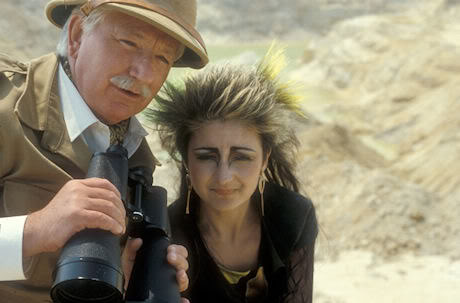
Captain Cook the Intergalactic Explorer is a brilliantly conceived character in that he represents a kind of pseudo-Doctor. He is a restless explorer with a boundless curiosity. He travels with a punky young woman who has a dangerous side. He is also a figure with somewhat colonial leanings, reflecting the Doctor's Edwardian tendencies. The Seventh Doctor would eventually take to wearing a safari suit himself in the New Adventure novels. With his obsession with past adventures, the Captain is Doctor Who gone wrong, sadly like too much of 80s Doctor Who (though the Whizzkids of fandom probably have an inflated view of much of 70s Doctor Who). T.K. McKenna brings him to life marvelously, though this unfortunately makes it a disappointment that he dies. It would have been nice to have seen a return from him. My favorite moment in the story has to be the look on the Captain's face when the Doctor calls him a 'crushing bore.' He looks so surprised and so furious.

Captain Cook's companion, Mags, is equally fascinating. She clearly disagrees with the Capatain's methods, but she sticks around with him and takes his orders. It's never altogether clear what Mags thinks of him. I can't help thinking that they are probably sleeping together. If the Captain represents slavish obsession with continuity, then Mags represents Doctor Who's capacity to terrify. The show has always aimed to scare and thus her character survives. It is noticeable that Mags is dressed like a Goth. As the Seventh Doctor era shifted into the New Adventure era, Doctor Who would develop close ties with the Goth subculture.


There have always been elements of Doctor Who that lie more in the realm of fantasy than science fiction- the Land of Fiction, the Celestial Toymaker and the Mara. Yet it is in the Seventh Doctor era, that the show makes a conscious shift to include overtly supernatural elements. Greatest Show is very much a story that is more fantasy than science fiction. The only real technological element here are the robots. We get no explanation as to how the kites work or how the ringmaster and Morganna disappear. Likewise the Gods of Rrrragnorrrak seem to be real gods. There is no suggestion that they are just aliens like Sutekh (even if they look a bit like him). According to All-Consuming Fire and Millennial Rites, they are Old Ones, powerful beings from a primordial pre-universe.

Sylvester McCoy gives a really great performance in this story. It is here that we really see the 'Dark Doctor' coming to life more than ever before. He appears to manipulate Ace into going to the circus, he seems to have an unstated agenda and he clearly knows a lot more about what is going on than he is letting on. We get a definite sense that what we are seeing is only a part of some larger cosmic game that the Doctor is playing. The Doctor's statement that he has been battling the Gods of Ragnorak throughout time and space is interesting. It is very similar to the way that we meet Fenric in the next season, a villain who turns out to be the Doctor's worst enemy, even though we had never heard of him before. This certainly throws a lot of mystery about the Doctor's activity. However, it could be that the Doctor is referring to Great Old Ones in general, and so would include encounters with the Great Intelligence (Yog-Sothoth) and the Animus (Lloigor). Though it was actually a mistake, this serial gives us the most inconic image of the Seventh Doctor ever, when he calmly walks away from the exploding circus. This image does so much better at demonstrating the presence and power of the Doctor than any rant by Matt Smith about how impressive he is and how scared the monsters ought to be of him.

We are treated to a lovely score by Mark Ayres. I found the rapping a bit annoying at first, but it grew on me. It sort of adds to the surreal atmosphere of the circus. A mention must go to the Chief Clown, played by Ian Reddington. Every moment that he appears onscreen is a pleasure, with his expressive hand gestures and his two distinct modes of speaking. I love the nervous tremor in his voice, when he is speaking without the clown persona.


The Greatest Show in the Galaxy is a fantastic example of how Doctor Who can triumph over a troubled production. It is not perfect and is not the greatest Seventh Doctor story, yet it has a brilliance that seems to defy categories and draws the viewer into an unearthly and surreal world of its own.

Friday, 16 November 2012

The Happiness Patrol


Like Delta and the Bannermen, the title of The Happiness Patrol is a reference to Indie music. This is just an example of the way the McCoy era exudes cool. No other era of Doctor Who has this sense of being in touch with pop culture.

As with so many Seventh Doctor stories, The Happiness Patrol completely divides fan opinion, with a large segment of fandom dismissing it for its camp excesses. My own opinion is that The Happiness Patrol is among the greatest of Doctor Who stories.

The Happiness Patrol is perhaps best remembered for the Kandyman. This Bertie Basset lookalike has drawn much mockery. Yet I would suggest that he is one of the greatest Doctor Who monsters ever created. Unlike so many other monsters, the Kandyman manages to avoid looking like a man in a suit. It's high pitched voice is delightfully sinister. A quite wonderful piece of terrifying surrealistic madness. He is also given a fascinating symbiotic relationship with his creator, Gilbert M.


Probably the greatest strength of this serial is how differently it looks and feels from other Doctor Who stories. It feels so fresh and original. It has a striking visual look with an immensely effective use of colour and shade. It also has a plot free from half-thought out hard Sci-Fi elements always end up creating confusion.

The subtext of The Happiness Patrol has been endlessly discussed and dissected by fans. Sheila Hancock is clearly imitating Margaret Thatcher and her husband is obviously Dennis. Yet the story is not simply a satire of Thatcherism. The references to townships echoes Apartheid South Africa and the disappearances bring up the spectre of South American dictatorships. Some have seen in it a subtext about homophobia. It is a multi-faceted story, but not one which becomes didactic or attempts to do too much as the audio Jubilee does.

What is particularly striking is how prophetic this story was. Not long after this story was broadcast, the Communist dictatorships would fall in a similarly bloodless manner to the downfall of Helen A's regime. People in these countries would simply get tired of doing what they were told and living under lies.

Sheila Hancock's performance as Helen A is very impressive. It is rather a shame that she was herself dismissive of the story. It is very clear from her portrayal that Helen A genuinely believes in her ideology of forced happiness. I also very much like Priscilla P. She seems to be the only inhabitant of Terr Alpha who tries to look happy. This perhaps fits with her fanatatical nature. Sylvester McCoy's performance shows considerable improvement from that of the previous season, even if it does become a little bizarre towards the climax.

The sets have been criticized as looking tacky, but I quite like them. They have the look of a faded, worn-out old theatre. It is interesting how the very stagey, simplistic sets are reminiscent of the less polished sets of the Hartnell era. The costumes are wonderful; they are so colourful. Of course, it is absurd that the Happiness Patrol dress that way. That is the point. Dictatorships always have something ridiculous about them. Just look at the way the North Koreans celebrate the birthdays of their leaders. The music also deserves a lot of praise, with both the lift Muzak and the bluesy harmonica. I especially like the moment when Earl switches to a happy tune as the Happiness Patrol go by.

I am glad that Helen A is not killed in the end. In a Hinchcliffe or Saward story, she would died an horrible death. Here she is defeated by her own inconsistency. It is a beautifully poignant moment when she weeps at the death of her pet. Presumably, she is tried and imprisoned for her crimes later.

The story suffers a little in places due to editing, but on the whole the fast pace works very well and it is a great example of how three-episode stories can be effective. The Happiness Patrol is one of the highlights of 80s Doctor Who and one of the greatest of Doctor Who serials.

Monday, 15 March 2010

Remembrance of the Daleks

First, let me clear up a stupid mistake by fans. In this story, the Doctor does NOT change history by destroying Skaro in 1963. It is quite clear on screen that the Hand of Omega travels forward in time before destroying Skaro. The fact that fans get confused about this shows how little attention they actually pay to the stories.

Have we cleared that up?

In my opinion this is the best ever Doctor Who story. Sure, there is stiff competition, but obviously the greatest Doctor Who story is going to feature the Daleks. And this story is quite clearly the best ever Dalek story. There are so many brilliant elements to this story- the dialogue, the nostalgia aspect, cool action, production values as well as splendid performances from the regulars and guests.

One advantage this story has over other Dalek stories is the speed at which the Daleks appear and get into the action. Other Dalek stories have this pointless suspense before the appearance of the first Dalek. If the word 'Daleks' is in the title, you expect to see a Dalek, so why leave it until the cliffhanger to bring a Dalek in?

One annoying about the four Dalek stories previous to Remembrance is that they all focus on Davros rather than the Daleks. True, this story features Davros, but he only has a few minutes of screen time and so the attention is on his creations.

Remembrance also passes the key test for a Dalek story in that the Dalek come across as pretty sinister, abusing children and killing their human accomplices. One very legitimate complaint about the story is the ease and frequency with which the Daleks are destroyed. This is a fault, but it is fun to see them getting blown up.

The production values for this story are superb. The gulf between the pantomime set of Paradise Towers (not that Paradise Towers is a bad story) and the explosions, landing space shuttle and heavy-weapons Daleks of this story is colossal.

Remembrance is essentially a nostalgia trip. It goes back to where Doctor Who began in 1963 and celebrates that era. It makes a delightful reference to the Quatermass show, which in some ways was a kind of proto-Doctor Who. Delta and the Bannermen was also a nostalgia trip. However, that story had a totally different feel. Delta was a 'Darling Buds of MaY' feelgood story. The fifties setting lacked depth. In contrast, Remembrance presents the dark side of Sixties Britain with the racist landlady, the paranoid Mike and the Mosleyite Ratcliffe. This theme is effectively linked in with the Dalek's obsession with purity.

The story has light moments, but it definitely has a serious flavour. Not only do we have the racial theme, but the story ends with a funeral and the Doctor giving Ace and equivocal answer as to the moral worth of the adventure's outcome. The Doctor's relationship with the military is marked by seriousness. Their is nothing of the chuminess which developed between the Third Doctor and UNIT. The Seventh Doctor regards Gilmore and the RAF personnel with contempt; his only concern is to keep them from getting killed by Daleks.

Nevertheless, while the military are not presented in an altogether positive light, the story still plays on the fan's sense of nostalgia, bringing back memories of the old Doctor-UNIT team. Simon Williams puts in an admirable performance as Group Captain Gilmore.

It is often said that at this point, the pantomime ended and we saw a new, more serious and darker Seventh Doctor. Of course, those say this are sometimes quick to point out that the early campy feel of the first few McCoy stories continued after Remembrance with The Happiness Patrol. As I noted above, there is a degree of similarity between Delta and the Bannermen and this story. We also see hints of a deep and mysterious Doctor in both Paradise Towers and Delta.

Remembrance hints at the idea that the Doctor is 'more than a Time Lord.' This strategy was popularly known as the 'Cartmel Masterplan.' I think this was a really good idea. Thankfully, the hints are not significant enough to cause any continuity problems.

Sylvester McCoy gives an outstanding performance. Some say he cannot do anger, but do we want him to rage? Is that doctorish behaviour? He shows complete utter exasperation at the predictability of Davros' ambitions in their confrontation. Sylvester had a superb rapport with Sophie and the two work really together.

It is in this story that Ace is seen for the first time as the Doctor's regular companion. I find it hard to say what I like about Ace. Sophie Aldred's performance was never brilliant. She never quite convinced as a teenage character. However, for some reason she is one of my favorite companions. Most likely it is her relationship with the Doctor. He manipulates her and patronizes her, yet there is still a strong bond of affection between them. I think it is a far more platonic relationship than the Third Doctor/ Jo relationship. There was always a rancid sense that Pertwee was a sad old man fancying a girl young enough to be his granddaughter. There is not a hint of that in the Ace/ Seventh Doctor relationship. Ace is like a wayward child who has found solace in the company of a blacksheep uncle.

Ace's disgust at the racist sign is well played. Her interaction with the Sixties world is developed effectively in the dialogue.


The Seventh Doctor and Ace go back to London in 1963, where Doctor Who began and battle the Daleks.

The real star of the guest cast is Pamela Salem as Rachel. Doctor Who is full of bland scientist types, but this is a minor character who is truly memorable. Somehow we feel that we have known her for more than just this one story. She has some superb dialogue, as well as a nice outfit (that tweed suit and heels). Rachel comes across as an older blend of Barbara Wright and Liz Shaw in the role of the Third Doctor. I have always thought Liz Shaw was a rather boring character. Had Liz Shaw's role been played by an older (and more talented actress than Caroline John) actor like Pamela Salem, her character would perhaps have been just a little more interesting. It would have been so awesome if Rachel had become a companion on board the TARDIS, but of we only ever have young companions. Rachel also has more sense than Tegan and Peri in removing her high heels before climbing into the Dalek spacecraft. The sight of her looking a little awkward in her stocking feet in the spacecraft is a nice one.


Some people think the many continuity references in this story are gratuitous, but as a fan I appreciate them and they do not detract from the story.

Few fans will agree with me, but Remembrance of the Daleks is the best Doctor Who story ever.