Showing posts with label Season 7 review. Show all posts

Saturday, 27 September 2014

Inferno


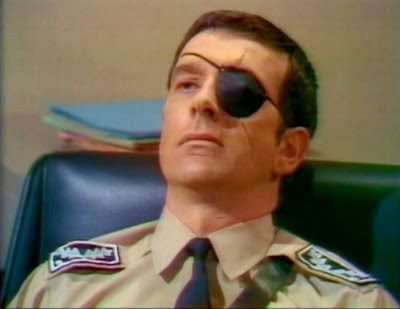
A lot of Doctor Who stories are padded out to fill extra episodes, but Inferno takes padding to a completely different level. The orginal story about a drilling station and green slime turning people into werewolves would have needed padding to fill out four episodes, but this serial had to stretch to an impossible seven episodes. The ever resourceful Terrance Dicks came up with the idea of filling this out by taking the Doctor to a 'mirror universe' version of the same setting, with Fascist versions of the main characters. Conveniently, this removed the need for new sets and hiring new actors. All it required was a slightly higher costume budget and Nicholas Courtney to spend a bit longer in the make-up chair.

A lot of fans think the idea of the 'mirror universe' is a fantastically clever one. I don't. As Phil Sandifer points out (there is very little in his Inferno essay that I disagree with), the idea of a mirror universe is one that television writers continually turn to. It's a very standard trope. It's not used in a particularly creative way in Inferno. The Doctor's witnessing of the destruction of the mirror Earth does not give him any new insight that enables him to save the regular Earth. It simply feels like a way to draw the story out and we are denied the pleasure of seeing the Fascist characters meeting their other selves.

That is not to say that the Inferno-verse is not fun to watch at times. The actors are clearly enjoying the chance to be evil for a while. Nicholas Courtney is particulary memorable as the sneering Brigade Leader. This is possibly a problem for Caroline John's Liz Shaw. Liz never really had much personality or character development. It is actually only when she becomes a Fascist that she appears to be an interesting character who we want to watch. Furthermore, the Fascist world is never really explored. It never really offers more than a fleeting glimpse of what this world is like. It seems perhaps a little surprising that the royal family were executed in this world. In our world, the British Union of Fascists supported the monarchy and our royal family were hardly left of centre in their views. Perhaps the mirror universe regime is closer to Communism than Fascism. Or more accurately, given the Terrance Dicks input, they are a British version of those nasty foreign bureacratic types that we British patriots all hate and UKIP imagine are running the European Union.


Of course, Inferno has some great direction, thanks to Douglas Camfield, with Barry Letts filling in when the director became ill. This story has some enjoyable moments, but for me it is just too long and bores me. This is not a classic by any stretch.

It has been said that the first four episodes of a new Doctor's run follow a pattern. The first story is a frenzied runaround (Spearhead from Space- not much plot going on), the second story is one more suited to the previous Doctor (Dr Who and the Silurians- the old base under siege) and the third story an experimental new kind of story that is not really repeated (Ambassadors of Death- realistic elements at the forefront and science fiction elements kept in the background). It is the fourth story that defines the new era. With its theme of industrial research, energy sources, green slime, Venusian Akido and pointless car chases, Inferno sets up the Third Doctor era perfectly. All that is missing is Jo Grant and the riotous colours that came in with Claws of Axos.


It does seem remarkable given all the massive historical differences between our universe and the Inferno-verse, that all the main characters are all together in an almost identical scientificc installation. The novel Timewyrm: Revelation offers a handy explanation that this universe has been artificially constructed. I did come up with my own theory as to the nature of the Inferno-verse. In The Chase, the Doctor conjectures that the TARDIS had entered a realm formed from human fears. It seems surprising that the Doctor would suppose that such a psychological world existed and that the TARDIS could take one there, but perhaps the Inferno-verse is this 'land of fears?' Could the Inferno-verse be a sort of projection of the Doctor's own fears about the drilling project? It occurred to me that the Republic Security Force represent the Doctor's anxieties about working with a military organisation. It's worth noting that the Brigade Leader is not that far removed from the Brigadier in personality. Notice the scene in Inferno where the real Brigadier rants at Benton and orders him to act like a bully and to coerce Stahlman. Of course, this theory contradicts the novels in which the Inferno-verse is a real place.


So what is going on with all that green slime? Some of the New Adventure novels hint at the idea, championed by Lawrence Miles, that the Earth is an artificial planet. After the Time Lords first experimented with Time Travel, they unleashed the vampiric Yssgaroth from a hellish other-universe. After Rassilon defeated the Yssgaroth, he fixed up the holes in the universe with artificial planets, Earth being one of these. Thus, the weird green slime that seems to defy the laws of physics is matter from another universe. This is supported by Planet of Evil, in which material from another universe has a similar effect in turning people into werewolves.

I think the Yssgaroth/ Hollow Earth theory fits Inferno perfectly. The very title of this serial captures the idea of hell being underground. The drilling station is not simply causing an ecological disaster, but is awakening demonic forces. Notice that the Primords and Stahlman in particular act like they are under the control of some unseen force. They are being controlled the Yssgaroth, who want to escape and unleash havoc on the universe (no pun intended).

Saturday, 9 February 2013

Ambassadors of Death


Ambassadors of Death is not the most highly regarded stories of the Pertwee era. It is not among the most well remembered stories of this period and is often considered to be the weakest story of Season 7. This is a real shame, as it seems to me to be among the best Pertwee serials (a short list in my opinion) and is a strong rival to Dr Who and the Silurians as the best story of Season 7.

What is so striking about Ambassadors of Death is how unlike typical Doctor Who this story feels. This story keeps its science fiction elements to the barest minimum possible since the era of Pure Historicals. We get only fleeting glimpses of the alien race and their spaceship. Instead of such fantastic trappings, the serial focuses on the more gritty and realistic elements of a near future society. This is a story foremost about brutal thugs, corpses being buried in quarries, paranoid generals and a space program that seemed realistic at the time. There is something very odd about watching the gun battle between UNIT and Carrington's goons- it feels like a different show with nothing to do with Doctor Who. This is the basic premise of Earthbound Season 7 taken up to the maximum level.

The influence of James Bond is apparent, with the presence of a multitude of gadgets, endless fights and escapes. Yet the serial strives to be much more than just Doctor Who doing James Bond. This is a story about the dangers of paranoia, xenophobia and militarism. But more than this, Ambassadors of Death is a story about the nature of space exploration. The influence of The Quatermass Experiment will be apparent to the educated viewer. The serial borrows many visual elements of Quatermass, such as the empty spacecraft and the sense of the mysterious otherness of the cosmos beyond our planet. Yet Ambassadors does not subscribe to the Quatermass view that outer space if a realm of of abject terror. The story offers the hope of peace between different planets. Nevertheless, Ambassadors portrays outer space as a realm of mystery beyond human comprehension. Ambassadors raises the question of whether humanity is ready or able to deal with that world of mystery. The trauma and mental breakdown of Carrington suggests the conclusion that humanity is too petty and small in its concerns to face the beauty and magnificent wonder of space.

This is a story on an epic scale, taking us from a futuristic space centre to country roads and even to the vastness of space. It has production values that match this sense of scale. Watching it, I am struck at just how well everything is realised visually, even with the unfortunate continuity errors like Liz's hair-length and choice of tights. This is a story with plenty to look at and it does not let us down. With the addition of Havoc to the team, we get some wonderfully well orchestrated fights.

Ambassadors offers us some fantastic guest performances. Ronal Allen is memorable as the controller, Ralph Cornish. In a much smaller role, Michael Wisher, the future Davros, is astounding as the news correspondent. There is a beautiful intensity to his delivery of every line. John Abineri also gives a really subtle performance as General Carrington. Doctor Who has plenty of crazy villains, but Carrington is one who has clearly suffered a deep psychological scarring, and this comes across in his performance.

It is Reegan, however, who steals the show and becomes the most memorable hired thug in the history of Doctor Who. What is shocking about Reegan is the sheer casualness to the way he kills people. Unlike other Doctor Who toughs, he does not get angry and point guns at people. He is absolutely in control of every situation, even when he is finally dragged away. He has no big ambitions like taking over the world; he just wants to exploit the situation and make money. Just look at his excitement at the thought that he can break into banks at leisure- he looks like a child in a toy shop! The novelisation gives him a fitting background; he was an IRA terrorist who helped himself to the funds.

Pertwee seems a lot more settled into his role in this story than in the previous two serials. He plays it absolutely straight and it comes off well. I am not a fan of Pertwee's Doctor and he is obnoxious in quite a few places, such as his rudeness to Cornish. Caroline John's Liz gets a few good moments, but as with other stories, her character is horribly underused. She is mostly there to get captured and to escape.

Ambassadors of Death is by no means perfect. While the fights are great, I think it could have done with a lower body count. Doctor Who should not trivialize the death of characters, as it too often does. The story is a bit padded and probably became wearying over the weeks. The motives of Tatalian are also a bit unclear. I don't think this is the best story of Season 7, in my opinion Dr Who and the Silurians has a stronger plot. I do think, however, that it is better than the rather overrated Inferno. Compared to this serial, Inferno feels hopelessly like a standard Doctor Who story with green slime and a monster of the week.

Monday, 1 August 2011

Spearhead from Space


I think I first watched Spearhead from Space when I was eleven years old. The day I watched the recently re-released DVD, I started reading The Adventuress of Henrietta Street, by Lawrence Miles, the first chapter of which features prostitutes offering Tantric sex. The variety of depth and scope in Doctor Who is just breathtaking.

The Pertwee era is definitely one of my least favorite parts of the Doctor Who legacy. Nevertheless, I can't help sharing the sense of excitement and anticipation that Spearhead from Space exudes. Coming right after the slightly repetitive format of the Troughton era, Spearhead from Space feels new and fresh. This is heightened by the fact that it was shot on entirely on location using film. This gives it a delightfully cinematic look and feel. I do wish more stories from the Pertwee era had been made this way.

The full revelation of the new Doctor is delayed for the first two episodes. In the meantime, we are re-introduced to the already familiar Brigadier Lethbridge-Stewart. Nicholas Courtney takes to his new role as a regular wonderfully. He is entirely removed from the buffoon that he would become in later stories. He is joined by Cambridge scientist Liz Shaw. Her scepticism and reluctance makes a nice contrast with the Brigadier's familiarity with alien menaces. This makes for a kind of Mulder and Scully team that might have actually worked in the absence of the Doctor. The mistake of later writers would be to make the Brigadier into the Scully figure, which was absurd as weekly encounters with aliens ought to eradicate anybody's scepticism.

Caroline John's performance as Liz is quite excellent. She comes across as intelligent and sophisticated and her sarcastic wit is amusing. Unfortunately, her character was never given sufficient chance to develop. She was also unwisely dressed in miniskirts that seemed to detract from the seriousness of the character. Part of me rather wishes we had seen her being searched on arrival at UNIT HQ.

John Pertwee was never the strongest actor to play the role of the Doctor, yet he comes across as fairly likable in this story. Robert Holmes does seem to be writing more for Troughton and at times one can see Pertwee attempting to mimic Troughton's style. Pertwee was clearly not at ease in the role at this point, nevertheless he is enjoyable. He comes across like Mr. Toad in Wind in the Willows in the way he borrows a motorcar.

We get some great guest performances in this story. Hugh Burden is superb as the sinister Channing. John Woodnutt comes across as wonderfully oppressed as Hibbert and Derek Smee is convincingly terrified in the role of Ransome. Neil Wilson also gives an enjoyable performance as the not altogether pleasant poacher.

As regards the Nestenes and their Auton servants, I'm afraid I can't really believe in them. We are told that they have been colonising planets for a thousand million years. The Virgin New Adventures gave them a Lovecraftian twist by identifying the Nestene Consciousness as the offspring of the Great Old One Shub-Niggurath. Nevertheless, all we ever see of the Nestenes is them using various infiltration tactics involving plastic objects. They seem to be a race perfectly adapted to invading Twentieth Century Earth, but as far as we are aware, have no conceivable activity beyond that. I can imagine the Daleks burning planet after planet to cinders. I can imagine Rassilon battling giant vampire bats. I cannot, however, imagine the Nestenes doing anything other than using plastic to invade Twentieth Century Earth. It does seem to me that the Nestenes have something of a gimmicky quality to them that does not make for convincing science fiction.

While the Nestenes might not be altogether believable as an alien race and a little gimmicky, in this story they do have the capacity to terrify. The scenes of the Auton approaching the UNIT van and menacing Mrs Seely are genuinely scary. It is rather surprising that the shot of the blood on the smashed windscreen was allowed in. Personally, I feel that was a little too horrible.

The biggest failing is the plot. The various elements, the walking dummies, the attempted kidnap of the Doctor and the waxwork dummies don't quite hang together very well. The Nestene strategy does not make a huge amount of sense and there are numerous holes in the plot. The ending feels rushed, with the Doctor simply building a gadget to kill the Nestenes.

Many fans are uncomfortable with the Doctor's new role working with a military organisation. Philip Sandifer at TARDIS Eruditorum argues that the problem is not so much that the Doctor does end up working with UNIT, but that he actively seeks them out without exploring any other options. This might be explained by the fact that Lethbridge-Stewart immediately seeks out the Doctor after his regeneration. It is likely that the Doctor is influenced by the things he encounters after he regenerates, for instance, the Fifth Doctor being taken by the cricket gear in Castrovalva. I also think that there may be an unseen adventure that the Second Doctor had with the Brigadier prior to The Invasion.

Although Pertwee's gurning at the end is rather hilarious, the tentacles really do look quite impressive. Spearhead from Space is on the whole, a good start to the Pertwee and UNIT era.

Saturday, 4 December 2010

Doctor Who and the Silurians

The Third Doctor and Liz discover intelligent reptiles that ruled the earth millions of years ago.

Get the title right! Its not 'The Silurians,' it's Doctor Who and the Silurians. He really is called Doctor Who. 'Who' may not be his real name, but it is at least a pseudonym that he has used on occasions. Fans who insist that he is not 'Doctor Who,' but 'The Doctor' betray their ignorance of the show.

As I have said on many occasions, I am really not at all keen on John Pertwee's Doctor. However, Season 7 is a really excellent period in the history of the show. Season 7 gave us a new format, a new style and fresh ideas. Of the stories in Season 7, I think Doctor Who and the Silurians is the best. It is a lot better than the rather overrated Inferno. Nevertheless, for whatever reason, fans seem to be a little too faint in their praise of Dr Who and the Silurians. I am not sure why, but there is a peculiar reluctance to accord it the classic status it deserves. Fans make various criticisms of this story that are really not deserved or justifiable. This story should be recognised as one of the best written and most intelligent Doctor Who stories.

This story deals with the destructive power of nationalism. It considers the issue of immigration with some irony (mankind as immigrants). It deals with the inadequacies and wilful blindness of government departments (Lawrence and Masters). It questions the morality of a violent military response to threats, but avoids passing judgment (the Doctor gives his opinion, but Liz gives no reply- the viewer is left to decide).

Timothy Coombs gives this story some brilliant direction. On the whole, it has a really dark, gritty atmosphere. The location work creating the moor is excellent, the caves are convincing and the scene of people dying of the plague in London is really disturbing. The Silurians (or more correctly, Eocenes) are very well created. Their costumes are rubber suits with zips occasionally visible, but they have a texture that later monster creations lack. In the first episode, they are hidden from view which helps to build suspense. The acting in this serial from both the regulars and the guests is of a very high standard and the characters are given space to develop.

A common complaint is that this story is too long at seven episodes. It is suggested that with the story about the plague and then the attempt to destroy the 'Van Allen Belt' it loses the way. I disagree. It's easy to fall back on the old defence that it was never intended to be watched on DVD like a feature length, but even without this, the story is full of meaty bits. The slower pace allows the characters to develop and take on a life of their own, such as the mental breakdown of Lawrence, the paranoia of Barker and the relationship between Quinn and Dawson. We simply would not get this richness in a four-parter, let alone in the single or double episode format that we are tragically served up by BBC Wales.

Another complaint is that Eocene society is not well developed in this story, making it difficult to sympathize with the Eocenes. The example of the young Eocene killing the old Eocene is particularly pointed out as a sign of their violent and dangerous nature. The answer to this is that Eocene society is not portrayed in this story because it no longer exists. They have woken up out of hibernation and their civilization has been lost forever. It would be ludicrous to think that it is normal for an Eocene subordinate to kill his leader and take over. Surely you have seen how people behave in post-apocalyptic films and stories? It is to be expected that with the loss of Eocene civilization, the normal chain of command would be weak and a dispute might be resolved through a violent coup.

Some suggest that we will inevitably agree with the Brigadier's military response at the end in blowing up the Eocenes and will have little sympathy for the Doctor's disapproval. I am not sure that I don't disagree with the Brigadier's action. I think the story leaves it open to the viewer to agree or disagree with the Doctor. Note that Liz gives no response to the Doctor. We don't know what she thinks about it.

It would have been nice if the tension between the Brigadier and the Doctor had been maintained throughout the Pertwee era. The two men become just a bit too cosy during Season 8. We see a little of the disagreement about methods in Claws of Axos, but this is largely dropped after that serial. I cannot help thinking, however, that the Brigadier/ Doctor conflict is largely the Doctor's own fault. When I watch Dr Who and the Silurians, I get really frustrated at the Doctor's contempt for the Brigadier. He shows no enthusiasm for going where the Brigadier sends him at the beginning, he avoids sharing information with him and takes action without consulting the Brigadier. The Doctor wants the humans to trust the Eocenes and the Eocenes to trust the humans, but he deviates from this ideal in his own behaviour. If he cannot even trust his own closest ally, how can he expect his ally to trust an enemy? I suspect that the Doctor would have done a much better job of persuading the Brigadier to seek peace with the Eocenes if he had been open and honest with him right from the beginning. We see in this what I really dislike most about the Third Doctor, his arrogance. I really dislike the high-mindedness and contempt for others that this Doctor shows. This contrasts enormously with the more self-effacing Second Doctor, who had a very effective relationship with the Brigadier in The Invasion. It is also difficult to imagine the Second Doctor being at all bothered by the destruction of the Eocenes. He had taken enormous pleasure in blowing up the Dominators and had no moral objection to wiping out the Macra.

Quatermass and the Pit is clearly an influence on this story, with its idea of a prehistoric alien race on earth and the race memory stuff. There is that Quatermass sense that the alien holds an unimaginable terror for humans. Where it differs from Quatermass is in the belief that peace and goodwill is a real possibility.

I have no idea whether writer Malcolm Hulkes ever read any Lovecraft stories, but there are clear similarity of themes here. The fact that people are driven mad by the Eocenes is very much a Lovecraftian element. At the Mountains of Madness deals with a pre-human civilisation, though a very different kind of creatures. Lovecraft refers to a number of reptilian races in his stories, most notably The Nameless City.

John Pertwee looks absolutely terrible in a t-shirt.

Friday, 5 February 2010

Season 7

The legendary Season 7. I am not a huge fan of Pertwee's Doctor (he comes across to me as too arrogant), but I agree with the generally held view that Season 7 of Doctor Who was amazing. I believe it was a perfect season, and disagree with those who think that it was let down by Ambassadors of Death.

Season 7 very much followed the directions suggested by Season 6 and the late Barry Letts had not yet disastrously introduced some of his own preferred changes to the format.

Having the Doctor stuck on earth could have been disastrous. The show was already losing popularity at the time and could easily have been cancelled at the end of this season. A season of cardboard alien invasions and act-by-numbers mad scientists could have killed the show. Season 7 had an alien invasion and a few mad scientists, but it took these elements and gave them a twist and a dose of realism.

Perhaps the greatest strengh of Doctor Who is its ability to shift its format and to introduce new interpretations of the basic concept. Season 7 is characterised by realism, political themes and the influence of James Bond. On the whole my preference is for the surrealism of the Sylvester McCoy years, yet I do see the realism of Season 7 as a vital part of the show's history.

One of the strongest elements of Season 7 is the Doctor's tense relationship with the Brigadier and UNIT. They need each other, yet they do not always see eye to eye. The Brigadier is portrayed at his best at this point. Rather than a buffoon who provided comic relief, he was here a true leader of men, a man of action. The Doctor might not have always like his methods, but the show treated the Brigadier's security concerns and hawikish methods with respect.

I think Liz Shaw (Caroline John) was a less succesful element of the season. While she was not irritating and childish, like Jo Grant, her replacement, she was just a rather boring companion. I think it was a shame they replaced her with Jo, but I do not think either character was that interesting.

The Season got off to a great start with Spearhead from Space. It was a smart move to delay the apperance of the Doctor and to focus the first part of the story on UNIT, particulary the Brigadier and Liz. This story introduced the realism of the show by taking the old idea of an alien invasion and inserting it into an industrial setting.

The second story, Doctor Who and the Silurians has acquired a reputation of being a little dull. This is sad, as it has a great science fiction concept, great characters, strong dialogue and moral depth. The tension between the Brigadier and the Doctor is explosive in this story. Silurians has been criticised as too long, but I think the story is strong enough and interesting enough to handle this. The Silurians themselves have been criticised as not being developed as a race, yet this is not untypical of Doctor Who monsters and they are only a small group of survivors.

Ambassadors of Death has often been viewed as the weakest story of the season. I disagree. It is long, but it has plenty of action. Here the James Bond element is brought out the most, with a large number of fights and chases. Ambassadors is one of the more unusual Doctor Who story in that it reduces the sci-fi elements to a minimum. The focus is on the human characters. The lack of screen time given to the extraterrestrials serves to heighten the reality of the paranoia expericed by the deranged Carrington. Ambassadors is superb drama.

Inferno is an highly regarded story. It explores environmental themes and the dangers of misguided science. The Doctor's visit to a parallel earth is a fascinating development of the theme of Doctor's tension with UNIT. In the 'mirror world' he meets fascist versions of the Brigadier, Benton and Liz. Perhaps seeing a less moral version of the Brigadier enables the Doctor to better understand the Brigadier's decisions and is what leads to the improved relationship in the next season.

A lot of people dislike the sand-coloured uniforms worn by UNIT in Season 7. Barry Letss particulary disliked them and changed them to more conventional uniforms in the next season. Perhaps the uniforms reflect the clear suggestion in Season 6 that the UNIT stories took place in the near future. I do not know Barry Letts' feelings on the thorny question of UNIT dating, but I think there are hints that the Season 8 stories are more contemporary, while the Season 7 stories are more near future in their style.

Season 7 introduced the Third Doctor's James Bond-like fixation with cars and various methods of transportation. I think in the more serious stories of Season 7 this actually works better than in the light-hearted stories that came after.

Probably the greatest legacy of Season 7 is the establishment of the Doctor's pacifist tendencies. While this adds a moral depth to the show, I feel that it was overdone in the Pertwee years and I am glad that the Fourth Doctor was much more willing to use violence when necessary. Pertwee's Doctor could at times come across as rather sanctimonious.