Showing posts with label Third Doctor review. Show all posts

Sunday, 7 June 2015

"I will be needing your frilly shirt and yellow motor car"- Day of the Daleks


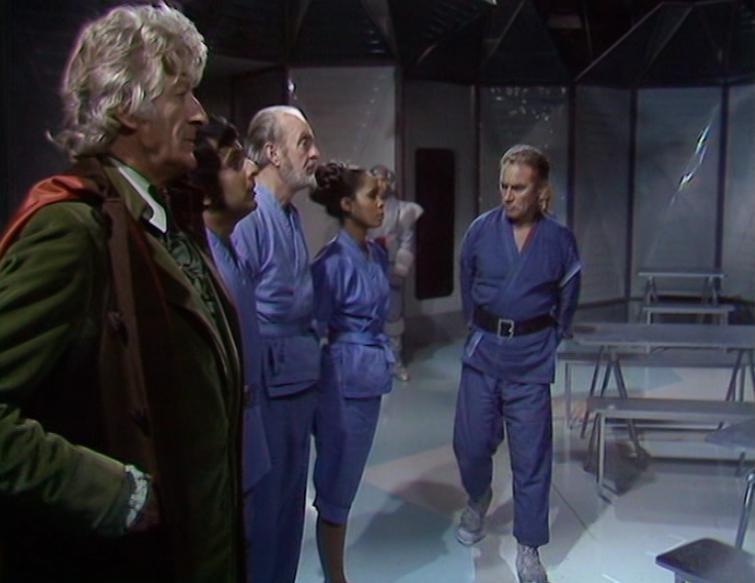
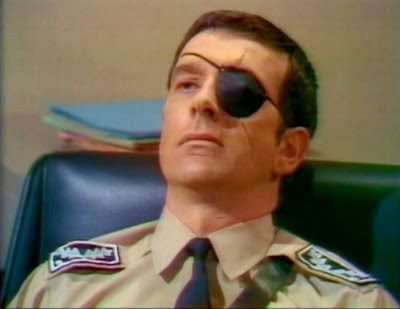
What I love most about this story is just how similar it is to the Terminator films. Rebels going back in time to prevent nightmare future and evil robots trying to stop them. I'd definitely rather watch Day of the Daleks and I think this serial is actually more believable than the Terminator movies. The idea of machines taking over the world is nonsense. Computers don't have minds. A robot, no matter how advanced is no more likely to take over the world than an electric kettle.

On the other hand, while the superficial Terminator similarity is fun, one is painfully aware that not everything is great about this story. For everything that is good about it, there is something that is not so great. It is very much in the middle rank of Doctor Who stories.

Most obviously, the use of the Daleks is not so great. The story was not originally intended to be a Dalek story, but a decision was made at a late stage to write them in. It has been a few years since the Daleks had been used in Doctor Who and the story does not quite seem able to get them right. Their voices are off and they lack menace. We are also denied a scene in which Dr. Who confronts the Daleks. Admittedly, this might be for the better. Pertwee was not the strongest actor to play the Doctor and he felt awkward interacting with the Daleks. It is hard to imagine Pertwee doing an job of confronting the Daleks. The final battle between UNIT and the Daleks is simply awful to watch. Few fights in Doctor Who have been as disappointing.

There are also a few problems with the plot. The whole time travel plot makes little sense. It also seems bizarre that the rebels would blame Reginald Styles for the explosion and not a terrorist group. Was terrorism not the problem that it was for us in the Doctor Who universe?

The Ogrons are an interesting addition as allies of the Daleks, but it is hard not to be uncomfortable with the Doctor dropping his usual pacifist stance and shooting down Ogrons. It's presumed okay to kill them because they are a big, stupid and dark-skinned.

What is great about the story is the moral complexity. The Controller is a villain with genuine reasons for being a villain and is quite understandable. The rebels on the other hand, come across as pretty thuggish. I imagine being right-wing and pro-establishment, I would easily be taken in by the Controller's lies just like Jo.

This is also a serial in which Pertwee is at his best. While he does not get to confront the Daleks, he does have so many brilliant scenes, such as his argument with the Controller and his weary, exhausted interrogation. I'm not much of a Pertwee fan, but in this story, we really see him at his best.

Day of the Daleks is a story with some bold ideas and a radically different approach, even if its execution seems a little poor at times.


Sunday, 10 May 2015

Planet of the Daleks


I watched the re-run of Planet of the Daleks on BBC1 in 1993. I was twelve years old at the time. I think at the time I was disappointed that it was not the original Dalek story. I was a huge Doctor Who fan at the time, but even then I found myself getting bore of the story as I watched the last two or three episodes. It just seemed so long and drawn out. This seems to challenge the argument(an argument I have sometimes used)that the overlong and padded stories can be more easily enjoyed and appreciated when watched over a course of weeks. Planet of the Daleks really is as padded out and tedious as any Doctor Who serial can get.

Planet of the Daleks is basically a re-working of The Daleks, with every one Terry Nation's favorite tropes thrown in for good measure. This is the ultimate cliched Dan Dare space adventure. Carnivorous plants, explosions and the inevitable virus.

Yet it does benefit from the superb direction of David Maloney, who was doing everything he can to make this a decent production. Admittedly, some of the effects are a bit weak, such as the Dalek army model shot. I don't think these detract too much overall from its overall visual strength.

Like so much of the Pertwee era, this story is colourful. I used to like the early gritty Season 7 Third Doctor material best. However, I have come to appreciate the colourful Glam Rock Third Doctor stories that don't really fit with the common perception of the Pertwee years as realistic TV action.

I love Phil Sandifer's essay on Planet of the Daleks. He does a great job of re-assessing it in a positive light. Sandifer points out that Nation does not quite get how to use the Third Doctor and so has him spending much of his time making speeches about the nature of courage:

"So Pertwee does not get to run around and be ostentatiously imperious as he prefers. Nor does he get to be ignored and occasionally tortured, as he's best at. Instead he stands around and gives speeches about the meaning of courage. Pertwee certainly isn't bad at this, but it's neither in his wheelhouse nor something he visibly enjoys."

Yet he argues that Pertwee finds the way to make this work:

"The solution he settles on, however, is perfect: he plays the story with a cool detachment. The result is a perfect postmodern commentary on the episode- as if the Doctor recognizes that he's in an unusually easy adventure of far less complexity than he routinely deals with, and that it does not actually require his full attention. The tendency to make speeches about fear instead of doing what are now the core elements of "Doctory" behaviour becomes not a mischaracterization but a case of the Doctor taking it easy and figuring he doesen't have to work, he can just sit back and encourage everybody else."

I think this is such a beautiful insight from Sandifer. I love the idea of Dr. Who having outgrown this sort of story.

By no means a great story, but I love the fab black and gold Dalek Supreme.


Friday, 10 April 2015

Frontier in Space


Frontier in Space is by no means the greatest of Doctor Who stories, or even the greatest of Pertwee era stories. Yet it certainly feels unique. In large part this is because it pursues the genre of epic planet-hopping Space Opera far more than any other serial. In this story we visit no less than three planets, as well as the moon and various spaceships. In this modern era, when Doctor Who stories are set on Earth, particularly in Twenty-First Century England, this stands out a lot. The mood of this story also feels different, with the rich political intrigue and the heavy political overtones, even if these are a little heavy-handed.

Most significantly, more than any other story, Frontier in Space makes the future feel like a real place. So many things contribute to this, such as the news reports, with their accounts of Finland and Japan. We get the delightful scene with the female president getting a massage. We get buildings that are seen from outside and which therefore do not feel like television sets. We get some nice costume designs, most notably the decision to put Jon Pertwee's Doctor in a prison uniform. This small costume change is such a massive dose of realism. We see the Doctor locked up all the time. We are used to seeing him threatened and in danger. Yet we seldom see him stripped of his visual identity as the Doctor.

The story has other things going for it; a visually interesting set of aliens in the Draconians, a script that plays to Pertwee's strengths and some fantastic performances. Chief of all of these is the superb last appearance of the Delgado Master. Sadly, Delgado would pass away in an automobile accident not long after this was made, but he had saved his best for last. Here we see the Master as the ultimate cosmic manipulator, trying to control events on a galactic stage, but doing it with an ever present sense of humour.

Unfortunately, Frontier in Space does have some significant weaknesses, particularly relating to its plot. Most obviously is the common complaint that Jo and the Doctor spend so much time in this story locked up in one jail cell after another. This feels almost parody of the Doctor Who staple of capture and escape routines. This would probably have been less obvious to the original viewers who saw the seven episodes over a considerable period of time, but it is irritating to those watching the DVD in one sitting. The conclusion is also disappointing and fails to give the Master the send-off he deserves. Yet despite these and other small faults, Frontier has a tremendous sense of grandeur that sets it above many other Doctor Who stories.

This is a story that tends to get overlooked in assessments and overviews of the Pertwee era. Phil Sandifer has pointed out at least once that most people who talk about the Pertwee era don't really appreciate its richness. People tend to view this era through the lens of Season 7 and forget how often the Third Doctor left the Earth. The BBC Wales Doctors have all spent far more time in England then Pertwee ever did.


Saturday, 27 September 2014

Inferno


A lot of Doctor Who stories are padded out to fill extra episodes, but Inferno takes padding to a completely different level. The orginal story about a drilling station and green slime turning people into werewolves would have needed padding to fill out four episodes, but this serial had to stretch to an impossible seven episodes. The ever resourceful Terrance Dicks came up with the idea of filling this out by taking the Doctor to a 'mirror universe' version of the same setting, with Fascist versions of the main characters. Conveniently, this removed the need for new sets and hiring new actors. All it required was a slightly higher costume budget and Nicholas Courtney to spend a bit longer in the make-up chair.

A lot of fans think the idea of the 'mirror universe' is a fantastically clever one. I don't. As Phil Sandifer points out (there is very little in his Inferno essay that I disagree with), the idea of a mirror universe is one that television writers continually turn to. It's a very standard trope. It's not used in a particularly creative way in Inferno. The Doctor's witnessing of the destruction of the mirror Earth does not give him any new insight that enables him to save the regular Earth. It simply feels like a way to draw the story out and we are denied the pleasure of seeing the Fascist characters meeting their other selves.

That is not to say that the Inferno-verse is not fun to watch at times. The actors are clearly enjoying the chance to be evil for a while. Nicholas Courtney is particulary memorable as the sneering Brigade Leader. This is possibly a problem for Caroline John's Liz Shaw. Liz never really had much personality or character development. It is actually only when she becomes a Fascist that she appears to be an interesting character who we want to watch. Furthermore, the Fascist world is never really explored. It never really offers more than a fleeting glimpse of what this world is like. It seems perhaps a little surprising that the royal family were executed in this world. In our world, the British Union of Fascists supported the monarchy and our royal family were hardly left of centre in their views. Perhaps the mirror universe regime is closer to Communism than Fascism. Or more accurately, given the Terrance Dicks input, they are a British version of those nasty foreign bureacratic types that we British patriots all hate and UKIP imagine are running the European Union.


Of course, Inferno has some great direction, thanks to Douglas Camfield, with Barry Letts filling in when the director became ill. This story has some enjoyable moments, but for me it is just too long and bores me. This is not a classic by any stretch.

It has been said that the first four episodes of a new Doctor's run follow a pattern. The first story is a frenzied runaround (Spearhead from Space- not much plot going on), the second story is one more suited to the previous Doctor (Dr Who and the Silurians- the old base under siege) and the third story an experimental new kind of story that is not really repeated (Ambassadors of Death- realistic elements at the forefront and science fiction elements kept in the background). It is the fourth story that defines the new era. With its theme of industrial research, energy sources, green slime, Venusian Akido and pointless car chases, Inferno sets up the Third Doctor era perfectly. All that is missing is Jo Grant and the riotous colours that came in with Claws of Axos.


It does seem remarkable given all the massive historical differences between our universe and the Inferno-verse, that all the main characters are all together in an almost identical scientificc installation. The novel Timewyrm: Revelation offers a handy explanation that this universe has been artificially constructed. I did come up with my own theory as to the nature of the Inferno-verse. In The Chase, the Doctor conjectures that the TARDIS had entered a realm formed from human fears. It seems surprising that the Doctor would suppose that such a psychological world existed and that the TARDIS could take one there, but perhaps the Inferno-verse is this 'land of fears?' Could the Inferno-verse be a sort of projection of the Doctor's own fears about the drilling project? It occurred to me that the Republic Security Force represent the Doctor's anxieties about working with a military organisation. It's worth noting that the Brigade Leader is not that far removed from the Brigadier in personality. Notice the scene in Inferno where the real Brigadier rants at Benton and orders him to act like a bully and to coerce Stahlman. Of course, this theory contradicts the novels in which the Inferno-verse is a real place.


So what is going on with all that green slime? Some of the New Adventure novels hint at the idea, championed by Lawrence Miles, that the Earth is an artificial planet. After the Time Lords first experimented with Time Travel, they unleashed the vampiric Yssgaroth from a hellish other-universe. After Rassilon defeated the Yssgaroth, he fixed up the holes in the universe with artificial planets, Earth being one of these. Thus, the weird green slime that seems to defy the laws of physics is matter from another universe. This is supported by Planet of Evil, in which material from another universe has a similar effect in turning people into werewolves.

I think the Yssgaroth/ Hollow Earth theory fits Inferno perfectly. The very title of this serial captures the idea of hell being underground. The drilling station is not simply causing an ecological disaster, but is awakening demonic forces. Notice that the Primords and Stahlman in particular act like they are under the control of some unseen force. They are being controlled the Yssgaroth, who want to escape and unleash havoc on the universe (no pun intended).

Friday, 11 October 2013

I Destroy Therefore I Am: The Three Doctors


"If I survive only by my will, then my will is to destroy!"


It was perhaps unfortunate that before watching The Three Doctors at the age of ten, I had read the Target novelization. It was disappointing that the Gell Guards did not form into one tentacled mass, as they did in the novel, nor was Omega's palace a fantastic castle, but instead a makeshift door in a quarry. While in the book, the Third Doctor was transported into a giant gladiatorial arena to battle a hideous demonic creature rather like the Destroyer in Battlefield, Pertwee instead wrestled a man in a sequinned catsuit. Thankfully this discovery of the limitations of BBC special effects did not spoil my enjoyment of the serial and they still do not twenty-two years later.

The first Doctor Who story I ever watched was The Five Doctors, so I'm rather used to seeing more than one Dr. Who around. It is hard to imagine what a treat it must have been for the original viewers to see Troughton, Hartnell and Pertwee sharing the screen. The celebration is rather marred by the sadly unwell state of Hartnell, who can only deliver a few lines from a chair. It is impossible not to notice how Troughton's acting outshines Pertwee's. Quite a few of the original viewers must have been wishing that Troughton had stuck around a bit longer.

Like the stories of Season 18, The Three Doctors seamlessly blends hard science with mysticism. It is striking that the story offers a three-decker model of the universe, with UNIT on Earth, the Time Lords in their heaven and Omega in his hellish Pandemonium beyond the black hole. The writers have quite clearly borrowed liberally from William Blake as is demonstrated in Phil Sandifer's beautiful, but barely comprehensible essay on the serial.

I just adore Stephen Thorne's performance as Omega. Doctor Who has plenty of baddies who shout and rant, but Thorne takes it up to a new level. His voice is so rich, even when he speaks softly, his voice booms. I found him rather scary when I fist watched The Three Doctors. He is helped in his performance by the brilliantly designed mask. With its hollow mouth and eyes, emotion can be projected on to it. Depending on Thorne's delivery, the mask looks angry, disdainful, haughty or sad. Omega truly comes across as a pitiable figure.


The Gell Guards have come in for a lot of criticism. While they look a little comical at times, I do like their appearance. They are how I imagine H.P. Lovecraft;s Shoggoths in At the Mountains of Madness. Admittedly, Katy Manning's Gell Guard vocal contributions on the DVD commentary is very funny. The blog creature is one of those less effective Seventies CSO effects. It looks good when going down drains, but when it becomes larger, it is less impressive. Omega's palace is interesting visually, despite looking a little unconvincing. Perhaps the stagey looks is appropriate given the story's Christmas pantomime feel.

While Brigadier Lethbridge-Stewart is rather funny in this story, it is unfortunate that he has become such a figure of fun. He is ridiculously obstinate and pig-headed in The Three Doctors. On the other hand, it is interesting how unhinged he seems to become throughout the story. Was his mental health deteriorating? Mawdryn Undead has the Brigadier undergoing a breakdown. This is explained in-story as a result of the timestreams crossing, but had he already suffered trauma as a result of this experience and others? It would explain the quiet and unglamorous circumstances of his retirement that seems to bother some fans for some reason. He was never meant to be a companion and seems to be seriously effected by TARDIS travel.

Jo Grant seems to have overdosed on Cute and Fluffy pills in The Three Doctors. She might as well be one of those generic anime cute girls that people love to draw on DeviantArt.

As with The Five Doctors, it is implied that the First Doctor is older and wiser than the other Doctors. This does not really fit with the First Doctor era, in which he appears to be a lot less mature and less able to handle situations than his successors. This might be explained if The Infinity Doctors is a pre-Unearthly Child story, featuring a younger Hartnell Doctor. It may be that the First Doctor, unlike the other two, has some memory of the encounter with Omega in The Infinity Doctors and can understand the situation better.

This was a celebration of Doctor Who, but in many ways this is a celebration of the Barry Letts era, with all of the usual tropes- Ineffectual UNIT, excessive CSO, blobby monsters, a bumbling scientist, a yokel and the Time Lords needing Dr. Who's assistance. It is held together by an interesting story. In my judgement, it is a lot better than The Five Doctors which was just a collection of set pieces artfully, but not altogether convincingly scraped together by Terrance Dicks. While I can't bring myself to dislike The Five Doctors, I genuinely do like The Three Doctors and consider it to be one of the more enjoyable stories of the Pertwee era.


Sunday, 22 September 2013

Verdigris, by Paul Magrs


I think Verdigris demonstrates that there is a difference between good writing and good stories.

Some of the writing in this novel is absolutely fantastic. Paul Magrs vividly recreates the Pertwee Doctor, along with Jo Grant. His satirical portrayal of the Pertwee era is very funny, with his lampooning of unconvincing monsters and bad CSO, the lack of characterisation of Mike Yates and the uselessness of the UNIT. This is not as hilariously funny as Mad Dogs and Englishmen, but the writing here is very entertaining.

On the other hand, while the writing is great, the story is not so good at all. The story is basically a sequence of one weird event after another, without much of a semblance of a plot. At times the tone feels altogether too silly. There is a place for silliness in Doctor Who sometimes. Magrs' Mad Dogs and Englishmen was silly, but it felt altogether more grounded than this work. It probably helped in Mad Dogs that Iris took more of a backseat in that story, whereas here she is central to the story.

I am one of those fans who enjoy Iris Wildthyme. I found it surprising how Magrs made her much more obnoxious and unpleasant in this story than in other works. This was perhaps appropriate given how obnoxious the Pertwee Doctor could be. I actually found that pairing the Third Doctor with Iris rather made him a little more likable.

I very much enjoyed the first few chapters of this novel, but halfway through I became very frustrated by the lack of plot progression. This is definitely not Magrs best novel.


Thursday, 8 August 2013

Find and Replace, by Paul Magrs (Big Finish Companion Chronicle)


Having experienced the disappointment of another white male being cast as Dr. Who, it was refreshing to get some Iris Wildthyme. The eccentric female Time Lady (?) is played by Katy Manning, and so with Katy resuming her old role as Jo, she effectively plays two parts, as well as voicing the Third Doctor when he appears.

I really don't care much for the character of Jo Grant, nor am I a fan of the Pertwee era, yet somehow I am drawn to the Companion Chronicles featuring Jo. Perhaps I appreciate the earnestness with which Katy Manning performs them, as well as the creativity with which the writers approach this popular, but difficult era of Doctor Who.

The beautiful cover tells you that you are in for a nostalgia trip on this audio. Indeed, this is very much a passionate celebration of the Pertwee era. You can just feel Katy Manning's delight in her memories of the show as she performs here. When Jo describes the feel of Dr. Who's velvet coat, one feels this is just as much Katy Manning's feeling as the character she is playing. The affection and tenderness displayed in the final parting scene between Jo and the Third Doctor is heartbreaking.


The premise of this story is that Jo, having been parted from the Doctor for over twenty years, bumps into Huxley, a creature called a Novelizer. This Novelizer informs her that her memories have been corrupted. She never knew the Doctor and had instead been a companion of Iris Wildthyme, while assisting MIAOW, the Ministry for Intrusions and Ontological Wonders. Both Jo and Iris are sceptical of this claim and travel back to the 'Seventies' to prove Huxley wrong.

There are so many great elements to this story; the nostalgic affection for the show's past, the fact that every line uttered by Katy as Iris is hilarious and the Novelizer's constant and breathless narration. I have only two real complaints about this story. Firstly, I object to the Pertwee era being called the 'Seventies.' I think those stories were set in the 1980s. Admittedly though, this story rightfully reflects the strong 70s character of the era. I also find it disappointing that Paul Magrs has ostensibly contradicted and effectively upstaged his novel, Verdigris, in which Jo meets Iris. Nevertheless, despite these complaints I found Find and Replace a truly enjoyable and heartwarming listen.

Saturday, 20 July 2013

TARDIS Eruditorum Volume 3: Jon Pertwee, by Phil Sandifer


Once again we review the most recent volume of Phil Sandifer's fascinating psychochronography of Doctor Who. As ever we ask, why buy it when you can read the blog for free? Firstly, the quality of the writing is so much better in the book than on the blog. Secondly, we get bonus essays on Torchwood, the mechanics of the TARDIS and a guest essay from Anna Wiggins.

From the outset, Sandifer admits that the Pertwee era is his least favorite period of Doctor Who. This is something I have in common with him, though my reasons for liking the Pertwee stuff are less political than his. This critical stance toward these episodes enables him to write on them with a very evident creative and reflective tension. His concluding essay on Jon Pertwee's tenure is delightfully nuanced, yet for all that he is able to celebrate those things about the character, the actor and the era that are enjoyable.

The book begins with a very interesting essay on Monty Python's Flying Circus. Phil points out that Monty Python had a sketch entitled Science Fiction Sketch, which comes across very much as an absurd parody of the Third Doctor and UNIT. However, remarkably this was broadcast before Spearhead from Space! Thus, the Pertwee era had been effectively lampooned before it had even begun. This observation sets the theme for much of the book, with Sadifer viewing Pertwee-Who as a sort of unintentional parody of itself.

Phil's leftist politics come out in his strong criticism of the Doctor's involvement with UNIT. He makes two criticisms, firstly that the Doctor so quickly becomes involved with a military organisation. Secondly, that the Doctor remains involved with UNIT after the Brigadier's actions at the end of Dr Who and the Silurians. He feels the Doctor's relationship with UNIT ought to have ended then and any criticism in that story is muted by this failure to disengage. He is also uncomfortable with the patrician demeanor adopted by Pertwee.

The essay on The Ambassadors of Death is primarily about David Whitaker, being his last story. It is an affectionate tribute to one of the most fundamental creators of the show. Phil is much more critical of Inferno, a story that gets a lot of undeserved praise from fans. I very much agree with Phil's preference for the former story.

Sandifer does not view Season 7 as a distinct era of Doctor Who, as some fans do. He does, however, make a distinction between 'Action Pertwee' and 'Glam Rock Pertwee.' The former is basically a straightforward action thriller styled science fiction story. The Mind of Evil is perhaps the best example of this. Phil is very critical of this kind of story and seems to feel it is too great a departure from the ethos of Doctor Who, as well as tending towards a dangerous moral simplicity. 'Glam Rock Pertwee' is a rather more complex beast. It is a kind of colourful composition of action and exotica that is absolutely serious, yet somehow feels like a pastiche. Sandifer views The Claws of Axos as the defining example of this genre, with each character playing a clearly defined role that on the surface appears absurd.

I was glad to see that Phil finds things to like about The Time Monster. It's a terrible story, yet he recognises that it has a fascinating combination of Platonism and Buddhism. His essay on the mechanics of the TARDIS also explores the alchemical properties of the Doctor's ship. I found the essay on David Bowie's music and it's thematic similarities to Pertwee-Who very enlightening, particularly as I have never been a Bowie fan.

Phil's essay on The Three Doctors is a marvel. He refers to Doctor Who characters by names taken from William Blake's mythological works. It's beautifully written, but I'm not sure I understand it. I do wish Phil would write a more straightforward essay about Blakean themes in Doctor Who for the benefit of more matter of fact people like me. Anna Wiggins, adds a little clarity to what Phil is trying to do, but her piece is not aided by her unfamiliarity with Blake. I would love to have a better understanding of what Phil is trying to say in his comparison of Blake and Doctor Who.

Unsurprisingly, Carnival of Monsters gets a lot of praise from Phil. It is definitely his favorite story of the period. It is of course, completely different anything else in its era. I would suggest that it feels more like a Season 24 story. Phil seems impressed with Frontier in Space, despite the problem of the Doctor spending much of the story in various jail cells. He comes up with an interesting redemptive reading of the underwhelming and rather tedious Planet of the Daleks. He points out that Terry Nation does not really capture the Third Doctor's usual persona:

"So Pertwee does not get to run around and be ostentatiously imperious as he prefers. Nor does he get to be ignored and occasionally tortured, as he's best at. Instead he stands around and gives speeches about the meaning of courage. Pertwee certainly isn't bad at this, but it's neither in his wheelhouse nor something he visibly enjoys."

Sandifer suggests that Planet of the Daleks is the kind of old fashioned space adventure that the Doctor has outgrown. Now that he is capable of dealing with more complex stories, he can take a back seat and just make speeches about courage and leave the heroism to others.

I was glad to see that The Green Death came in for some criticism. This story tends to get let off easily by fans, despite its shortcomings. While praising The Time Warrior, Phil savages it for its sexism. He finds little to praise and much to criticize in the (in my opinion barely watchable) Season 11.

I am a bit puzzled by Sandifer's handling of Jo Grant. He attacks the sexism of Terrance Dicks which led to her creation. However, he seems to offer some sort of redemptive reading, describing her as 'alchemical' and claiming that she subverts the narrative structure of the stories. I'm not quite sure what he is talking about. This seems to be an example of our author getting lost in his nether-world of radical literary theory and losing the rest of us. That said, this volume is yet another interesting read from Phil and I must say I can't wait for the Tom Baker volume.

Monday, 13 May 2013

The Scorchies (Big Finish Companion Chronicle)


Given the importance of Doctor Who as a children's television program, it is very appropriate that Big Finish did a story about classic children's television.

The titular fictional show, The Scorchies, is a sort of amalgam of the Muppets, Bagpuss, Blue Peter and The Clangers. However, the Scorchies are not merely puppets, but an alien intelligence bent on taking over the world. In a bid to stop their evil plans, Jo becomes trapped in their colourful television studio.

I must confess, I actually found this story very frightening and disturbing. The idea of cute puppets on a children's show being murderous and evil was really unsettling. Yet despite this sense of eeriness, I still found it hugely fun and enjoyable. I loved the use of music. The song 'Jo is making a thing' is really catchy and 'The Doctor's Dead,' with its references to enemies of Dr. Who, is hilarious. I also loved the reference to Delia Smith being a celebrity guest on the Scorchies Show.

Jo is one of my least favorite companions, but this is a story that really suits her. Being quite a childish character, she fits into the world of the Scorchies, a world that is very much in the background of the Pertwee era. Katy Manning does a great job of evoking Pertwee's voice, an impersonation that is resonant with her personal affection for the late actor.

My only complaint about the story is that Jo never sings a song. We are told that guests on the Scorchies Show have to tell a story, make a thing and sing a song, yet Jo only does the first two things. The absence of Jo singing a song feels conspicuous and disappointing. We know Katy Manning can sing, because she sang (as Iris Wildthyme) in The Wormery. Nevertheless, The Scorchies is definitely one of the best Big Finish audios I have heard.

Sunday, 3 March 2013

The Time Warrior


"Why don't you take off that ridiculous gear and go home to your butcher's shop!"


I watched this story on VHS in 1991 when I was ten years old. I think it might have been a birthday present. It was a story I was very keen to see back then and I enjoyed it a lot. When I bought the DVD, I expected to be a good deal less impressed and to find lots of faults with it (after all this a Pertwee/ Letts story!). Nevertheless, I was surprised to find myself enjoying it as much, if not more than I did aged ten.

It is this story which pretty much chrystalizes the pseudo-historical genre. It is perhaps unfortunate that this kind of story has become thought of as almost the default mode for Doctor Who (hence that dull runaround, The Visitation), yet here most of the elements involved work well. The story has something of a theatrical feel and though this is at odds with what the show often tries to do, this adds enormously to the charm and effectiveness of this serial.

What is most delightful about The Time Warrior is Robert Holmes' glorious script. Watching it, one feels as though every single line is priceless and more than half of them get a laugh out of me. Even more importantly, Holmes gives us a great cast of characters.

Linx, our first introduction to the Sontarans is also the best appearance of that race that we have seen in Doctor Who. Not only is his mask brilliantly realized, but Kevin Lindsay creates this character masterfully, offering not only a great vocal performance, but a real sense of an alien physiology in the way he moves. He is also, as some people have pointed out, a counterpart to the Pertwee Doctor, being stranded on Earth and acting as a scientific adviser to a bunch of soldiers.

Linx is made even more interesting by the fact that he is given an human counterpart in Irongron. Though Linx is an alien and Irongron is an Earthman, they are remarkably similar characters in their relish for military glory. Notice how their behaviour mirrors each other at the beginning of the story. When Irongron sees the 'falling star' he claims it as 'Irongron's Star.' When Linx steps out of his spacecraft, he claims planet Earth for the Sontaran empire. Every single scene shared by Irongron and Linx is a joy to watch. Their is such a beautiful chemistry between the two contrasting, but not dissimilar characters. As much as they may hurl insults at each other and desire the other's death, I am quite convinced that they both have a fondness for each other deep down.

Other characters are enjoyable too. Just watch how Blood Axe adores his captain! June Brown as Lady Eleanor is pleasantly Shakespearean in her performance. Rubeish is a little silly, but still fun. I don't know why Alan Rowe gets criticized in a lot of fan reviews for his performance as Sir Edward. The character he is playing is supposed to be rather pathetic and this comes across.

The Time Warrior is notable for the first appearance of Sarah Jane Smith, generally considered the most popular of companions among fans. Her portrayal is somewhat problematic, as Phil Sandifer argues on TARDIS Eruditorum. The presence of a feminist companion results in the Doctor becoming rather more sexist and patronizing than he was before. Sarah also comes across as remarkably stupid. Why on Earth does she conclude that Dr. Who is a spy? She sees him in conversation with the Brigadier, so it should be obvious to her that he is in a position of trust with the Brigadier. Spies generally try to be inconspicuous, yet the Doctor has a police box with him and flaunts bizarre gadgetry for everyone to see. There is an horrible sense that the viewer is being made to laugh at the stupid trendy modern girl.

There are other flaws to this story, most obviously the padded plot. The robot subplot feels unnecessary, as does the need for a final return trip to Irongron's castle. As with a lot of Doctor Who stories, there are a fair few holes in the plot. Some of these can be explained. I quite like the suggestion of Tat Wood in About Time that Sarah Jane Smith is working for UNIT as an investigator. This would explain how she breaches security so easily.

Linx's comment about Sarah's thorax was rather an eye opener for me when I watched this aged ten. Prior to this I had never noticed the different construction of the female thorax. Doctor Who can be educational!

The Time Warrior is simply one of the most enjoyable Doctor Who stories of the Seventies and one of the best of the Pertwee/ Letts era.


Saturday, 9 February 2013

Ambassadors of Death


Ambassadors of Death is not the most highly regarded stories of the Pertwee era. It is not among the most well remembered stories of this period and is often considered to be the weakest story of Season 7. This is a real shame, as it seems to me to be among the best Pertwee serials (a short list in my opinion) and is a strong rival to Dr Who and the Silurians as the best story of Season 7.

What is so striking about Ambassadors of Death is how unlike typical Doctor Who this story feels. This story keeps its science fiction elements to the barest minimum possible since the era of Pure Historicals. We get only fleeting glimpses of the alien race and their spaceship. Instead of such fantastic trappings, the serial focuses on the more gritty and realistic elements of a near future society. This is a story foremost about brutal thugs, corpses being buried in quarries, paranoid generals and a space program that seemed realistic at the time. There is something very odd about watching the gun battle between UNIT and Carrington's goons- it feels like a different show with nothing to do with Doctor Who. This is the basic premise of Earthbound Season 7 taken up to the maximum level.

The influence of James Bond is apparent, with the presence of a multitude of gadgets, endless fights and escapes. Yet the serial strives to be much more than just Doctor Who doing James Bond. This is a story about the dangers of paranoia, xenophobia and militarism. But more than this, Ambassadors of Death is a story about the nature of space exploration. The influence of The Quatermass Experiment will be apparent to the educated viewer. The serial borrows many visual elements of Quatermass, such as the empty spacecraft and the sense of the mysterious otherness of the cosmos beyond our planet. Yet Ambassadors does not subscribe to the Quatermass view that outer space if a realm of of abject terror. The story offers the hope of peace between different planets. Nevertheless, Ambassadors portrays outer space as a realm of mystery beyond human comprehension. Ambassadors raises the question of whether humanity is ready or able to deal with that world of mystery. The trauma and mental breakdown of Carrington suggests the conclusion that humanity is too petty and small in its concerns to face the beauty and magnificent wonder of space.

This is a story on an epic scale, taking us from a futuristic space centre to country roads and even to the vastness of space. It has production values that match this sense of scale. Watching it, I am struck at just how well everything is realised visually, even with the unfortunate continuity errors like Liz's hair-length and choice of tights. This is a story with plenty to look at and it does not let us down. With the addition of Havoc to the team, we get some wonderfully well orchestrated fights.

Ambassadors offers us some fantastic guest performances. Ronal Allen is memorable as the controller, Ralph Cornish. In a much smaller role, Michael Wisher, the future Davros, is astounding as the news correspondent. There is a beautiful intensity to his delivery of every line. John Abineri also gives a really subtle performance as General Carrington. Doctor Who has plenty of crazy villains, but Carrington is one who has clearly suffered a deep psychological scarring, and this comes across in his performance.

It is Reegan, however, who steals the show and becomes the most memorable hired thug in the history of Doctor Who. What is shocking about Reegan is the sheer casualness to the way he kills people. Unlike other Doctor Who toughs, he does not get angry and point guns at people. He is absolutely in control of every situation, even when he is finally dragged away. He has no big ambitions like taking over the world; he just wants to exploit the situation and make money. Just look at his excitement at the thought that he can break into banks at leisure- he looks like a child in a toy shop! The novelisation gives him a fitting background; he was an IRA terrorist who helped himself to the funds.

Pertwee seems a lot more settled into his role in this story than in the previous two serials. He plays it absolutely straight and it comes off well. I am not a fan of Pertwee's Doctor and he is obnoxious in quite a few places, such as his rudeness to Cornish. Caroline John's Liz gets a few good moments, but as with other stories, her character is horribly underused. She is mostly there to get captured and to escape.

Ambassadors of Death is by no means perfect. While the fights are great, I think it could have done with a lower body count. Doctor Who should not trivialize the death of characters, as it too often does. The story is a bit padded and probably became wearying over the weeks. The motives of Tatalian are also a bit unclear. I don't think this is the best story of Season 7, in my opinion Dr Who and the Silurians has a stronger plot. I do think, however, that it is better than the rather overrated Inferno. Compared to this serial, Inferno feels hopelessly like a standard Doctor Who story with green slime and a monster of the week.

Thursday, 17 January 2013

Interference, by Lawrence Miles (BBC novel)


Do you remember the Nirvana song In Bloom? In that song, Kurt Cobain sneered at the listener who:

likes all our pretty songs
And he likes to sing along and he likes to shoot his gun
But he knows not what it means
Knows not what it means

I imagine I'm probably the equivalent reader of Lawrence Miles' books. I love Lawrence Miles books and count myself a fan, but I suspect I haven't really understood what they are about. I also suspect, in the unlikely instance of Lawrence Miles ever reading this blog, that he would hate the fact that a Tory like me, who stands for everything he is against, is a fan of his work. So I'm an odd fan for Lawrence Miles, and possibly not the best person qualified to review his work.


Interference is uniquely for a Doctor Who novel, published in two volumes, Shock Tactic and The Hour of the Geek. It seems very surprising that BBC books were willing to do this. This is certainly a novel written on a grand epic and cosmic scale, but it has to be said that it is overly long. The first volume is very slow moving, with the plot unfolding at a snail's pace. The Doctor in particular, spends a good deal of the first volume imprisoned in a jail cell, contributing little to events. The second volume is faster paced, but the whole novel is in much need of trimming down a bit.

While Interference is overly long and poorly paced, it is undeniably well written and of a much higher standard than a lot of Doctor Who novels. Miles switches between different genres; diary entries, movie scripts, television documentary dialogue as well as more standard novelistic prose. A couple of scenes are cleverly turned into film and television drama, with one character described as being played by Nicole Kidman and another by Wesley Snipes. In a particularly glorious chapter, the Dark Times of Gallifrey are retold as a BBC costume drama with Rassilon played by Brian Blessed!

Interference does all the things that I love about Lawrence Miles books. There is the cosmic sense of scale, the playful use of continuity and the grappling with big intellectual ideas. I think Miles does better with these things in his other novels, but I enjoyed them no less in this work.

Interference is very political. It deals with the issue of the arms trade and how British companies were selling electro-shock batons in the late nineties. While I am not against the arms trade in general (it does play a pretty big part in our economy and every country needs an air force), I think everyone ought to agree that this country should not be exporting torture equipment. Lawrence Miles deserves credit for spotlighting the issue.


The novel has generated a lot of controversy for the way it re-writes Doctor Who continuity. As a result of the intervention of Faction Paradox, the Third Doctor regenerates before his encounter with the Great One on Metebelis 3 and as a result of a gunshot wound. This is a really interesting trick, even if it falls foul of my own dislike of 'timey-wimey' (I hate that word) stuff. Whatever one's opinions of Miles subversive retcon, he does a beautiful job of portraying the Pertwee Doctor. His classic regeneration line, A tear, Sarah Jane? is made even more poignant when he follows it with This is wrong. In a typically postmodern touch, Miles has the Third Doctor observing that the story he is in does not feel like one of his typical adventures.

Miles' portrayal of the Eighth Doctor is a little more problematic. He does next to nothing in the story. He spends a major part of the first volume suffering brutal torture in a Saudi Arabian prison. I'm not quite convinced by the idea that the Doctor would be completely helpless in the situation in which he is placed. In all his adventures, has he never experienced the kind of random brutality that overwhelms him here? That sort of thing is pretty common on Earth, so I don't see why other worlds have not cottoned on to the idea of random brutality.

The Doctor's prison cell discussion is very interesting. He admits to his cellmate that he interferes on future colonies, but he never interferes on Earth without being able to give any rational reason why. I don't buy this. In my opinion, the reason the Doctor does not interfere on Earth is because he knows he can't change history, not one line. When the Doctor interferes in the future, he is not changing history, but participating in it. His knowledge of the future is not exhaustive, so he has no reason to worry about failure on his part. If he tried to overthrow Hitler in 1938, he would know his failure was inevitable. He has no idea of the fate of Terra Alpha, so he can try to overthrow Helen A without worrying about the consequences.

Sam is handled very well in this book. She is given real depth of personality. The only problem is that she ends up looking a bit stupid. Compassion suggests to Sam that if she is against electro-shock batons, she should also be against matchsticks, as they can also be used to torture people. I can't believe any intelligent person would be unable to see a logical flaw in this proposition. Strangely, Sam does a lot of running around in high heels for somebody who is not used to wearing them. I loved the use of the older Sarah Jane Smith in this story. She is given a personal life and an identity beyond her travels with the Doctor. She also interacts nicely with Sam. I am not a K9 fan, but he was great in this too.


Interference is an overly-ambitious work that has some problems, but I enjoyed it as much as any of Lawrence Miles' books. The cameo appearance of Iris Wildthyme is a nice treat too.

Saturday, 5 January 2013

The Daemons


I first watched The Daemons in when it was repeated on the BBC in 1992. I was eleven years old at the time. I remember my parents being a little concerned about whether it was morally wholesome, with its depictions of Satanism. I remember sharing their concern. Even though I was keen on Doctor Who at that time, I don't remember enjoying it all that much.

The Daemons has a reputation of being a classic, a pinnacle of Seventies Doctor Who. While the story benefits from its beautiful location filming, I really don't see what is so amazing about it. Phil Sandifer has claimed that the New Series has far superior writing and direction than anything in the Classic Series. I don't feel able to dispute the point; I haven't taken a course in media studies and I don't watch television. I don't even own a television. I have absolutely no idea what makes good television. But I think it is fair to say that a lot of classic Doctor Who has been vastly overrated by fans and when held up to scrutiny often shows glaring failings.


To a large extent, The Daemons is Quatermass and the Pit relocated to an English village. I vastly prefer the Quatermass story to this. That story felt eerie and disturbing. The Daemons fails completely to generate the menacing atmosphere of Quatermass and the Pit. The Daemons feels far too cosy. I also prefer the choice of the Quatermass story to give the ancient aliens an insectoid appearance. Making Azal look exactly like a traditional image of Satan is the kind of crass literalism that treats the viewer like an idiot. It's the same crass literalism that requires the Kaleds to look like Nazis and wear Iron Crosses in Genesis of the Daleks.

In Quatermass and the Pit, the ancient aliens are long dead. They are kept at a distance from the viewer, which adds to the sense of eerie mystery and avoids the difficulty of portraying terrifying cosmic evil on the screen. In contrast, in The Daemons, the devil makes a personal appearance and what a letdown he is! Satan turns out to be just another alien. Dr. Who facing the devil ought to be a glorious moment, but we've seen alien races before, but this one is defeated without any effort. There is something utterly soul crushing about the lazy and stupid resolution to this story that matches even the banality of reducing Satan to just another lame monster.


As mentioned above, one of the great strengths of the story is its delightful use of an English village as a location. Unfortunately, the script gives us an appalling set of stereotyped yokels. There are no real a characters among them. They are just a mob. They can be inspired to burn witches simply by the quotation of Scripture. Seriously, how often did witches get burned in Twentieth Century English villages?

Miss Hawthorne is the only real character, other than the regulars. Given her obsession with the Devil and her cosy relationship with the previous vicar, one might have expected her to be an eccentric and over-zealous Christian rather than a witch. She certainly comes across more like a middle-class High Anglican spinster. I suppose having a character with a real Christian faith would raise too many awkward questions about religion.


Although this serial is uniquely a five-part story, it has all the padding of a six-parter. The story is basically gearing up for the big confrontation at the end, but it takes a very long time to get there, with all the nonsense about the heat barrier and the repeated attempts to kill Dr Who. The story feels just too elongated to be really enjoyable.


I don't care much for Jon Pertwee's version of Dr Who, but in this story he is especially annoying. He is so rude, arrogant and patronizing! I want to scream when he tells Jo off for being rude about the Brigadier! And then when Jo saves his life, he does not even bother to thank her. Fans endlessly quote the Brigadier's line about five rounds rapid, but this rather obscures the fact that for most of The Daemons, the character is left standing around.

We do get a lovely performance from Delgado. He never let us down. That said, as a mastermind manipulator, he falls rather short in this. He gathers together the locals to persuade them to join his side. How does he do this? He accuses them of various misdeeds, than insults them and then starts telling them to obey him or he will destroy them. Don't bother running for the local council, Master.


Perhaps I am a bit harsh in my judgement of this story, but it does seem to get a lot of undeserved praise from fans. I do think the production team deserve praise for their ability to come up with Earthbound stories like this one, without ending up with variations on mad scientists and alien invasions. This may not be the most original story, but it does make creative use of the Doctor's exile on Earth.

Saturday, 7 April 2012

Rags, by Mick Lewis (BBC novel)


Rags appears to aspire to be the most violent Doctor Who novel ever. It certainly succeeds. We are treated to chapter after chapter of savage and graphically described violence. People are butchered, sometimes by people they know. Every character is affected by the primal urge to fight and kill, except the Doctor, of course. Generally, I dislike strong violence in Doctor Who, however, I accept that Rags is a book that could never have been written without the shocking graphic brutality it is given. I doubt that it had many young readers, fandom at this period in Doctor Who having become a more mature company.

This novel is about punk rock. That in itself is an interesting topic because until the McCoy era, there are no visual references to punk in Doctor Who. The show and its writers appear to have largely ignored the punk movement when it was at its most prominent. While the New Adventure novel No Future dealt with the DIY performance side of punk, this novel deals with the nastier, more disturbing side of the movement and how the music was associated with a savage urge to deal out physical violence.

The real pleasure of this story is seeing the world of the Third Doctor era turned upside down. The kind of realistic violence we see here just didn't happen in Third Doctor stories. Best of all is what the author does with Jo Grant. We see Jo get into punk rock, smoke a joint and share a lesbian kiss. This is Jo Grant as you have never seen her! Mike Yates is as daft as ever and wears an appalling disguise as an hippy. Yet strangely, he is show to be rather useful in hand-to-hand combat.

While I certainly enjoyed reading Rags, I was very conscious of its flaws. It feels very much like it is a little too derivative of other novels, particularly in the New Adventures range. It almost feels like an ironic tribute to the Virgin New Adventures. It's plot is also a little too stodgy and slow paced. I also felt that the incident with Princess Mary was oddly handled. This was a massively significant event and its implications were barely touched on this novel.

On the whole I was disappointed with the way the Doctor was handled. He is described accurately, but he lacks the colour he might have been given. I would have liked to have seen him vent some snooty disgust at punk rock music. Unfortunately, he is written out of a good deal of the action and spends time in a kind of dreamscape (New Adventure cliche!). The way he stays out of the action and he keeps his plans to himself actually adds to the Virgin New Adventure feel of the story, but unfortunately fails to make it engage as a Third Doctor story.

The subplot with Kane and his family secrets felt somewhat out of place; this was very much supernatural horror territory. While this subplot was written well, it very much felt like a distraction from the much more interesting socio-political exploration of the punk theme.

Rags is an interesting installment in the BBC Past Doctors range and does something quite different, but perhaps fails to be a great Doctor Who novel.

Monday, 19 September 2011

Terror of the Autons


"I refuse to be worried by a renegade like the Master. He's an unimaginative plodder."

It is unfortunate that script editors in various eras of the show did not share the opinion expressed above. If they had, we would have been spared endless tedious stories about the Master coming up with yet more ludicrous and uninteresting schemes. As I have said before, giving the Doctor an evil opposite number was an all-round bad idea. It made for lazy script writing, it gave us really uninteresting stories like Time Flight and it removed any ambiguity from the Doctor's character by making him into the knight in shining armour.

While the Master is deeply enjoyable in Terror of the Autons, the problem with this character is apparent. He lacks any convincing motivation for his actions and his scheme seems half-thought out. The Doctor points out the flaw in his scheme at the end and he immediately changes sides. A lot more of this sort of thing was on its way.

This story marks big changes to the UNIT format- the change of the uniforms, the introduction of the hopelessly drippy Captain Yates and the transition of the Brigadier to comic opera buffoon. These changes were very much for the worse. The harsh and bleak realist vibe of Season Seven was squeezed out in favour of a much lighter tone, but without any reduction in the horribly high body counts. It began to look like Dad's Army, except with people actually getting killed.

The departure of Liz Shaw and her replacement by Jo Grant was also one of the changes introduced in this story. Liz Shaw was never well developed as a character and the miniskirts she was dressed in did not serve her well, nevertheless her departure is saddening. I am one of those that despise Jo Grant;s character. The way she comes across as so child-like is incredibly annoying.

The Third Doctor was arrogant in Season 7, but in this story he becomes particularly obnoxious. Particularly, as he is given a stupid young woman that he can constantly patronise. It also turns out that the Doctor is a patrician who attends private clubs with government ministers. I'm a Tory myself, but I don't particularly care for the Doctor being an establishment figure, regardless of my own politics. It has been suggested that Holmes did not really intend this to be the case; the Doctor was supposed to be making up that nonsense about knowing the minister, but Pertwee misunderstood this and played it as sincere.

Terror of the Autons is not blessed with a strong plot. It feels like a move from one set piece to another. The way it delights in one clever form of killing after another feels gimmicky. It is unfortunate that the creators of the BBC Wales series felt this was the way to do Doctor Who, hence such absurdities as robot Santas and Sat-Navs that kill people. It has been argued that there is a form of satire going on in Terror of the Autons, with the tastelessness of plastic consumer products being shown up. This would be rather more meaningful if it were people that bought plastic products being killed by them, but the plastic chair kills a man who thinks it looks tacky and the troll doll kills a man who thinks it looks hideous.

I'm not sure the Nestenes needed a return after Spearhead from Space. As I argued with regard to that story, the Nestenes don't quite feel believable. Everything about them seems tailored for invading Twentieth Century Britain. It is impossible to imagine the Nestenes having an existence independently of a UNIT story. They are a plot device for writing gimmicky stories.

On the positive side, Michael Wisher gives an impressive performance as the young factory director. His relationship with the charismatic Master is very well accomplished.

A lot of fans regard Terror of the Autons very highly, but I'm afraid it's really not my cup of tea.

Monday, 1 August 2011

Spearhead from Space


I think I first watched Spearhead from Space when I was eleven years old. The day I watched the recently re-released DVD, I started reading The Adventuress of Henrietta Street, by Lawrence Miles, the first chapter of which features prostitutes offering Tantric sex. The variety of depth and scope in Doctor Who is just breathtaking.

The Pertwee era is definitely one of my least favorite parts of the Doctor Who legacy. Nevertheless, I can't help sharing the sense of excitement and anticipation that Spearhead from Space exudes. Coming right after the slightly repetitive format of the Troughton era, Spearhead from Space feels new and fresh. This is heightened by the fact that it was shot on entirely on location using film. This gives it a delightfully cinematic look and feel. I do wish more stories from the Pertwee era had been made this way.

The full revelation of the new Doctor is delayed for the first two episodes. In the meantime, we are re-introduced to the already familiar Brigadier Lethbridge-Stewart. Nicholas Courtney takes to his new role as a regular wonderfully. He is entirely removed from the buffoon that he would become in later stories. He is joined by Cambridge scientist Liz Shaw. Her scepticism and reluctance makes a nice contrast with the Brigadier's familiarity with alien menaces. This makes for a kind of Mulder and Scully team that might have actually worked in the absence of the Doctor. The mistake of later writers would be to make the Brigadier into the Scully figure, which was absurd as weekly encounters with aliens ought to eradicate anybody's scepticism.

Caroline John's performance as Liz is quite excellent. She comes across as intelligent and sophisticated and her sarcastic wit is amusing. Unfortunately, her character was never given sufficient chance to develop. She was also unwisely dressed in miniskirts that seemed to detract from the seriousness of the character. Part of me rather wishes we had seen her being searched on arrival at UNIT HQ.

John Pertwee was never the strongest actor to play the role of the Doctor, yet he comes across as fairly likable in this story. Robert Holmes does seem to be writing more for Troughton and at times one can see Pertwee attempting to mimic Troughton's style. Pertwee was clearly not at ease in the role at this point, nevertheless he is enjoyable. He comes across like Mr. Toad in Wind in the Willows in the way he borrows a motorcar.

We get some great guest performances in this story. Hugh Burden is superb as the sinister Channing. John Woodnutt comes across as wonderfully oppressed as Hibbert and Derek Smee is convincingly terrified in the role of Ransome. Neil Wilson also gives an enjoyable performance as the not altogether pleasant poacher.

As regards the Nestenes and their Auton servants, I'm afraid I can't really believe in them. We are told that they have been colonising planets for a thousand million years. The Virgin New Adventures gave them a Lovecraftian twist by identifying the Nestene Consciousness as the offspring of the Great Old One Shub-Niggurath. Nevertheless, all we ever see of the Nestenes is them using various infiltration tactics involving plastic objects. They seem to be a race perfectly adapted to invading Twentieth Century Earth, but as far as we are aware, have no conceivable activity beyond that. I can imagine the Daleks burning planet after planet to cinders. I can imagine Rassilon battling giant vampire bats. I cannot, however, imagine the Nestenes doing anything other than using plastic to invade Twentieth Century Earth. It does seem to me that the Nestenes have something of a gimmicky quality to them that does not make for convincing science fiction.

While the Nestenes might not be altogether believable as an alien race and a little gimmicky, in this story they do have the capacity to terrify. The scenes of the Auton approaching the UNIT van and menacing Mrs Seely are genuinely scary. It is rather surprising that the shot of the blood on the smashed windscreen was allowed in. Personally, I feel that was a little too horrible.

The biggest failing is the plot. The various elements, the walking dummies, the attempted kidnap of the Doctor and the waxwork dummies don't quite hang together very well. The Nestene strategy does not make a huge amount of sense and there are numerous holes in the plot. The ending feels rushed, with the Doctor simply building a gadget to kill the Nestenes.

Many fans are uncomfortable with the Doctor's new role working with a military organisation. Philip Sandifer at TARDIS Eruditorum argues that the problem is not so much that the Doctor does end up working with UNIT, but that he actively seeks them out without exploring any other options. This might be explained by the fact that Lethbridge-Stewart immediately seeks out the Doctor after his regeneration. It is likely that the Doctor is influenced by the things he encounters after he regenerates, for instance, the Fifth Doctor being taken by the cricket gear in Castrovalva. I also think that there may be an unseen adventure that the Second Doctor had with the Brigadier prior to The Invasion.

Although Pertwee's gurning at the end is rather hilarious, the tentacles really do look quite impressive. Spearhead from Space is on the whole, a good start to the Pertwee and UNIT era.

Wednesday, 11 May 2011

Saturday, 12 March 2011

The Five Doctors


What? No, not the comfy chair!

This is the first Doctor Who story I ever watched (barring about five minutes of The Curse of Fenric that terrified me). The BBC video was released not long after I had taken an interest in the show and my mother bought it for me. Not having become a fan while the show was still on television I can say that there is no one Doctor that I saw first (hence I feel that the New Adventures Seventh Doctor is "My Doctor"). It is interesting how many other fans watched this story before any others. For those who saw the original broadcast, this is a testimony to the publicity this story generated at the time.

Creating a story to include five Doctors plus six companions, the Master and a bunch of old monsters was a rather ludicrous idea. Unsurprisingly the plot suffers enormously and we are left with characters with little to do, a party-trick scenes and very little of the interaction between the Doctors that made The Three Doctors so enjoyable. It is a testimony to Terrance Dicks' writing skills that he makes it work as well as he does. Terrance Dicks is the disaster management guy of Doctor Who. Need a story writing with little budget and little time? He will always save the day.

There is a real celebratory feeling about The Five Doctors. It is fun and it is goofy. In fact it smacks you in the face with it's goofiness. I am certainly not one of those fans who enjoys watching bad Doctor Who. If a story is absolute garbage, I am not going to waste time watching it again. Yet with the The Five Doctors, I cannot but help enjoying the sillier scenes in this, such as the First Doctor and Tegan hiding from Cybermen who are right in front of them, or Sarah needing to be rescued after rolling down a gentle slope. The Five Doctors challenges you to dislike it and wins every time. One almost feels that the production team are aware of how naff it all is and are sharing the joke with the viewer.


Take the scene in the council chamber where the Master is brought in. It's a dull and heavy expository scene with lots of dialogue. The actors are trying to do Shakespeare, but are ending up with dull Doctor Who and even manage to muddle up that line about the clause in the constitution. Borusa looks a bit embarrassed, Flavia looks incredibly bored, the Castellan finds it rather funny and the Master is hilariously camp. It's hardly well done, but somehow there is a magic to it.

The unavailability of Tom Baker is perhaps not so unfortunate as it seems. It's hard to imagine Tom Baker being happy being slotted into a few scenes and not being given the chance to dominate the whole thing. Terrance Dicks in the commentary, points out a number of ways in which Tom's absence made the writing process simpler. The scene taken from Shada is really nice, in fact, I think it's the only decent scene of Shada that survives. The original broadcast edition of The Five Doctors raises continuity issues in relation to Shada that make it's canonical status problematic. I don't mind if Shada is left out of the canon at all. Fans imagine it would have been the redemption of Season 17, but what is left of it looks like garbage to me.

The absence of William Hartnell is a problem. I find it hard to forgive John Nathan-Turner for choosing to use an impersonation of Hartnell. Can you imagine it being done with an impersonation of Troughton or Pertwee? You can't. Fans would never forgive such an insult. Yet because of the low regard with which Hartnell and his era was held, it was felt that somebody could just pretend to be Hartnell. I get really annoyed when people say that Richard Hurndall is just like Hartnell. Hurndall tries hard and gives a good performance, but he does not capture the original Doctor. This is not just his fault. Terrance Dicks never wrote scripts for the First Doctor and you can tell because he fails to capture his character completely. The First Doctor was not just a bit grumpy and short-tempered. He was full of life, humour and curiosity. There is none of that richness in either the script or in Hurndall's performance. I simply cannot imagine the First Doctor wanting to wait in the TARDIS instead of going straight to the tower to solve the mystery. The Five Doctors also makes the mistake of thinking of the First Doctor as being older and wiser than the others. This is not the case. The First Doctor was actually the least mature and sensible of any of the Doctors, except the Sixth. He was like a teenager in an old man's body. Terrance Dicks simply did not get the First Doctor.
I do enjoy the First Doctor's chemistry with Tegan. The two of them really get on! Never mind Season 6B, I want to see Season 3B/20B where Tegan becomes a companion of the First Doctor! If you think the Sixth and Peri like to argue, you ain't seen nothing yet.


Susan is also handled dreadfully. I know Carole Ann Ford was not a great actress, but there was an ethereal beauty to her performances in season 1. She was never well used by writers then and on her return, Dicks cannot think of anything to do with her other than have her twist her ankle. This looks especially ridiculous because she is wearing flat boots, while Tegan is skipping across the moorland in high heels. As I suggested before, Tegan's ability to do almost anything in high heels was probably the result of cybernetic enhancement. I am not sure about Tegan's first aid skills though. I am a substance misuse worker not a nurse, but I am sure you don't put a bandage on to a stockinged foot. Do you? I am also rather bothered by the fact that none of the Doctors apart from the First acknowledges Susan as their granddaughter. In fact, apart from saying goodbye, they don't interact with her. The special edition includes some extra footage where the Fifth Doctor and Susan smile at each other before being separated by the First Doctor. This was cut, presumably because of the incestuous implications of somebody's grandfather becoming young and sexy. There does seem to be a tendency in post-Hartnell Doctor Who for the Doctor's relationship with Susan to be forgotten and for her to be treated as just another companion. According to Carole Ann Ford, in the original script Susan addresses the Doctor as 'Doctor' which seems pretty shocking in it's disregard for the Hartell material.

Patrick Troughton is sadly given little to do. He does have some wonderful moments. I suspect that this story, more than his original performances, have built up the notion of the Second Doctor as being mysterious and slightly sinister. His angry challenge to the ghosts is rather chilling. He is put with the Brigadier, who is rather less impressive in this story. He whinges and moans and only shows his old strength of character towards the end when he gets to slug the Master from behind.

The Third Doctor is even more arrogant, obnoxious and patronising than he used to be. Terrance Dicks got his 'writer's revenge' on Pertwee for his arrogance during the Letts years by making him obstinately refuse to believe the Master's story. Being an anti-Pertwee fan, I think that's cool. He is paired up with Sarah Jane Smith who, like the Brigadier, does an awful lot of moaning and moping. It must be the bad weather in the Death Zone.


While Troughton's performance is great, it is Peter Davison who is the real star of the show. His performance is full of energy and urgency. The moment I loved best was when he discovers that Borusa is the villain. He asks "What happened to you, Borusa?" While he is horrified at Borusa's corruption, he is full of compassion towards the man he once admired so much. He recognises the tragedy of the way Borusa has fallen into bad ways. That one moment of horror captures the tender heart of the Doctor's conscience. Mark Strickson gives a great performance as Turlough, but he is the character who suffers most from the lack of space in the narrative. In the end, he is just left in the TARDIS worrying.

Anthony Ainley is delightfully camp as the Master. I think this really is one of his best performances. The fruity way in which he greets Chancellor Flavia cracks me up and it's wonderful the way he smiles as Borusa describes the extent of his villainy. You have to feel rather sorry for the Master. He tried to do the right thing and help the Doctors, but ended up being scorned.

The Dalek scene was a singularly pointless and quite unimpressive. The Daleks only work when backed up with a decent story. Just having one Dalek appearing and then destroying itself does them a real disservice. The Cybermen end up looking a bit stupid, but they are dreadfully fun. The Raston robot is a remarkable achievement. It is amazing how the low budget trick of putting a dancer in a spandex suit creates one of the most memorable monster scenes ever. Just watch those Cybermen getting slaughtered!


There is something rather appropriate about Borusa turning out to be the villain behind it all. The Doctor's old schoolteacher turns out to be the Demon Headmaster. It's remarkable how so many of his former pupils turned out to be such renegades and drop-outs- the Doctor, the Master, the Rani, Drax. It would hardly be a surprise if that younger renegade, the Monk, turned out to have been Borusa's last student before he went into politics. I also would not be surprised if it turned out that it was Morbius who first suggested his change of career. In the New Adventure Blood Harvest, Terrance Dicks included a rather tongue in cheek chapter set in the Dark Tower, in which a repentant Borusa is freed from his perpetual imprisonment by Rassilon and goes to some sort of Time Lord heaven.

The Five Doctors was broadcast in between seasons 20 and 21, but it fits the themes of season 21 much better than the previous season. Season 21 is all about the compassionate and morally pure Fifth Doctor discovering just how dark and brutal the universe is, a darkness that overcame him and brought his death and regeneration into an unstable and more morally ambivalent persona. In The Five Doctors, he is placed in a microcosmos filled with terrors and dangers from his past and in the end he comes to find that his past (Borusa) has turned to evil. We knew the Time Lords were a shady bunch, but here it turns out that the Time Lord closest to the Doctor and seemingly the most incorruptible has succumbed to the grim darkness of the cosmos.


Being a New Adventures fan, I love all that stuff about the Dark Times. The history of the Time Lords is presented as dark and mysterious. Questions are raised about the accuracy of the official version. While Rassilon appears to be good when he acts as Deus Ex Machina in the end (in a literal sense), the Second Doctor alluded to rumours and legends about his cruelty. He certainly comes across as a dark and ambiguous figure. He operates the so-called Game of Rassilon. This is clearly distinct from the games in which creatures were forced to fight each other for the entertainment of the Time Lords, as this was banned by Rassilon. The Game of Rassilon is a sort of trap to ensnare dangerous individuals who seek immortality. This is exactly the sort of scheme that the chess-playing Seventh Doctor would set up. If Rassilon is an ancestor of the Doctor, clearly the family likeness came out most in his Seventh incarnation.


The sinister theme of the Gallifreyan past is captured by the design of the Dark Tower, both in it's interior and the model shots. The atmosphere of medieval grimness is enhanced by the hornblast theme in the musical score. The location filming is rather less effective. The fog looks atmospheric, but the Welsh moorland is simply too gentle and picturesque to look like any 'Death Zone.' It's got trees (aren't they scorched by the regular thunderbolts?) and a beautiful lake. It's even got very well paved roads for automobiles. This really does not look the hellish place that is demanded by the script. The Capitol sets are the best that we have seen in the classic series. We only get to see a hallway and two rooms, but they are very well designed. The hallway boasts a lovely ornamental garden feature and the council chamber has a real elegance, with it's harp and painting. There is the sense of a much greater and nobler past.


The 1995 anniversary edition made a number of changes, adding extra scenes, adding CGI effects and altering the score in places. A good deal of these are rather pointless and add little to the story. One very regrettable change is the removal of the Cyberman's expression 'ah!' when spotting the Doctor. It sounded silly, but it was rather funny. The Doctor is given a different tune to play on the harp. I preferred the old one. I was also annoyed by the alteration to Rassilon's voice. Those changes really weren't necessary.

The DVD includes a publicity appearance by Davison, Fielding and Strickson on Saturday Superstore. I found this hilarious because Janet Fielding uses such a wonderfully posh voice! She sounded so refined and precise in her pronunciation! Nothing at all like either Tegan or the much more Australian accent she uses today.

Oh, and before I forget, that line about the mindprobe cracks me up every time!


"Toulouse is to win; and he who wins shall lose."